AI marketing 30 days: The complete challenge guide to transform your strategy from day 1 to day 30
Ready to transform your marketing with AI in just 30 days? This complete challenge guide covers tools, daily tasks, real results, and expert strategies to get measurable ROI fast.


TL; DR
- The 30-day AI marketing challenge is a structured sprint (foundation → automation → optimization) for building a real AI workflow, not a productivity stunt — teams that run it properly report 20–30% ROI gains over traditional methods.
- Week-by-week structure: Week 1 builds quick wins (social, email, research) to prove value fast; Week 2 scales into repurposing and nurture sequences; Week 3 layers in segmentation and personalization; Week 4 documents, tests, and systemizes what worked.
- Two heuristics keep it from going wrong: the 30% rule (AI handles roughly a third of creative/strategic work, humans direct and approve the rest) and the 10-20-70 rule (invest 10% in tools, 20% in data/workflow, 70% in people and process).
- Real results cluster around specific use cases — content production, email subject lines, ad copy variation — with documented gains like 44% higher marketer productivity and 42% more content output, but every output still needs human factchecking and brand-voice review.
- Day 30 isn't a finish line — it's an audit that feeds directly into planning the next sprint, and the biggest failures come from over-automating, skipping the feedback loop, or publishing without editing.
There's a thought experiment called "compounding specificity." The idea is simple: the more precisely you define what you want, the faster you get it. Vague inputs produce vague outputs. Specific inputs produce specific results. It sounds obvious until you realize that most marketing teams spend their first month with AI doing the exact opposite — pasting generic prompts into AI platforms, publishing the output without editing, and wondering why nothing improved.
The 30-day AI marketing challenge exists to fix that. Not as a productivity stunt or an experiment, but as a structured method for moving AI from "tool we occasionally use" to "workflow we actually depend on." Companies that run this properly often report a 20–30% boost in marketing ROI compared to teams still running entirely on traditional methods. That gap is widening every quarter.
But results like that don't come from downloading five apps and hitting "generate." They come from treating the first 30 days as a foundation-building exercise, not a magic trick.
This guide covers exactly how to do that: what to prioritize, what to ignore, what real marketers actually achieved, and what the most common mistakes look like before you make them.
What is the AI marketing 30-day challenge?
The concept emerged from a simple frustration: most marketing teams know AI can help them, but they don't know where to start, what to measure, or when to stop experimenting and start systematizing.
A 30-day challenge solves the "where to start" problem by imposing structure. Instead of picking up a new tool whenever a Twitter thread recommends one, you commit to a sequence: foundation first, automation second, optimization third.
The origin of the 30-day AI marketing concept
The framework draws from two parallel traditions. The first is the classic 30-60-90 day implementation model used in enterprise software rollouts, where organizations organize data, select tools, and define metrics in the first phase before touching automation.
The second is the creator-economy "daily challenge" format — marketers like Darren Redmond ran
"30 Days of AI" on LinkedIn to build public accountability and document what AI could actually produce across a month of consistent use.
The hybrid version, a structured 30-day sprint with defined weekly goals and measurable outputs, is what this guide teaches.
Who should attempt a 30-day AI marketing challenge
You don't need to be a technical marketer or an AI specialist. The challenge works best for:
- Marketing managers who produce content, emails, and campaigns manually and feel constantly behind
- Small business owners doing their own marketing without a full team
- Agency teams looking to systematize what's currently ad-hoc
- Growth marketers who need to prove ROI quickly to leadership
What you do need: at least one recurring marketing task that's repetitive (content, email copy, reports, ad variants), a willingness to review AI output before publishing, and 45–90 minutes per day for the first two weeks.
What you can realistically achieve in 30 days with AI
Real business data points from documented implementations show you can expect:
- First leads in the pipeline by Day 14 (if you deploy a lead-handling workflow)
- First measurable revenue impact by Day 30
- Time savings of 50–60% on content creation and campaign optimization
- Meaningful improvements in ad performance, often within the first campaign cycle
What you can't realistically expect: a fully autonomous marketing machine, perfect output from day one, or results without any human review. Those expectations don't just lead to disappointment — they lead to published content with fabricated statistics and off-brand messaging.
What is '30 AI tools in 30 days' — and how it differs
"30 AI tools in 30 days" is a different concept entirely: one new tool every day, evaluated independently, more of a discovery sprint than an implementation one. It's useful for understanding what exists. It's nearly useless for building a system that works, because you never get deep enough with any single tool to understand its limitations or customize it to your brand.
The challenge in this guide is the opposite: fewer tools, deeper use, measurable output.
Does AI marketing actually work? Honest results from real 30-day experiments
Before committing to 30 days of anything, you deserve an honest answer to this question.
Real case studies: what marketers reported after 30 days with AI
The results from documented AI marketing implementations are striking, but they cluster around specific use cases where AI has a clear mechanical advantage.
For one sporting goods retailer, this produced 30% more top search rank placements and 67% growth in average daily sales, translating to a $17 million revenue lift within 60 days. The key detail: that same work previously took up to a year to complete manually.
Hatch, working with Monks creative agency, used AI-generated and optimized ad variations and recorded an 80% improvement in click-through rate, 46% more engaged site visitors, and a 31% better cost-per-purchase. Production time dropped by 50% and costs by 97%.
A travel industry marketing platform, reduced audience generation time from two weeks to less than two days using AI-driven targeting. Their clients achieved 20–50% improvement in cost-per-acquisition.
These are not small gains. And in each case, they happened within timelines comparable to a 30-day sprint.
The numbers behind AI marketing effectiveness in 2024–2025
The aggregate statistics support what the individual cases show. According to an AI marketing data:
- Marketers using AI are 44% more productive, saving roughly 11 hours per week
- 68% of businesses have seen increased content marketing ROI from AI
- Companies using AI publish 42% more content per month than before
Where AI marketing falls short (and what it can't replace)
AI produces average outputs by default. It pulls from broad internet patterns, which means the first draft of almost anything will resemble what everyone else is publishing. Without deliberate customization — brand voice guidance, specific audience context, competitive positioning — AI output tends toward what practitioners' call "LinkedIn soup": pleasant, generic, and unmemorable.
AI also hallucinates. It generates confident-sounding statistics that don't exist, cites "studies" that were never conducted, and occasionally produces claims that are factually inverted. Every piece of AI output needs human review before it goes anywhere near a customer.
What AI genuinely can't replace: strategic judgment, original insight, brand relationships, and the ability to read a room in real time. The 30-day challenge isn't about removing those things — it's about freeing up time for more of them.
Before you start: setting up your AI marketing foundation
The most common reason 30-day AI marketing experiments fail isn't the tools. It's the absence of a foundation. According to AI's implementation framework, skipping the initial 30-day foundation phase leads directly to "costly setbacks later." That warning is earned.
Choosing your core AI marketing tools for the challenge
Resist the urge to build a 10-tool stack. For a 30-day challenge, you need three categories covered:
- A general AI writing assistant for prompts, copy drafts, summarization, and ideation
- A content repurposing or scheduling tool if you produce video, podcasts, or long-form content
- Your existing CRM and email platform, connected wherever possible
More tools than that create integration complexity that burns the first two weeks of your sprint. Start lean; add tools only when you hit a specific limitation the current stack can't solve.
Defining your goals before day 1 begins
Vague goals produce vague results. "Use more AI in our marketing" is not a goal. These are goals:
- Reduce time spent on email copy drafts from 3 hours per week to 45 minutes
- Test 10 ad headline variants in 30 days versus the usual 2–3
- Generate and publish 3 long-form blog posts using AI-assisted workflows, measuring organic traffic change at Day 30
Pick two or three specific, measurable targets. Everything you do during the challenge should map back to at least one of them.
Understanding the 30% rule for AI in marketing
The 30% rule is a practical heuristic: AI should handle roughly 30% of the creative and strategic workload, with humans directing, editing, and approving the rest. It's not a precise formula, but it captures something real. When AI handles more than about a third of final decisions without oversight, quality drift begins. Content becomes generic, brand voice flattens, and minor inaccuracies accumulate into a pattern.
Think of AI as a very fast first-draft machine and research assistant. You're the editor, strategist, and quality control layer.
Understanding the 10-20-70 rule for AI implementation
The 10-20-70 framework applies to resource allocation in AI marketing programs:
- 10% on AI tools and technology (the actual software)
- 20% on data, integration, and workflow design
- 70% on people, process, and adoption
Most teams invert this, spending the majority of their time evaluating and purchasing tools while underinvesting in the processes that make those tools useful. The 30-day challenge structure is designed to force the 70% into focus: building workflows, writing prompt libraries, training the team, and documenting what works.
Building your prompt library and workflow templates
Your prompt library is the most valuable asset you'll build during the challenge. It's a shared document where every successful prompt gets saved with its context: what you were trying to produce, what audience you specified, what constraints you set, and what the output quality was.
By Day 30, a well-maintained prompt library means new team members can produce on-brand AI-assisted content from Day 1, and experienced team members can iterate faster because they're not re-solving the same prompting problems every week.
Week 1 (days 1–7): AI marketing quick wins to build momentum
The first week has one job: prove to yourself and your team that this is worth continuing. That means shipping visible output fast, not perfecting the system.
Day 1–2: Automate your social media content calendar with AI
Start with the most time-intensive, lowest-stakes content: social media. Feed AI your brand description, target audience, and three recent posts that performed well. Ask for 15 post drafts across different formats: a contrarian opinion, a step-by-step how-to, a short story with a lesson, a data point with commentary, and a direct question.
You'll publish maybe 5 of those 15. The others go into your prompt library as reference points for what the AI misunderstood about your voice, which becomes training data for better prompts next week.
Day 3–4: Generate a month of email subject lines and copy drafts
Email subject lines are the highest-leverage, lowest-risk AI application in marketing. The turnaround is fast (you can test within days), the stakes are low (a bad subject line costs you an open, not a customer relationship), and AI is genuinely good at generating variations.
Ask for 20 subject lines grouped by angle: pain point, desire/aspiration, social proof, urgency, and curiosity. Pick 5. Run them. By Day 14, you'll have real performance data comparing AI-suggested lines to your previous baseline.
Phrasee's integration with Virgin Holidays is the proof-of-concept here: before AI, their team produced 2–3 subject line options per campaign. After integration, they tested at scale and saw measurable lifts in open rate and conversion within a few campaign cycles.
Day 5: Use AI to conduct competitor and audience research
AI can synthesize competitive information quickly: ask it to summarize the messaging patterns of your three main competitors, identify gaps in their positioning, and surface questions your target audience is likely asking that aren't being answered well. This output needs human verification, but it compresses what used to be a two-hour research session into 20 minutes.
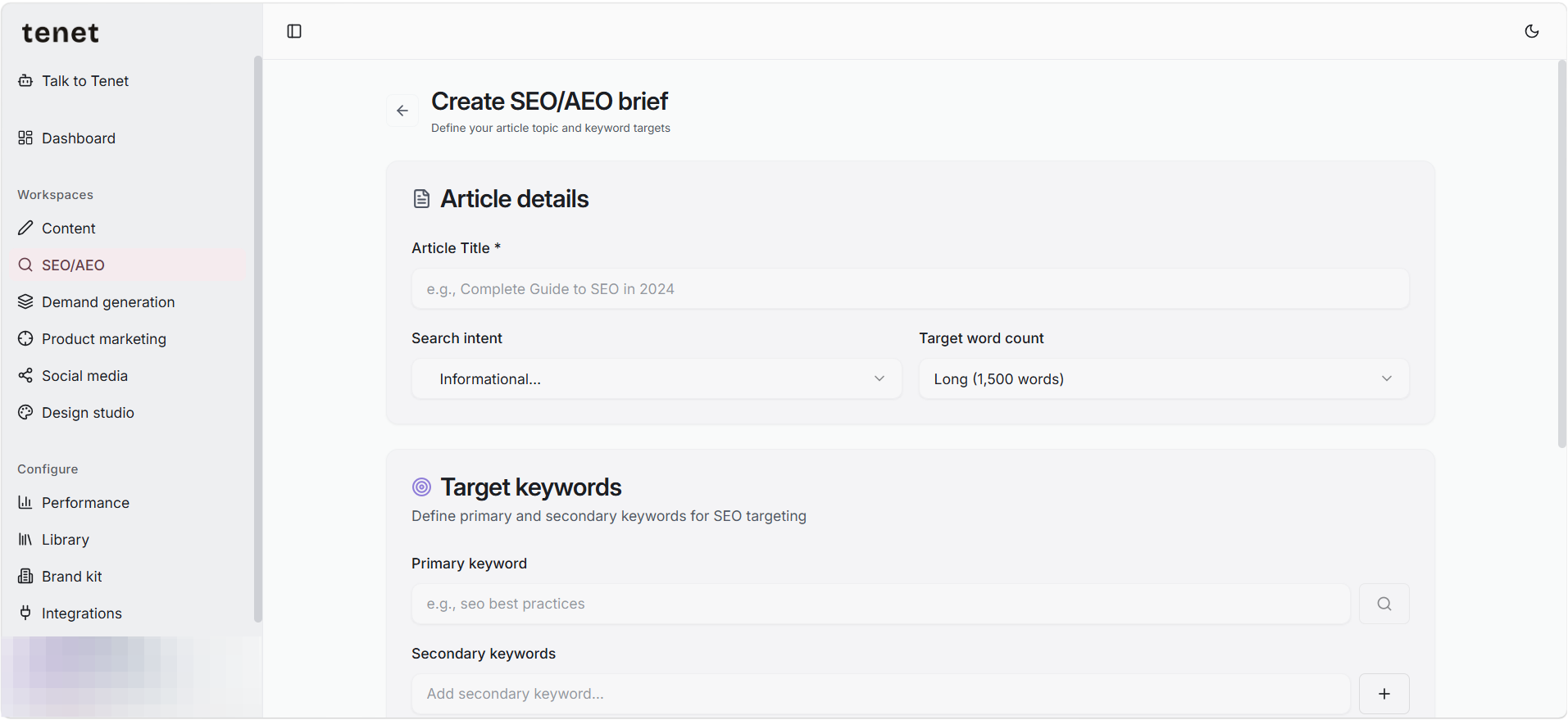
Day 6: Create AI-assisted blog post outlines and SEO briefs
Search-engine marketing content briefs are another high-leverage application. Feed AI a target keyword, your audience persona, and three competitor articles. Ask for a full outline with H2s, key points per section, and suggested stats or case studies to include.
The brief you get back is a starting point, not a final document. Your job is to edit it to include your original perspective, your brand's specific positioning, and angles your competitors haven't covered.
Day 7: Review, refine, and audit your week 1 AI output
Day 7 is the most important day of the first week. Sit down with every piece of AI-assisted content you produced and answer three questions:
- Would a customer who knows nothing about AI assume this was human written?
- Does this sound like us, or like a generic version of an agency in our industry?
- Did any claim in this content need to be fact-checked and corrected?
The answers to these questions shape your prompting strategy for Week 2.
Week 2 (days 8–14): Scaling content and automating repetitive workflows
Week 2 is where the compound effects start to show. You now have a baseline, a prompt library in progress, and a sense of where AI saves time versus where it creates work.
Day 8–9: Hand your content repurposing workflow to AI
The highest-ROI workflow in most marketing operations is content repurposing: taking one piece of long-form content and systematically converting it into assets across every channel.
The process looks like this: feed a blog post or webinar transcript to AI with a standard prompt set.
- "Summarize this in 150 words for [target audience]. Then list 5 distinct angles from this content."
- "Using Angle 2, write 3 LinkedIn posts: one contrarian, one how-to, one short story. Each under 180 words."
- "Create a 7-slide carousel outline: slide 1 is the hook, slides 2–6 are the steps, slide 7 is a CTA."
- "Turn this into an email under 200 words with a compelling subject line and a single CTA."
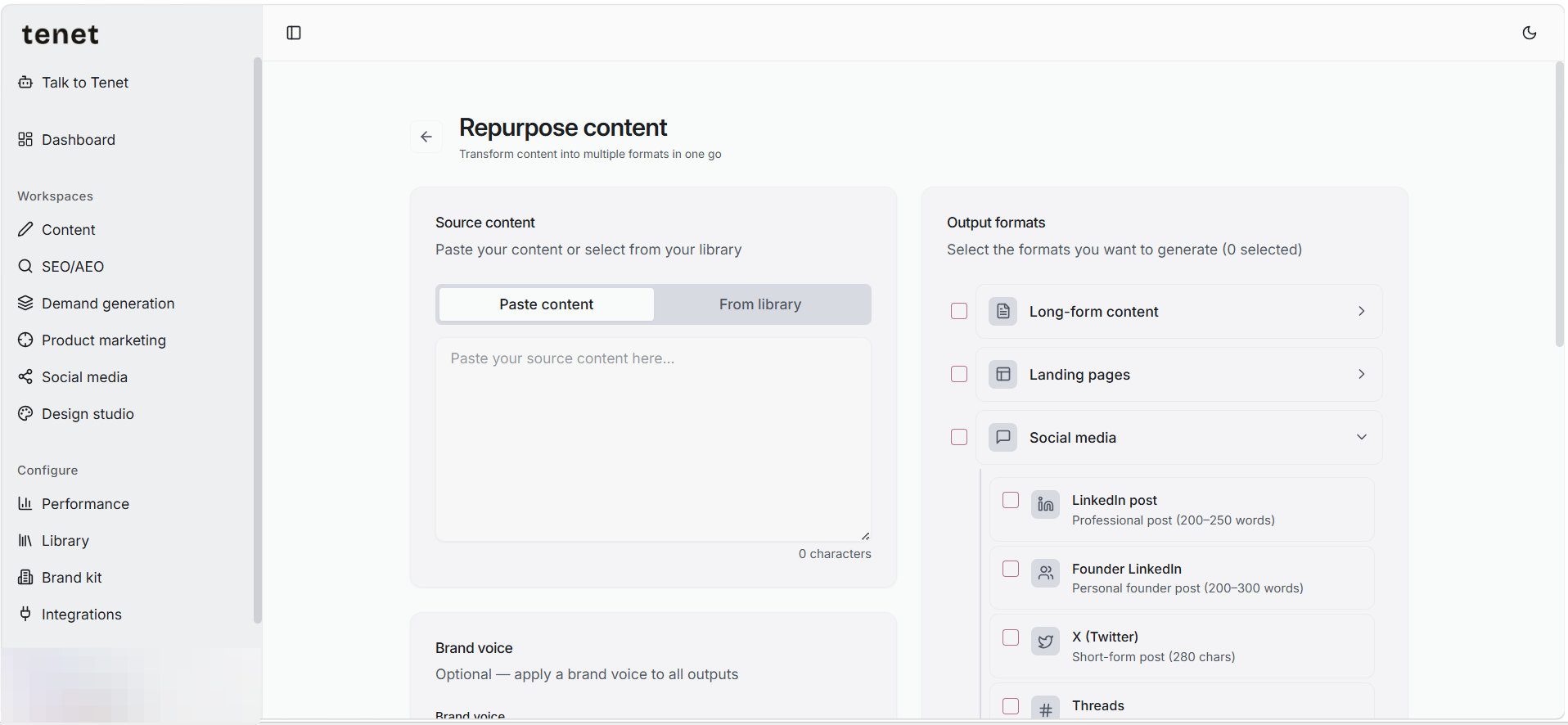
McKinsey’s research identifies multi-channel content repurposing as one of the most effective AI marketing quick wins precisely because it's repeatable, measurable, and produces output that humans can review meaningfully.
Day 10–11: Build an AI-powered lead nurturing email sequence
A 5-email nurture sequence is a project that typically takes a copywriter 2–3 days. With AI assistance and a solid brief, you can get a first draft of all five emails in an afternoon, spend a morning editing, and deploy by the end of the same week.
Day 12: Use AI for ad copy testing and creative variations
Most marketing teams test 2–3 ad variants per campaign. AI makes it trivial to test 10–15. Feed the AI your offer, your audience, and your best-performing historical ad copy. Ask for 10 headlines grouped by angle, 5 long-body variants with different narrative styles (story, direct response, FAQ, social proof-led, pain-first), and 3 CTA variations.
Select your top 5 and run them. The performance data you collect by Day 30 is genuinely useful, not just directional.
Day 13: Automate social listening and trend identification
Use AI to synthesize what your audience is talking about across forums, review sites, and social platforms. Paste in customer reviews, support ticket summaries, or community posts and ask: "What are the top 5 unresolved frustrations in this content? What questions are people asking that aren't getting answered?"
The output feeds directly into your content strategy for Week 3.
Day 14: Mid-challenge audit — what's working, what isn't
At the halfway point, you need data, not feelings. Pull your numbers: engagement rates on AI-assisted social posts versus previous posts, open rates on AI-suggested email subject lines, time spent on content production this week versus two weeks ago.
If you haven't instrumented your baseline by now, start today. You can't evaluate Day 30 ROI without a Day 14 checkpoint.
Week 3 (days 15–21): Advanced AI marketing strategies and personalization
Day 15–16: Implement AI-driven audience segmentation
AI-driven segmentation doesn't require a sophisticated ML setup. At its most practical, it means using AI to analyze your existing CRM data and identify patterns: which customer profiles convert fastest, which segments have the highest lifetime value proposition, which industries or company sizes respond to which messaging angles.
Clean data matters here. Synthesis of 2025 studies, audience targeting is rated effective by 43% of B2B marketers — the highest of any AI marketing application. But that number assumes you have data worth targeting from.
Day 17–18: Use AI to personalize landing pages and CTAs
Even basic personalization produces meaningful lift. A/B test an AI-generated version of your primary landing page CTA against your current one. Ask AI to write five alternative headline and sub headline combinations for different audience segments (by industry, job function, or funnel stage), then route traffic accordingly using your existing tools.
Sephora's "Virtual Artist" feature and Starbucks' mobile app personalization are enterprise examples of this principle, but the underlying logic scales down: the more specifically a page speaks to someone's situation, the more likely they are to convert.
Day 19: Build your first AI-assisted marketing report
Ask AI to read your performance data and produce a narrative summary: what improved, what declined, probable reasons for each, and recommended next actions. This doesn't replace analysis — it accelerates the first draft of analysis, so you spend your time on interpretation and decisions rather than data formatting.
Analytics and reporting are rated effective by 41% of B2B marketers who use AI. It's underutilized relative to content creation, which means it's also under competed.
Day 20: Leverage AI for video script writing and visual content briefs
Video scripts are one of the most time-consuming content assets. AI can produce a full script from a brief in minutes. The quality of the brief determines the quality of the output: specify the hook (first 5 seconds), the core argument, the proof point, and the call to action. Ask for two tonal variations: one direct, one narrative driven.
Day 21: Integrate AI tools into your existing marketing stack
By Day 21, you should understand exactly which tools you're using and how they connect. Spend this day mapping the actual workflow: where does AI output enter your CRM, email platform, or ad manager? What's manual versus automated? What's a single point of failure if someone leaves the team?
Week 4 (days 22–30): Systemizing, optimizing, and making it sustainable
Day 22–23: Document your AI marketing SOPs and workflow maps
The most common post-challenge failure is that the system lives in one person's head. Day 22–23 is documentation day: write a standard operating procedure for every AI workflow you've built. Include the trigger (what starts the workflow), the AI tool and prompt used, the human review step, the publishing or deployment step, and the measurement point.
This documentation is what turns a 30-day experiment into a durable system.
Day 24–25: A/B test AI-generated content against human-written content
If you've been running the challenge with proper baselines, you now have enough data for a meaningful comparison. Pull engagement rates, CTRs, conversion rates, and time-to-produce for AI-assisted content versus your previous approach.
The finding most teams discover: AI-assisted content performs comparably to human-written content in most categories, and dramatically better in volume and production speed. Where human-only content consistently outperforms AI: pieces requiring original insight, personal narrative, or genuine expertise.
Day 26–27: Train AI tools on your brand voice for consistent output
Most AI writing tools accept custom instructions or system prompts. Use Days 26–27 to write a detailed brand voice guide for your AI tool: tone (formal versus conversational), what you say versus what you never say, your target customer's language, your product's key differentiators, and two or three examples of on-brand and off-brand copy.
Once this is in place, the quality floor for AI output rises significantly.
Day 28–29: Build a repeatable 30-day AI content calendar template
Create a template that a new team member could follow starting tomorrow: which AI workflows run which day, which prompts to use for which content types, where outputs get reviewed, and where they get published. This template is your intellectual property from the challenge.
Day 30: Final audit — measuring ROI and lessons learned
Day 30 is reckoning day. Measure against the goals you set before Day 1:
- Time saved on content production (target: 50%+ reduction in draft time)
- Performance lift on AI-tested emails or ads versus previous baseline
- Content volume change (target: 40%+ increase in published assets)
- Lead or revenue impact if you deployed any lead-handling workflows
Document what worked, what failed, and what you'd do differently. This document is the brief for your next 30-day sprint.
The 30 AI marketing prompts you need for the entire challenge
Social media prompts (days 1–10)
These prompts assume you've already fed the AI your brand description and target audience.
- "Write 10 LinkedIn hooks for [topic] aimed at [audience]. Each under 15 words. Use curiosity without clickbait."
- "Turn this blog post excerpt into 3 different social posts: a contrarian take, a how-to, and a data-driven observation."
- "Create a 7-slide carousel outline on [concept]: Slide 1 is the hook, Slides 2–6 are the steps, Slide 7 is a clear CTA."
- "Write a 6-part social thread on [topic]. Each part 1–2 sentences, progressing from problem to solution."
- "List 5 counterintuitive things about [topic] that [audience] probably believes wrong. Write one short social post for each."
Email marketing prompts (days 11–20)
Here are some email marketing prompts that get you started:
- "Write 20 email subject lines for [offer] aimed at [audience], grouped by angle: pain, desire, proof, urgency, and curiosity. Four per angle."
- "Write a 5-email nurture sequence for [product/service]. Audience: [description]. Primary objection: [objection]. Desired action: [CTA]. Include a subject line for each."
- "Turn this case study into an email under 200 words with a compelling subject line and a single CTA."
- "Rewrite this email from a pain-first angle, a curiosity-first angle, and a social proof-first angle."
- "Write 3 re-engagement emails for subscribers who haven't opened in 60 days. Different tone for each: direct, empathetic, playful."
Content and SEO prompts (days 21–30)
- "Create a full blog post outline for the keyword [keyword]. Include an H1, 6 H2s, key points per section, and 3 suggested statistics or case studies."
- "Summarize this [transcript/article] in 150 words for [audience]. Then list 5 distinct angles I could write about from this content."
- "Write an SEO meta description for this page under 155 characters targeting [keyword]. Then write 3 H2 options that target the same keyword."
- "Turn this list of customer results into a narrative case study under 300 words: context, challenge, approach, results, takeaway."
- "Identify 10 questions [audience] is likely asking about [topic] that aren't well-answered by current search results."
Bonus: 5 advanced prompts for paid ads and conversion optimization
- "Write 10 ad headlines for [offer] aimed at [audience]. Group them by angle: pain relief, aspiration, proof, urgency. Use under 30 characters per headline."
- "Write 5 ad body copy variants for this offer. Styles: direct response, story-led, FAQ-format, social proof, and objection-first."
- "Rewrite this landing page headline and sub headline for three different audience segments: [segment 1], [segment 2], [segment 3]."
- "Analyze these 5 ad copy samples ranked by performance. What patterns explain the top performers? What should I test next?"
- "Write 5 CTA button text options for [action]. Each under 5 words. Make them action-oriented and benefit-specific."
How to do AI marketing the right way: key principles to follow
Applying the 30% rule: where AI ends and human strategy begin
The 30% rule isn't arbitrary. It reflects where AI's mechanical advantages (speed, volume, variation) stop and where human judgment becomes irreplaceable (strategy, original insight, ethical judgment, brand relationships). In practice: AI can write the first draft of nearly anything. Humans decide what gets published, what gets cut, and what the strategy actually is.
When AI handles more than about 30% of final decisions without oversight, two things happen. Quality drifts, because AI defaults to average patterns. And accountability gaps open, because no one is really reading the output before it reaches customers.
Applying the 10-20-70 framework to your marketing operations
The 10-20-70 rule redistributes investment toward what actually makes AI marketing work. Tools (10%) are the easy part; any competent marketer can select and deploy a writing assistant. Data integration and workflow design (20%) are harder, requiring real decisions about what gets automated and what stays human. People, process, and adoption (70%) are where most implementations fail, because organizations underestimate how much change management is involved in making AI a genuine part of how a team works.
Maintaining brand authenticity while using AI at scale
The risk of AI at scale isn't that customers will notice AI wrote something. The risk is that your brand voice gradually flattens into something generic and undifferentiated. Over months, this shows up as declining engagement, lower conversion rates, and an audience that recognizes your content but doesn't feel anything about it.
The solution is deliberate: maintain a brand voice guide in your AI system prompt, review AI output with your brand standards in mind (not just grammar) and periodically read your last 30 days of published content in sequence to spot drift before it compounds.
Ethical considerations: disclosure, accuracy, and bias in AI marketing
AI training data contains human biases. When you ask AI to suggest audience segments, messaging angles, or creative direction, those suggestions can reflect patterns that skew toward majority demographics and exclude or misrepresent others. Review AI recommendations with this in mind, particularly for audience targeting and personalization decisions.
On accuracy: AI hallucinates. Every statistic, case study, and factual claim in AI output needs verification before publication. This isn't optional. Publishing a fabricated statistic confidently attributed to a real organization is a reputational risk with real consequences.
Enterprise-adjacent AI marketing platforms for agencies and growing teams
Once teams start scaling, the tool conversation shifts toward integrated platforms that combine AI content generation, campaign orchestration, and performance reporting. These platforms are built for organizations with dedicated marketing ops, larger budgets, and the runway to configure them properly.
The honest note on these tools: they're designed for teams with the infrastructure to match. Advanced governance features only matter once you have enough people to govern. Robust CRM integrations only sing when there's real data behind them. These are Month 6 investments, not Month 1 ones
YouTube channels and resources for learning AI marketing fast
For building skills during the challenge, this YouTube resource on AI marketing covers practical implementation for marketers at various experience levels. Pair video learning with hands-on practice; the gap between "understanding how AI works" and "being able to prompt it effectively for your specific brand" only closes through doing.
Common mistakes to avoid during your 30-day AI marketing challenge
Over-automating without human oversight
The pattern is predictable: a team starts with one automated workflow, gets excited about the time savings, and within two weeks has handed over content, customer communications, and reporting with minimal review. The quality decline is rarely dramatic; it's gradual. Open rates drop a few percentage points. Engagement softens. The brand voice starts sounding like everyone else in the industry.
Human review isn't optional overhead. It's the mechanism that keeps AI marketing from becoming expensive noise.
Publishing AI content without editing or factchecking
AI produces confident text. It does not produce verified text. The distinction matters enormously because a confident, well-formatted piece of content containing a fabricated statistic or misattributed quote looks credible right up until someone checks it.
Build a fact-checking step into every AI content workflow. It adds 10–15 minutes. It prevents the kind of mistake that ends up in a correction notice or, worse, a client complaint.
Ignoring analytics and skipping the feedback loop
The biggest waste in a 30-day challenge is running AI-assisted campaigns without measuring them against your previous baseline. Without data, you can't distinguish AI content that's actually performing from AI content that's producing the appearance of activity. Vanity metrics (word count, post frequency, email volume) multiply fast with AI. Real metrics (leads, conversions, revenue, time saved) require instrumentation.
Set up your measurement before Day 1, not as an afterthought at Day 25.
Trying to use too many tools at once
There's a version of this challenge where someone downloads 12 tools in the first week, spends most of their time on integrations and troubleshooting, and publishes almost nothing by Day 14. It's the tool-exploration trap. More tools feel like more capability, but they deliver more complexity.
Three well-used tools outperform 12 superficially tested ones every time. Pick your stack in Week 1 and don't change it until Week 3 at the earliest.
Failing to customize prompts for your specific audience
Generic prompts produce generic outputs. The marketers who get strong results from AI are the ones who treat prompting as a skill to develop, not a text box to type into casually. Every prompt should include: the audience, the context, the format, the tone, the constraints, and an example of what good looks like.
The prompt library you build during this challenge is the difference between an AI assistant that helps and one that generates work for you to redo.
What comes after day 30: turning your experiment into a long-term AI marketing system
Day 30 is not an ending. Handled correctly, it's a planning session for the next sprint.
How to scale your AI marketing workflows beyond the challenge
The workflows that performed — measured by time saved, output quality, or performance lift — become permanent parts of your process. The ones that didn't perform get documented with the reasons why and either retired or redesigned.
Scaling means two things: adding volume (more content, more variants, more channels) and adding sophistication (better personalization, more specific segmentation, tighter feedback loops). Both require more data, which is why the foundation you built in Days 1–7 matters so much six months later.
Building a last-30-days skill review into your monthly marketing rhythm
Every month, spend one hour reviewing how AI is being used across your team: what prompts are producing the best results, what workflows have accumulated technical debt, and what new capabilities are worth testing. AI tools update frequently; what was a limitation in Month 1 may be resolved in Month 3.
Training your team to use AI marketing tools effectively
The 10-20-70 rule applies at team scale. Onboarding a new marketer to your AI workflows means sharing the prompt library, walking through the standard operating procedures, and having them shadow an existing workflow before running it independently.
Without this, you get inconsistent output and the single-point-of-failure problem where one person's departure collapses the system.
Planning your next 30-day AI marketing sprint
Use your Day 30 audit to define the next sprint's goals. Common second-sprint focuses:
- Implementing AI-driven personalization across your email sequences
- Running a full paid media test with AI-generated creative at scale
- Building your first AI-assisted sales enablement content library
- Integrating AI reporting across all channels into a unified weekly brief
Each sprint compounds on the last. By Month 3, you're in the optimization phase of the 30-60-90 framework: refining what works and scaling what performed.
Ready to run your 30-day AI marketing sprint — without running it alone?
That's exactly what Tenet Operator is built for.
It's not an agency. It's not a freelancer. It's one dedicated Marketing Operator who works inside your Tenet account — accountable for shipping your marketing every week and reporting back on what's actually moving. The way it works:
Tenet handles the strategy and execution end to end — the research, the drafts, the campaigns, the optimization. Your Operator reviews it and ships it. You approve the things that matter and watch the results come in. No standing calls. No chasing. No handing your work to a rotating team working in tools you can't see.
And because everything lives in your account, you keep a fully working setup whether you stay or go. Not a folder of PDFs.
The real takeaway from 30 days
Thirty days is enough time to build something real — but only if you treat Day 1 as a foundation day, not a launch day.
The teams seeing the biggest gains aren't the ones who automated the most the fastest. They're the ones who pointed AI at specific, measurable problems and kept a human in the loop before anything shipped. That's the pattern behind the standout results: clear use cases, a real baseline to measure against, and a review process that makes sure nothing goes out half-baked.
The teams seeing the worst results did the opposite: automated broadly, published without editing, and called it too early to see any real signal.
By Day 30, you won't have a perfect AI marketing system. You'll have something more useful — a system that works, documented well enough that it gets sharper every month after that. That's the compounding advantage. And it's available to any lean team willing to build marketing efficiently.
 Anjana Vasan
If you want to see what that looks like for your business, book a 20-minute demo.
Frequently asked questions about AI marketing in 30 days
What is the 30% rule for AI in marketing?
The 30% rule is a practical guideline suggesting AI should handle roughly 30% of the creative and strategic workload, with humans directing, editing, and approving the rest. It's not a formula derived from a single study; it's a heuristic that reflects the point where AI's speed advantages start to outweigh the quality risks of reduced human oversight.
When teams push past roughly 30% AI decision-making without review, quality drift and accuracy problems tend to compound. Use it as a warning threshold, not a compliance target.
Does AI marketing actually work for small businesses?
Yes, with two important qualifications. First, the use cases that produce the clearest results for small businesses are content production, email subject line testing, and ad copy variation — all tasks where volume and speed matter and where AI can produce meaningful drafts quickly.
67% of SMBs now use AI in marketing, and those businesses report productivity gains and content output increases consistent with larger organizations. Second, AI amplifies your strategy, not replaces it. If your positioning, offer, or targeting is weak, AI will execute that weakness faster. Small businesses tend to see the best results when they start with one specific use case, prove it, and expand from there.
What is the 10-20-70 rule for AI?
The 10-20-70 rule describes how AI implementation investment should be distributed. Ten percent goes to AI tools and technology itself. Twenty percent goes to data infrastructure, integration, and workflow design. Seventy percent goes to people: training, process development, change management, and adoption.
Most organizations get this backwards, spending the majority on tools and almost nothing on process and people. That's why so many AI marketing initiatives look good on paper and underperform in practice. The 30-day challenge structure in this guide is designed to force that 70% into focus.
What is '30 AI tools in 30 days'?
It's a discovery format, not an implementation one. The concept involves evaluating a different AI tool every day for 30 days, typically through short reviews or demonstration posts on LinkedIn or YouTube. It's useful for understanding the range of available tools and building awareness of specific capabilities.
It's not useful for building a functional AI marketing system, because you never develop deep enough familiarity with any single tool to customize it effectively. If you've followed a "30 tools" challenge and want to now make AI marketing actually work, the next step is picking two or three of those tools and running the sprint structure in this guide.
Can I do the AI marketing 30-day challenge for free?
The first two weeks, yes. Free tiers of major AI writing assistants are sufficient for social media content, email drafts, content briefs, and basic competitor research. Week 3 and beyond, you'll likely hit rate limits or context window constraints that make paid tiers worth considering.
The tools with the clearest ROI for paying are AI writing platforms with brand voice training (which dramatically improve output consistency) and email optimization tools that connect to your live campaign data. Budget estimate for a functional mid-tier stack: $80–150/month for a solo marketer or small team.
How long does it take to see results from AI marketing?
Real implementation data suggests: measurable time savings by Day 7, first performance data (email open rates, ad CTRs) by Day 14, revenue impact by Day 30 if you've deployed a complete lead-handling or nurture workflow. The mistake most teams make is evaluating AI at Day 10 based on a few posts and one email campaign, seeing only modest gains, and concluding it "doesn't work."
The compounding effects, where AI-assisted content, targeting, and testing interact to lift overall performance, typically show up between Day 30 and Day 60. Commit to measuring properly before drawing conclusions.
Should I disclose that my content was AI-assisted?
Disclosure practices are still evolving, but the ethical principle is clear: don't let AI introduce factual claims you haven't verified, don't publish AI content without review, and don't use AI to fabricate testimonials, case studies, or research. Whether to label content as "AI-assisted" depends on context.
For editorial content, increasingly common practice is to note AI involvement in production. For marketing copy and ad creative, disclosure requirements vary by jurisdiction and platform. When in doubt, prioritize accuracy and brand honesty over efficiency.