

Tenet Operator is our done-with-you tier. You get Tenet's AI agent plus a dedicated Tenet Operator who plans, executes, and improves your marketing inside your account every week. Consistent outcomes, without managing another agency, freelancer, or employee.
It's the step up from running Tenet yourself. Starter is for solo operators and Growth is for teams of five or fewer who run Tenet on their own. Tenet Operator is for founders and SMBs who'd rather hand the whole function to one person — with Tenet — who owns it end to end.
Want to learn more about Tenet Operator? Reach out and we'll be in touch soon.
What is Tenet Operator?
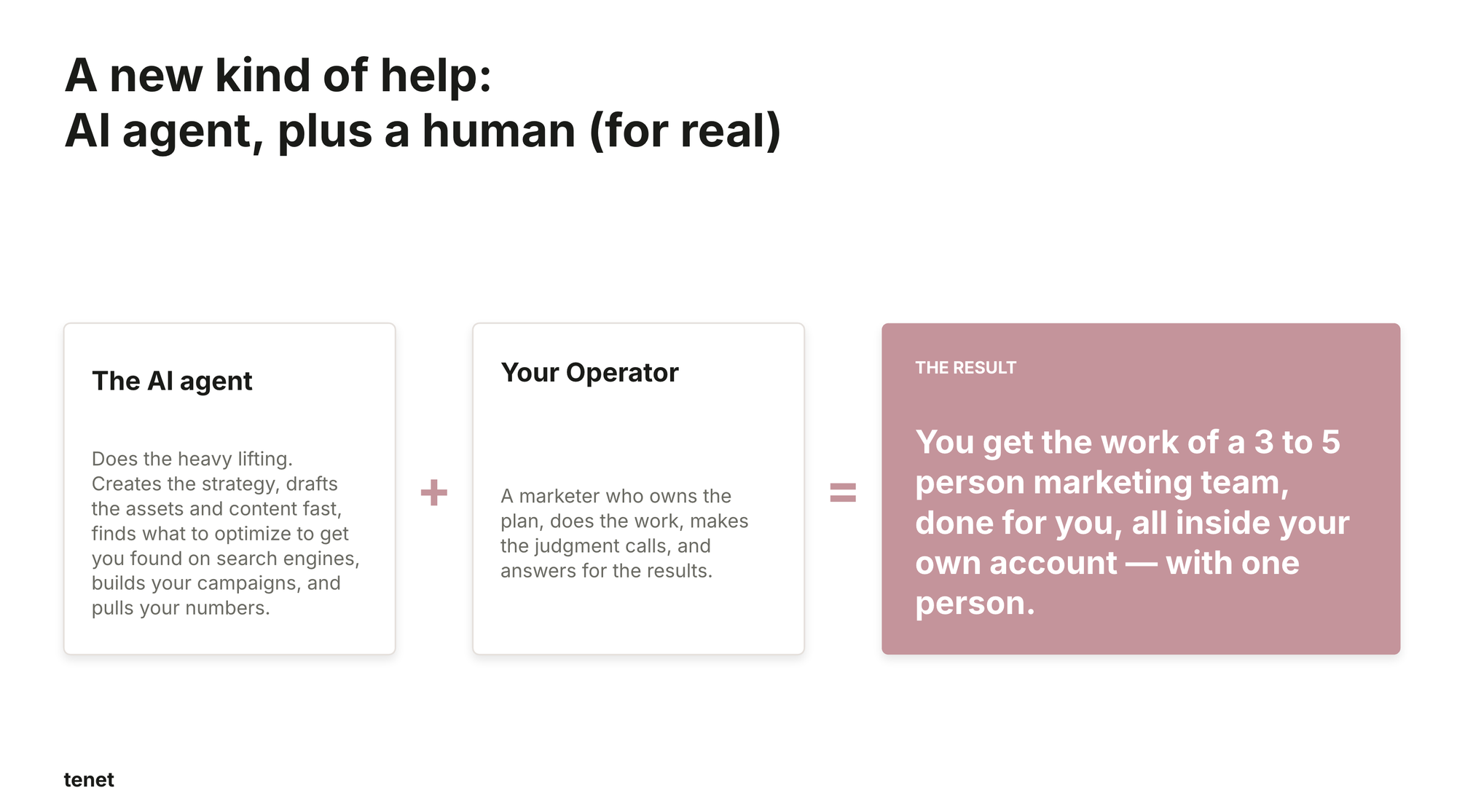
Tenet Operator is Tenet's AI agent paired with a dedicated person who runs it for you. The AI agent handles the heavy lifting across content, SEO, campaigns, social, and reporting. The Operator owns the strategy, drives the work week to week, and is accountable for what it produces. Together they cover a full marketing function, the kind that usually takes a team of three to five.
Most options force a trade-off. Software on its own still needs someone to operate it. A single hire can't match the output of a system. An agency runs the work in their tools, on their timeline, behind their reporting. Tenet Operator closes that gap: the work runs inside your account, on a weekly cadence, owned by one person you can hold to outcomes.
In practice, that means one point of accountability instead of a rotating cast. You can see every priority, campaign, and result inside your own system at any time. And you approve the direction, not every task, because your Operator is measured on what moves your business, not on hours logged or decks delivered.
That's the whole idea. The software does the work. The Operator runs it. You stay focused on the business.
What your Operator does
Your Tenet Operator runs a complete weekly marketing operation inside Tenet.
Every week, they:
Own your content calendar. Plan topics, set publish dates, and keep the pipeline full based on your offers, your audience, and what's driving pipeline right now. This isn't a static document reviewed quarterly. It's a living plan that adjusts as your business moves, tied to the campaigns and offers you're actively running, not an editorial calendar someone built during onboarding and never touched again.
Execute SEO. Research keywords, optimize pages, update existing content, and build internal links so your search visibility compounds over time instead of sitting still. AI-powered content and optimization delivers an average 3.2x ROI, making it one of the strongest-returning activities in a marketing function. Your Tenet Operator builds that return systematically, week by week, not in bursts when someone remembers to think about search.
Plan and launch campaigns. Build and ship email sequences, landing pages, and demand gen campaigns across the channels that fit your business, then optimize based on what converts, not based on what looks good in a report. Personalization and campaign-level testing deliver an average 2.7x ROI. Your Tenet Operator runs the experiments, reads the results, and moves spend and effort toward what's working.
Run your social presence. Draft, schedule, and publish content across platforms so your brand stays visible and consistent without you touching a calendar or a caption. Roughly 35% of marketing teams now use AI-assisted workflows for social media management and ad targeting. Your Tenet Operator uses Tenet's infrastructure to do this at a pace and consistency most small teams never achieve on their own.
Track performance and report weekly. Review the numbers inside Tenet, surface what's working and what isn't, and send you a clear, plain-English summary of results and next steps. Not a 40-slide deck once a month. A short, direct update every week: what shipped, what changed, what the data says, what happens next.
Decide what to do next. Prioritize the work based on what's moving revenue, not just what's on a list. This is the part most marketing models skip entirely. An agency executes the scope you agreed on in month one. A freelancer does what you tell them. Your Tenet Operator looks at the numbers, understands your business goals, and adjusts the plan accordingly, without you having to direct every decision.
The combined effect of a consistent weekly loop (content, SEO, campaigns, social, reporting, and re-prioritization) is a marketing function that compounds. Marketers using structured AI-enabled workflows save an average of 6.1 hours per week. When those hours go back into execution rather than coordination and project management overhead, the output difference over a quarter is significant.
How it works
Most marketing engagements fail at the handoff, the point between "we've agreed on a plan" and "the work is shipping." Agencies lose momentum in internal approvals. Freelancers stall waiting for briefs. In-house hires take months to ramp before they're trusted to run anything independently. Tenet Operator eliminates that gap, because your Tenet Operator is inside your system from day one, working against a plan you've already approved, on a cadence that doesn't need restarting every week.
Want to learn more about Tenet Operator? Reach out and we'll be in touch soon.
Step 1: Onboarding: get embedded, not briefed
Your Tenet Operator doesn't start with a questionnaire. They start with access. In the first one to two weeks, they connect to your Tenet account and to the tools you already use (your CRM, your ad accounts, your analytics, your email platform) and build a real baseline from real data.
What's your current traffic and where is it coming from? Which pages are converting and which aren't? What campaigns have you run and what did they produce? What offers are live right now and which audiences have responded to them? What have you spent on marketing in the last six months and what came back?
That context is what separates a Tenet Operator from a generic hire. They're not starting from a blank brief. They're starting from your actual data, inside the system that holds it, with a clear view of what's working and what isn't before a single piece of work gets planned.
By the end of onboarding, you've aligned on the goals that matter (leads, qualified demos, pipeline value, revenue) and your Tenet Operator knows exactly what they're being held to.
Step 2: Strategy: a 90-day plan you approve once
Before anything ships, your Tenet Operator builds a 90-day marketing plan inside Tenet. Not in a slide deck. Not in a shared Google Doc living in someone's Drive folder. Inside the system, where priorities are visible, tasks are trackable, and progress is measurable from week one.
The plan is built on what will move the most pipeline for your specific business, not on what's easiest to execute or most impressive to present. That means making hard decisions early: which channels to focus on, which content formats will work for your audience, which campaigns to run first, and, critically, what to stop doing so execution stays focused.
You review the plan. You approve the direction. You push back if something doesn't fit. And then you're done with the strategy conversation, because from that point forward, your Tenet Operator runs with it. You're not managing a project plan week by week. You're checking in on outcomes.
This is a structurally different relationship than most owners have with their marketing. The typical agency model requires the client to stay deeply involved in approvals, content direction, and campaign decisions throughout the engagement. That's not a service. It's a co-working arrangement where the agency bills for their hours and the client does the thinking. Tenet Operator inverts that: your Tenet Operator does the thinking, runs the work, and you approve strategy at the beginning and results at the end.
Step 3: The weekly execution loop: plan, ship, measure, adjust
Every Monday, your Tenet Operator reviews last week's performance data inside Tenet. What published? What launched? What converted? What fell short of the benchmark? Based on that review, they update priorities for the week ahead, shifting effort toward what's working, cutting or adjusting what isn't, and adding any new tasks that have surfaced since the last cycle.
Mid-week, the work ships. Content goes live. Campaigns launch or get optimized. SEO updates go in. Social content gets scheduled and published. If something needs your approval (a campaign offer, a landing page headline, a new channel test) you get a direct, specific ask with context, not an open-ended question that requires you to become the marketing strategist for an hour.
By end of week, results are updated inside your Tenet account and you get a short summary: what shipped, what changed in the numbers, what the plan is for next week, and whether any decisions need your input. No meeting required. No chasing. No silence for three weeks followed by a 40-slide performance review.
The loop runs every week, whether you're actively in it or not. That consistency is the entire product. Most SMB marketing fails not because the strategy is wrong but because execution is intermittent: a burst of content in January, a campaign in March, nothing through the summer, a push again in Q4. Your Tenet Operator eliminates that pattern. The work runs on a cadence. The results compound.
Who this is for
This is for the business owner who has spent too much time managing the people supposed to be managing their marketing: chasing agency updates, approving freelancer work, sitting in strategy calls that never turn into results, and wondering whether any of it is connected to revenue.
If you want marketing that runs on a consistent weekly schedule, tied to real revenue goals, owned by one accountable person who works inside your system and shows you results in plain numbers (not in vanity metrics and reach charts) this is built for you.
It's also for the lean team that needs a full marketing function running without adding a full-time head. A mid-level in-house marketing hire, fully loaded with salary, benefits, management overhead, and recruiting costs, runs between $90,000 and $130,000 per year before you've paid for a single tool or covered the skills they don't have. Most SMBs can't absorb that cost, and they shouldn't have to. Tenet Operator gives you a dedicated, senior Tenet Operator running your entire marketing function (content, SEO, campaigns, social, reporting, and strategy) without the overhead of a full-time hire or the friction of building a team.
This is the right fit if:
- You want marketing tied to pipeline and revenue, not impressions and engagement rates
- You want one accountable person, not a rotating agency cast
- You want to see the work happening inside your own system, not receive a monthly report from someone else's
- You've been burned by an agency that was impressive in the pitch and invisible in the execution
- You're running marketing yourself right now and want to hand it to someone who will own it completely
This is not the right fit if:
- You want a one-off project (a website, a single campaign, a rebrand) with no ongoing execution
- You need to personally approve every sentence before it publishes
- You're looking for a large, multi-layer agency structure with account directors, strategists, and creative teams
Why Tenet Operator beats an agency, freelancer, or full-time hire
The market gives you four options for running marketing: do it yourself, hire an agency, hire a freelancer, or build an in-house team. All four share the same structural problem. They separate the people doing the work from the system holding the data, the goals, and the results.
An agency works in their own tools, runs their own reporting, and gives you a view of your marketing through their lens. You see what they want you to see. A freelancer works across five clients in five different setups and brings you whatever their current bandwidth allows. An in-house hire is embedded, but comes with recruiting lag, a ramp period, full-time cost, and a single skill set that rarely covers the full scope of what a growing SMB needs from its marketing function.
Tenet Operator is different on every one of those dimensions.
The ownership point matters more than most buyers realize. With an agency, your campaigns live in their ad accounts, your reporting lives in their dashboards, and your strategy lives in their slide decks. When you leave (or when they stop performing and you decide to leave) you're starting over. With a Tenet Operator embedded in your Tenet account, everything is yours: the campaigns, the data, the content, the audience lists, the SEO work. If anything ever changes, you walk away with a fully operational marketing system, not a box of PDFs.
What you stop doing the day you start Tenet Operator
The benefits of this model are usually framed in terms of what you get: more leads, better SEO, consistent campaigns. Those outcomes matter. But for most owners, the more immediate relief is what disappears from their plate.
You stop managing marketing vendors. No more standing weekly calls with the agency. No more chasing the freelancer for the draft that was supposed to be done Tuesday. No more being the project manager for a function that was supposed to run itself.
You stop guessing at strategy. No more quarterly planning sessions where you try to figure out which channels to prioritize, what content to produce, or whether to run paid ads this quarter. Your Tenet Operator owns the roadmap and updates it based on data, not on whoever made the loudest argument in the last meeting.
You stop explaining your business from scratch every time. One of the most expensive hidden costs of agencies and freelancers is context loss, the time you spend bringing new people up to speed on your offers, your positioning, your audience, your tone. Your Tenet Operator is embedded in your system. They know your business because they're working inside it every week. The context builds over time instead of resetting.
You stop wondering if marketing is working. Your Tenet account holds the data. Your Tenet Operator reviews it weekly and surfaces what matters. You don't need to build a reporting dashboard or decode a spreadsheet to know whether your marketing is producing results. The summary lands in your inbox every week, in plain English, with a clear view of what's moving and what's next.
The average marketer using structured, AI-enabled workflows saves 6.1 hours per week. For a business owner currently running marketing themselves on top of everything else, that number is almost certainly higher, because the overhead isn't just execution time. It's the cognitive load of deciding what to do, managing the tools, interpreting the results, and maintaining the consistency that makes any of it work.
Pricing anchor
A fraction of what you'd pay an agency retainer. A fraction of what you'd spend on a full-time hire.
No benefits. No payroll overhead. No six-month notice period if it isn't working. No retainer that keeps billing while delivery slows down. You get a dedicated Tenet Operator running your entire marketing function (strategy, content, SEO, campaigns, social, and reporting) for a predictable monthly investment with nothing hidden.
Most agency retainers for the scope your Tenet Operator covers run between $8,000 and $30,000 per month. A mid-level in-house marketing hire, fully loaded with salary, benefits, recruiting costs, and onboarding time, runs $90,000 to $130,000 per year, and that's before you've covered the tools, the channels they don't own, or the strategic direction they can't provide on their own.
Tenet Operator replaces all of it. One person, one AI agent, one cost. The strategy and execution is already built into Tenet. The direction and reporting are already owned by your Tenet Operator. There is no separate invoice for the SEO platform, the content calendar tool, the analytics dashboard, or the campaign management software. It all runs inside Tenet, on a single line in your budget.
The engagement is also structured differently from an agency contract. You're paying for a dedicated Tenet Operator delivering consistent weekly execution, and the engagement is structured around the outcomes you agreed to at the start, not around protecting someone else's revenue.
See how Tenet Operator would work for your business
Book a strategy call and get a clear, direct conversation about your current marketing, where the biggest gaps are, and what consistent weekly execution would look like inside your Tenet account from week one.
Already using Tenet and thinking about adding a Tenet Operator? Bring that data to the call. We'll look at what's already running inside your account and show you exactly what a dedicated Tenet Operator would take off your plate.
Want to learn more about Tenet Operator? Reach out and we'll be in touch soon.
Frequently asked questions
What is Tenet Operator?
It's the done-for-you tier. You get Tenet's AI agent plus one dedicated person who runs your marketing for you, every week. They own the plan, do the work, and report back on what's actually bringing in customers, all inside your own account.
How is it different from an agency or a freelancer?
An agency hands your work to a rotating team and runs everything in their tools, so you only see what they show you. A freelancer is stretched across other clients. With Tenet Operator, one dedicated person owns it, the work lives in your account where you can see it any time, and if you ever leave, you keep a fully working setup, not a folder of PDFs.
Do I need to know marketing to use it?
No. That's the whole point. You brief your Operator in plain language about your business and your goals, and they handle the strategy and execution. You approve the direction and the things that matter, nothing more.
How much of my time does it take?
Very little. You okay the 90-day direction once at the start, then your Operator runs it. After that it's a quick approval when one's genuinely needed and a short update each week.
What does it cost?
One simple, all-in price that covers the strategy, the work, your dedicated Operator, and the software, with no hidden tool fees or payroll overhead. Pricing depends on your scope, so the best next step is to book a call for a quote.