

TL; DR
- Copywriting is writing designed to produce a specific, measurable action — it's not a finishing touch, it shapes perception before anything else does.
- 80% of readers never get past the headline, making it the highest-leverage sentence in any piece of copy.
- The core mistake most businesses make is writing about features instead of benefits — people buy transformations, not specifications.
- The proven frameworks (AIDA, PAS, BAB) aren't shortcuts; they reflect how humans actually process information and make decisions.
- AI tools can accelerate drafts and generate options, but they don't replace the strategic judgment needed to know which angle will actually resonate with a specific audience.
Copywriting is writing designed to produce a specific, measurable action — a click, a signup, a sale. It differs from content writing in that every line moves the reader toward one decision: benefits over features, a headline that earns the read (80% of readers never get past it), and structures like AIDA, PAS, and BAB that mirror how people actually decide.
 Tenet
TenetThere's an old story about John Caples, one of the most celebrated advertising copywriters of the 20th century. He once changed a single word in a headline and increased response rates by 20%. It wasn't a redesign or a new offer. He literally changed one word.
That story has been passed around marketing circles for decades because it captures something counterintuitive about persuasive writing: the smallest changes in how you say something can produce dramatically different outcomes.
A headline that speaks to what someone fears losing outperforms one that speaks to what they could gain, even when the underlying product is identical. The words are the product, in a sense, because the words are what the reader actually experiences.
And yet most businesses treat copywriting as a finishing touch. You build the product, design the website, plan the campaign, and then someone writes the words at the end. That's backwards. The copy shapes perception before anything else does.
This guide is for anyone who wants to understand copywriting properly: what it is, how it works, what real professionals actually do, and how you can use it whether you're a business owner, a marketer, or someone considering copywriting as a career.
What is copywriting? (and why the definition actually matters)
The simplest definition: copywriting is writing designed to produce a specific action.
That action might be clicking a button, handing over an email address, booking a call, or buying something. The distinguishing feature isn't the channel or the format; it's the intent. Copy is written to get a result, and that result is measurable.
It's a useful framing because it clarifies what copy is supposed to do. A good salesperson doesn't recite product specs; they read the room, address objections, and guide the conversation toward a decision. Copy does the same thing, just without the back-and-forth.
Copywriting vs. content writing: what's the difference?
These two terms get used interchangeably, which causes real confusion about what each is actually for.
Content writing informs, educates, or entertains. A blog post explaining how machine learning works is content writing. A guide to planning a kitchen renovation is content writing. The goal is to provide value, build trust, and keep people coming back. Conversions are a downstream effect, not the primary measure of success.
Copywriting converts. A landing page that turns visitors into trial signups is copy. An email subject line written to maximize open rates is copy. An ad that gets someone to click is copy. Every sentence is in service of one specific, trackable action.
In practice, the line blurs. A well-written blog post might contain a CTA at the bottom that reads like copy. A landing page might open with a story that reads like content. But the underlying intent differs, and that difference matters when you're deciding what to write and how to measure it.
Copywriting vs. copyright: clearing up the confusion
These are completely unrelated. Copyright is a legal protection for original creative work. Copywriting is the craft of writing persuasive marketing materials. The only thing they share is the first five letters. If you're searching for help writing ads and you accidentally search for "copyright," you'll end up in a very different place.
Why copywriting matters in numbers
The case for taking copywriting seriously is well-documented. According to research cited by Copyblogger, 80% of readers never make it past the headline. That's not a metaphor; it's a measurement. The headline is doing most of the work, and if it fails, the rest of the copy never gets read.
Grammar and spelling matter too: 59% of consumers say they would avoid buying from a company with obvious spelling or grammar mistakes. Nearly six out of ten potential buyers, lost not because of the product, but because of how the product was described.
What does a copywriter do exactly?
The short answer: copywriters translate business goals into words that produce action. The longer answer involves a lot more research than most people expect.
Core responsibilities
Before a skilled copywriter writes a single sentence, they spend substantial time understanding three things: the product, the customer, and the competitive context.
Product research means going deep on what something actually does, how it works, and what makes it different. Customer research means understanding the specific language, fears, desires, and objections of the people who might buy. Competitive research means knowing what else is already being said in the market, because a message that sounds exactly like every competitor's message has no persuasive force.
The writing comes after all of that. And after the writing comes editing, which most working copywriters will tell you is where the real work happens.
Types of copy a copywriter produces
The range is wide. A copywriter might write:
- Website pages (homepage, about, services, product pages)
- Landing pages and sales pages
- Email subject lines, preview text, and body copy
- Paid ad copy for Google, Meta, LinkedIn, or print
- Product descriptions
- Direct mail letters
- Video scripts
- Press releases
- Taglines and brand messaging
Each format has different constraints and conventions, but the underlying skill (understanding the reader and writing toward a specific outcome) applies to all of them.
Who hires copywriters and why
The honest answer: almost every business with a marketing budget. E-commerce brands need product descriptions and email sequences. SaaS companies need landing pages and onboarding copy. Agencies hire copywriters to produce content for multiple clients simultaneously. And solo copywriters build independent practices serving one niche or multiple industries.
The market for skilled copywriters is genuinely undersupplied. Practitioners and professional training organizations consistently note more demand than available talent, particularly for writers who combine strategic thinking with strong execution.
The different types of copywriting
Copywriting isn't one thing. Different specializations require different skills, produce different outputs, and command different rates.
Direct response copywriting
This is the oldest and most technical form. Direct response copy is written to generate an immediate, measurable action, usually a click, a call, a form submission, or a purchase. The tradition runs from Claude Hopkins and John Caples through David Ogilvy and Gary Halbert to today's online marketers.
The hallmark of direct response is accountability. Every headline, every subhead, every call to action is treated as a variable to test. Hopkins' book Scientific Advertising, still required reading in this field, argued in 1923 that advertising should be treated as a scientific experiment. The principles haven't changed.
Brand (or creative) copywriting
Brand copywriting is less focused on immediate conversions and more on shaping perception over time. A tagline like "Just Do It" or Apple's "1,000 songs in your pocket" doesn't ask you to buy anything right now; it creates a feeling and an association that builds equity over years.
The Apple iPod example is worth unpacking.
The product had a storage capacity that could be expressed as a number of gigabytes. That's a feature. "1,000 songs in your pocket" is the outcome that feature produces, expressed in the emotional currency of the customer. That distinction, features versus benefits, separates forgettable copy from copy that actually works.
SEO copywriting
SEO copywriting serves two audiences at once: the people reading the page and the search engines indexing it. Getting this balance wrong in either direction is a failure. Copy written primarily for algorithms becomes unreadable for humans. Copy that ignores how people actually search doesn't get found.
The working principle, articulated well by copywriter Kate Toon, is "humans first, Google second." Write the most useful, clear, and relevant page you can for the person who needs it. Then optimize the structure, headers, and keyword placement to ensure search engines can understand what the page is about.
Email copywriting
Email copy is one of the highest-leverage places to apply copywriting skill, because small changes in subject lines produce disproportionate effects. Research cited by marketing analysts shows that adding just two words to a subject line increased open rates by 25% in one Econsultancy study. Subject line length around 28-39 characters tends to perform best, and with 46% of emails opened on mobile, short and clear copy isn't optional.
Social media copywriting
Social copy operates under brutal attention constraints. The scroll is fast. The hook has to work in the first line, before the "more" button. Engagement metrics tell you quickly what's working, which makes social a useful training ground for anyone building copywriting skills.
Technical and B2B copywriting
B2B copy often has to speak to multiple stakeholders with different priorities. A product might have a technical buyer who cares about integrations, a financial buyer who cares about ROI, and an end user who cares about ease of use. Good B2B copywriting acknowledges this complexity without becoming incomprehensible.
The SuperOffice case study illustrates what's possible here: a Facebook ad campaign built on deep audience research generated $40,000 in new revenue from $6,200 in ad spend, because the copy spoke directly to the specific frustrations of the target buyer rather than making generic claims.
UX copywriting
UX copy (sometimes called microcopy) is the text inside products: button labels, error messages, empty states, onboarding flows. It's easy to underestimate how much this writing affects behavior. A button that says "Start free trial" performs differently than one that says "Get started." The words users see at moments of decision are consequential, and UX copywriters are specialists in reducing friction and guiding action at exactly those moments.
The core frameworks every copywriter should know
Experienced copywriters don't start with a blank page and inspiration. They start with frameworks that reflect how humans actually process information and make decisions.
Same product, same features — watch what happens when a framework reorganizes the sentence.
the product didn't change. the structure did — that's the entire job of a framework.
AIDA: attention, interest, desire, action
AIDA is the oldest and most widely used structure in copywriting.
- Attention means stopping the reader. A headline, a bold visual claim, a surprising statistic, or a problem stated so precisely that the reader feels seen. If you don't earn attention in the first few seconds, nothing else matters.
- Interest means developing the premise. You've got their attention; now explain why they should keep reading. This is where you clarify the problem, introduce the stakes, and show that you understand their situation.
- Desire is where you build the case for your solution. Benefits over features. Outcomes over specs. Proof over claims. Social proof (testimonials, numbers, case studies) matters here because people believe other customers more than they believe brands. Research from Unbounce found that adding social proof to a landing page increased subscriptions by 20%.
- Action is the ask. Be specific and direct. "Download the guide," not "Learn more." "Book a 30-minute call," not "Get in touch." The CTA should be impossible to misunderstand.
AIDA copy: Stop losing 20% of your website sales to a confusing checkout process. Join over 5,000 profitable brands using our 1-click system—claim your free trial now.
PAS: problem, agitate, solution
PAS is particularly effective for email, ads, and shorter pieces where you need to move quickly.
- State the problem clearly.
- Agitate it by exploring the consequences and frustrations it creates.
- Then present the solution as a relief.
The agitation step is what separates PAS from a flat problem-solution structure; making the pain more vivid before offering the answer increases urgency and engagement.
PAS copy: Your team is constantly missing deadlines because important files are scattered across messy chat apps and inbox folders. Bring ultimate peace of mind to your workflow with our all-in-one central dashboard.
Ellen Langer's famous 1978 photocopier study found that giving people a reason (even a weak one) for a request increased compliance from 60% to 94%. Copy that states the problem and then immediately gives a clear reason to act is applying the same principle.
The researchers used three distinct phrasing variations:
- No Reason (Control): "Excuse me, I have 5 pages. May I use the Xerox machine?"60% compliance rate.
- Valid Reason: "Excuse me, I have 5 pages. May I use the Xerox machine because I'm in a rush?"94% compliance rate.
- Weak / Placebic Reason: "Excuse me, I have 5 pages. May I use the Xerox machine because I have to make copies?" 93% compliance rate.
Key Takeaway: The study demonstrated that for low-stakes requests, people often operate on "autopilot" or a state of mindlessness. The brain registers the structural trigger word "because" as an indication that a reason is being offered. Because the request is small, individuals automatically comply without actually processing whether the explanation makes logical sense.
Before-after-bridge (BAB)
BAB paints a picture of the reader's current situation (Before), shows them what their life looks like after the problem is solved (After), and then presents the product or service as the Bridge between the two. This structure works well for brand copy, case studies, and testimonials because it maps onto the story structure readers find most intuitive.
BAB copy: You used to waste hours manually typing out weekly data reports; now you can generate them instantly in seconds. Our automated SmartSheet AI Tool is the exact bridge that gets you there.
The 4 U's: useful, urgent, unique, ultra-specific
Originally developed for headline evaluation, the 4 U's apply to almost any piece of copy:
- Useful: Does this solve a real problem the reader has?
- Urgent: Is there a reason to act now rather than later?
- Unique: Does this say something competitors aren't saying?
- Ultra-specific: Are the claims concrete and credible, not vague?
Run any headline or subject line through these four questions and you'll quickly identify what's weak.
4U copy: Our patented micro-knit fabric guarantees zero back sweat during intense 90-degree summer runs. Claim your 30% discount before this exclusive launch inventory sells out tonight.
Copywriting examples: what great copy looks like in the wild
Theory matters less than seeing the principles applied to real situations.
Headlines that work (and why)
Consider the difference between:
"Announcing a new way to manage your CRM"
vs.
"Your sales team is losing deals because they can't find customer data. Here's how to fix it."
The second headline is longer, but it earns the length. It names a specific problem, implies that the reader is experiencing it, and promises a solution. The first headline announces a feature. The second one starts a conversation.
Buffer's research suggests the ideal headline length is around six words, which pushes you toward specificity by forcing you to cut every unnecessary word.
High-converting landing pages
Gemma Bonham-Carter, an online business coach, has a landing page that consistently converts at around 70%. That's an extraordinary number; the average landing page converts at 2-5%. What makes it work isn't a design trick. It's alignment: the traffic coming to the page already understands the problem, and the copy delivers on exactly what they were promised in the ad or post that sent them there.
The lesson is that a landing page isn't a brochure. Every element (headline, subheads, bullets, testimonials, CTA) has a specific job in moving the reader from "interested" to "convinced."
Email subject lines that get opened
Effective subject lines are specific, slightly incomplete (they create a gap the reader wants to close), and free of spam signals. Mailchimp advises using no more than three punctuation marks in a subject line to reduce spam detection.
80% of readers never get past the headline — the same math applies to your inbox, one subject line at a time.
specific and slightly incomplete beats complete and generic, every time.
A bad subject line: "Our latest newsletter is here!"
A better subject line: "Why your email open rates dropped this month"
A stronger one: "The one word that killed your subject line"
The stronger version creates curiosity and names a specific, painful problem. The reader needs to open it to find out if they're the one making the mistake.
 Tenet
TenetHow to start copywriting: a step-by-step beginner's roadmap
Getting started in copywriting doesn't require a degree or a specific background. It requires study, practice, and patience.
Step 1: Learn the fundamentals
The reading list is short and well-established. Ray Edwards, a prominent direct-response copywriter, identifies Bob Bly's The Copywriter's Handbook as "the gold standard" for understanding what copywriting is.
Dan Kennedy's The Ultimate Sales Letter lays out a practical system for writing persuasive copy from scratch. Claude Hopkins' Scientific Advertising remains essential for understanding the testing-and-optimization mindset.
These books are cheap, short, and contain more applicable insight than most courses.
Step 2: Study great copy and build a swipe file
A swipe file is a collection of copy that works: ads, emails, landing pages, headlines. You don't copy it; you study it. What problem is it solving? What's the hook? How does it build desire? Where does the call to action live and how is it worded?
Gary Halbert's advice on learning copywriting was blunt: read massive amounts of copy, then hand-copy the best of it by hand. The physical act of writing out a great ad forces you to slow down and notice things you'd skip if you were just reading.
Step 3: Practice writing every single day
The gap between reading about copywriting and writing copy that performs is entirely a practice problem. Write three headlines a day. Rewrite an email you received this morning. Take a product description from Amazon and make it better. The feedback loop is fast, especially with digital channels.
Step 4: Choose a niche or specialty
Generalist copywriters exist, but specialists earn more and get hired faster. If you understand SaaS product marketing, or email for e-commerce, or financial services copywriting, you can speak the client's language from day one. Clients pay premiums for writers who already understand their world.
Step 5: Build a portfolio without clients
You don't need clients to have a portfolio. Write spec pieces: take a real product you admire and write a landing page for it. Rewrite a bad email as a demonstration of your skills. Document your reasoning alongside the work so potential clients can see how you think.
Step 6: Land your first client
Start with your existing network. Tell people what you're doing and that you're looking for projects. Outreach on LinkedIn works well for B2B niches. Platforms like Upwork and Contra give you access to clients who are already looking. Your first client is usually less about finding the perfect opportunity and more about removing the psychological barrier of the first commitment.
Copywriting jobs: career paths and opportunities
In-house roles at technology companies tend to pay above average because they combine copywriting with product marketing skills. Agency roles develop speed and range. Freelance is the path to the highest earnings, but it requires business development skills alongside writing ability.
Freelance copywriting: how to build a business around your words
Set your rates
The most common mistake new freelancers make is pricing by the hour, which penalizes efficiency. Project-based pricing (and eventually retainer agreements) align your income with the value you deliver rather than the time it takes.
A beginner might charge $500 for a landing page. An experienced copywriter who can demonstrate conversion results charges $3,000-$10,000 for the same deliverable, because the outcome justifies it.
The Strategyzer example is instructive: a $503 Facebook ad spend generated eight sales of a $499-$799 product, producing substantial ROI. That kind of result is what experienced copywriters charge for.
Find clients
Cold outreach works better than most people expect, especially when it's specific. A message that references a real problem in a company's existing copy, and briefly shows how you'd fix it, converts at much higher rates than a generic introduction. Referrals compound over time: one satisfied client leads to two or three introductions, and those lead to more.
Can you make $10,000 a month with copywriting?
Yes, but not quickly and not without specialization.
The path to $10K/month typically looks like: 18-36 months of deliberate practice, a defined niche with clear expertise, a small roster of retainer clients, and copy you can point to that produced measurable results.
Niches that consistently command premium rates include direct response for financial products, SaaS product marketing and launch copy, email sequences for e-commerce, and conversion optimization for high-ticket services. The commonality is that clients in these areas can directly attribute revenue to copy performance, which makes the ROI case straightforward.
Advanced copywriting tips to write copy that converts
Understanding your audience at a deep level
The brief doesn't give you enough. Go further: read customer reviews on competitor products, look at forums and communities where your target audience talks, interview real customers if possible.
The goal is to find the exact language people use when they describe the problem you're solving. The most powerful copy often reads like it was written by the customer, because the language was borrowed directly from how customers describe their own experience.
Writing headlines that stop the scroll
Draft a minimum of ten headline variations before choosing one. This isn't inefficiency; it's the process. Most headlines fail because writers stop at the first decent option. The tenth attempt is almost always better than the second.
The four U's framework is a reliable filter. Read your headline and ask: is it useful, urgent, unique, and ultra-specific? If three of the four are weak, keep writing.
The power of storytelling in copy
Stories work in copy because they bypass the reader's critical faculties. When someone is following a narrative, they're not evaluating claims; they're experiencing a sequence of events.
The before-after structure of a good case study (Foxley's email sequence generating $3,000 in course sales, or the workshop email that produced 242 ticket purchases at a 10% conversion rate) is more persuasive than the same information presented as statistics, because it puts the reader inside the outcome.
Using social proof and credibility triggers
Specificity is what makes social proof believable. "Our customers love this product" is not social proof. "2,413 marketing teams have used this to cut their content production time by half" is social proof. The number, the category, and the outcome make it real.
A/B tests consistently show that adding testimonials and customer results to landing pages increases conversions, sometimes dramatically. The 20% subscription lift attributed to Unbounce's landing page testing is a conservative example.
Crafting irresistible calls to action
The CTA should tell the reader exactly what happens when they act. "Start your free 14-day trial" is better than "Get started" because it removes ambiguity. "Book a 30-minute call (no sales pitch)" handles a common objection inside the button copy itself.
Editing and tightening your copy
Gary Halbert's advice was to write everything first without editing, get it all out, and then cut ruthlessly. The goal in editing isn't to polish; it's to remove. Every sentence that doesn't contribute to the outcome is slowing the reader down.
Practical tests: read the copy out loud. If you stumble, it needs revision. Count the "we/our" vs. "you/your" ratio. Good copy tilts hard toward the reader. Remove phrases like "in order to" (use "to"), "very," "really," and "sort of." None of them do anything.
5 common copywriting mistakes to avoid
Five mistakes account for most copy that doesn't convert — worth running your own drafts against this list.
the fix for all five is the same habit: start from the reader's situation, work toward the product.
1. Writing for yourself instead of your audience
The most pervasive mistake. Copy written from the inside out (here's our product, here's what it does, here's why it's good) fails because it answers questions the reader wasn't asking. Start with the reader's situation and work toward the product, not the other way around.
2. Focusing on features instead of benefits
Mckinsey emphasizes this consistently: people buy transformations, i.e., value, not specifications. The benefit of a daily backup feature isn't that it runs daily; it's that you'll never lose a week of work to a single hardware failure. Features describe what a product does; benefits describe what the reader's life looks like after they have it.
3. Weak or vague calls to action
"Learn more" is not a call to action. It doesn't tell the reader what they're learning, how they'll learn it, or what commitment they're making. The vaguer your CTA, the lower your conversion rate. Specificity reduces hesitation.
4. Ignoring the headline
Given that 80% of readers make their go/no-go decision at the headline, spending five minutes on it and four hours on the body copy is a poor allocation. Reverse the ratio, at least in terms of deliberate attention and iteration.
5. Skipping research and writing on assumptions
Copy written from assumptions about the audience consistently underperforms copy written from real customer language. The research investment before writing is almost always worth it: customer research shapes every word choice, every objection addressed, and every benefit emphasized.
The future of copywriting: AI, trends, and what's coming
AI writing tools can produce first drafts, generate headline variations, and accelerate research. For copywriters, this compresses the time from brief to draft. The tools are genuinely useful for certain tasks: generating options, overcoming blank-page paralysis, and repurposing existing content across formats.
What they don't do is replace strategic judgment. A tool that generates ten headline options still requires a human who understands the customer well enough to know which one will resonate and why.
Why human copywriters still have an edge
The highest-leverage copywriting work involves insight: finding the angle that makes a product feel irreplaceable to a specific customer, not just competent. That insight comes from deep customer research, category expertise, and the kind of strategic thinking that isn't reducible to pattern-matching on existing text.
The copywriters at risk are those producing generic, undifferentiated work. Specialists with genuine domain expertise and a track record of measurable results have a different value proposition entirely.
Skills that will future-proof your copywriting career
- Conversion strategy: understanding why copy works, not just how to write it.
- Audience research methodology: being able to surface insights that aren't obvious.
- And the judgment to edit AI output into something that sounds human and actually converts rather than generating generic text that reads like a press release written by committee.
TenetHow Tenet can help
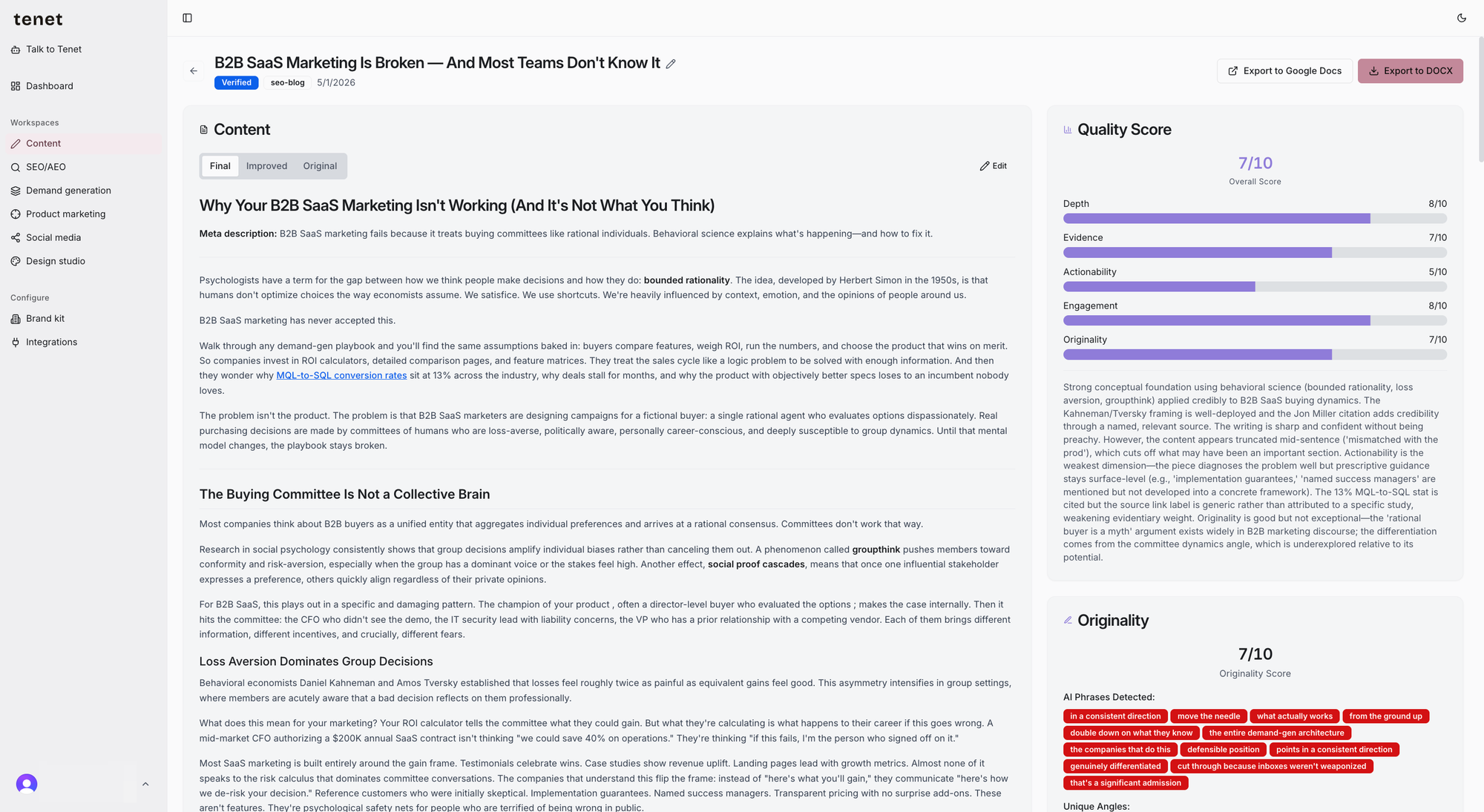
If you're a small team or a solo marketer, the gap between understanding copywriting and producing a consistent volume of high-quality copy is huge.
- Research takes time.
- Drafting takes time.
- Editing, reformatting for different channels, maintaining brand voice across a dozen deliverables simultaneously: the work compounds quickly.
Tenet is is an AI marketing agent built for lean teams who need to produce the results of a larger marketing function.
It handles the entire research-to-draft pipeline, maintains your brand voice across formats, and generates channel-specific copy, including landing pages, email sequences, social posts, and ad copy, without requiring you to manage a roster of freelancers or switch between a half-dozen tools.
For teams that already understand the principles of good copywriting and need to execute at scale, Tenet has you covered. And if you're a small business that doesn't have copywriting figured out, Tenet has your back, too.
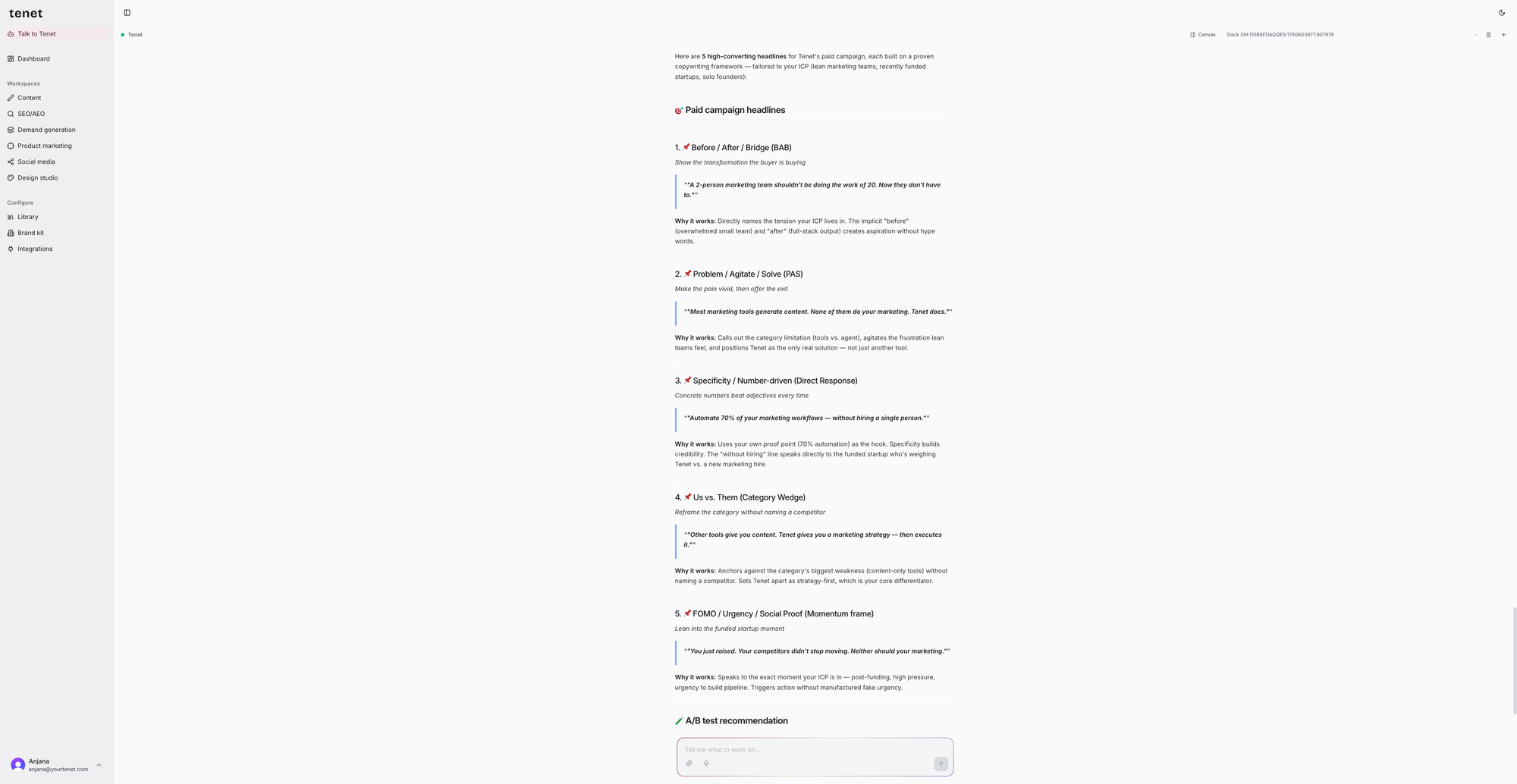
Tenet learns your brand, competitive landscape, your product positioning, your ICP, and your edge, so every piece of content powerfully communicates your value, unlike generic AI outputs.
Ultimately, copywriting is one of the most measurable skills in marketing. The research is clear:
- Headlines determine whether the rest gets read
- Grammar and spelling affect purchase intent
- Subject line length shifts open rates by double-digit percentages
- Social proof increases conversions.
Every claim in this guide is traceable to a real test with a real result. And that's where Tenet excels.