


TL;DR
- Direct response marketing is built around one goal: a measurable action right now — a click, call, form submission, or purchase you can attribute to a specific ad and measure within hours or days.
- Every successful campaign runs on three principles: a specific offer (not "learn more," but exactly what you'll get), urgency (a real reason to act now), and built-in tracking so you know what worked.
- The key metrics are CPA, ROAS, conversion rate, and CLV — if your cost to acquire a customer is lower than what they're worth, you scale; if not, you fix it fast.
- Direct response and brand marketing aren't competitors — brand builds future demand, direct response harvests it now. Most companies should run both, just weighted by how urgently they need growth.
- The four most common campaign killers: a weak or vague offer, multiple competing CTAs on the same page, skipping A/B testing, and sending the same message to every audience segment regardless of where they are in the buying journey.
There's a fundamental split in how companies spend their advertising dollars, and most don't realize which side of the line they're on until it's too late.
On one side, you have campaigns designed to make people feel something about your brand. They build awareness, shape perception, and plant seeds for future consideration. The ROI is fuzzy, measured in surveys and brand-lift studies months after the ads run.
On the other side, you have campaigns designed to make people do something right now. Click this link. Call this number. Enter your email. Buy this product. The ROI isn't fuzzy at all—you know within hours or days whether you're making money or burning it.
That second approach is direct response marketing, and executing it well requires a direct response marketing strategy that operates by completely different rules than the brand advertising most people picture when they think of "marketing." You're not trying to win awards or shift sentiment scores. You're trying to generate a specific, trackable action that moves someone closer to (or directly into) a purchase. Every dollar spent must justify itself in leads, calls, or sales you can count.
The difference matters because direct response doesn't just change what you say—it changes how you measure success, how you write copy, which channels you choose, and how quickly you can tell if something is working.
Direct response campaigns are judged entirely on quantitative KPIs like conversion rate, cost per acquisition, and return on ad spend, not brand perception. You're playing a different game with different scorekeeping.
What is direct response marketing?
Direct response definition and core principles
Direct response marketing is performance advertising designed to produce an immediate, trackable action instead of long-term awareness. The action might be a click, a phone call, a form submission, a download, or a purchase—but the defining characteristic is that you can count it, attribute it to a specific ad or campaign, and measure whether it was profitable.
The core idea is simple: you're asking people to respond right now, and you're tracking exactly who does. That tracking is what separates direct response from brand advertising. Every campaign includes a mechanism—a unique URL, a promo code, a dedicated phone number, a click-through link—that lets you tie responses directly back to the creative, channel, and audience that generated them.
The economics are straightforward. If you spend $1,000 on an ad campaign and it generates 50 leads at $20 each, you know your cost per acquisition. If those leads convert to customers worth $200 in revenue, you know your return. You can run the numbers daily or even hourly, adjust what isn't working, and scale what is. This feedback loop—spend, measure, optimize, repeat—is the engine that makes direct response work for companies that need growth marketing, not just goodwill.
Three principles show up in every successful direct response campaign:
- Specificity. The offer, the ask, and the benefit are concrete. Not "Learn more about our services," but "Download the 7-step checklist to double your conversion rate." Not "Contact us," but "Book your free 15-minute strategy call today." Vague promises and vague actions both kill response rates.
- Urgency. People respond now because there's a reason to respond now. Limited-time discounts, countdown timers, limited inventory, early-access bonuses—these aren't manipulative tricks, they're forcing functions that overcome inertia. According to research cited by McKinsey 80% of consumers say they're more likely to do business with brands that personalize interactions, and part of that personalization is respecting that people need a nudge to act.
- Measurability. You can't optimize what you can't measure. Direct response campaigns are built with tracking baked in from the start, so you know not just that something happened, but which ad, audience, and offer made it happen.
How direct response differs from brand marketing
Brand marketing builds awareness and shapes perception over time. It's the Super Bowl commercial that makes you laugh and remember the company name. It's the billboard with a clever tagline. It's the sponsored podcast that subtly associates the brand with values or ideas. The payoff is distant and cumulative, measured in brand recall surveys, consideration metrics, and long-term revenue lift that's hard to isolate.
Direct response marketing asks for the sale—or the step before the sale—right now. It's the Facebook ad with a "Start your free trial" button. It's the direct mail piece with a 20%-off coupon and a deadline. It's the email that says "Your cart is waiting—complete your order and save $15 today." The payoff is immediate and measurable, tracked in clicks, conversions, and cost per acquisition.
The difference shows up in how you judge success. Brand campaigns are evaluated on long-term indicators like awareness and preference, while direct response is judged by short-term metrics like conversion rate and ROAS. If your direct response campaign doesn't generate enough leads or sales to cover its cost within days or weeks, you turn it off. If your brand campaign doesn't shift sentiment scores after three months, you might still call it a success because "these things take time."
Neither approach is wrong; they're tools for different jobs. Many companies run both in parallel: brand advertising builds the pipeline of future demand, and direct response harvests the demand that exists right now. But the mistake is treating them as interchangeable. A brand-focused creative team will write copy that's clever and memorable but doesn't tell people what to do. A direct-response-focused team will write copy that's specific, benefit-driven, and ends with a clear call to action—even if it's not particularly clever.
The psychology behind direct response
Direct response works because it exploits predictable patterns in how people make decisions under conditions of limited attention and abundant choice.
- The first pattern is clarity beats cleverness. When people are scrolling through their inbox or social feed, they're not looking for a puzzle to solve. They're looking for something relevant to a problem they have right now. The faster you can show them what you're offering and why it matters to them, the more likely they are to stop and engage. That's why direct response copy tends to be concrete and benefit-focused—"Save 30% on your first order" beats "Discover a new way to shop" every time.
- The second pattern is action requires a reason. People are great at putting things off. Even if your offer is compelling, "I'll do it later" is the default response unless you give a reason to act now. Deadlines, limited quantities, and expiring bonuses work because they shift the calculus: the cost of waiting (missing the deal) becomes greater than the cost of acting (taking five minutes to fill out a form). This isn't manipulation—it's recognition that without urgency, even interested prospects will drift away.
- The third pattern is trust comes from specifics, not claims. Saying "We're the best" is a claim. Saying "1,247 customers saved an average of $340 in the first 30 days" is a specific that invites belief. EIILM’s research shows that direct response campaigns that include concrete proof—testimonials, case study results, guarantees—consistently outperform those that rely on abstract promises. The specificity signals that you have nothing to hide.
- The fourth pattern is friction kills conversion. Every additional step, every confusing instruction, every unnecessary form field gives people a reason to abandon the process. Direct response practitioners obsess over reducing friction: one-click ordering, pre-filled forms, mobile-optimized layouts, crystal-clear instructions. The goal is to make responding so easy that the only barrier is whether the person actually wants what you're offering.
Key elements of direct response marketing
Clear and compelling offer
The offer is the thing you're giving in exchange for the action you want. It's not your product or service in the abstract—it's the specific deal, package, or incentive that makes someone decide to respond right now.
Weak offers are vague and undifferentiated: "Contact us to learn more." "Check out our services." "Sign up for updates." These don't give people a concrete reason to act, and they don't create any urgency. Strong offers are specific, valuable, and time-bound: "Download the free 15-page guide to cutting your ad spend by 30%." "Get 20% off your first order—offer ends Friday." "Book a free 30-minute consultation and get a custom growth plan."
What makes an offer compelling is the perceived value relative to what you're asking. If you're asking for a purchase, the discount or bonus needs to feel significant enough to overcome price objections. If you're asking for contact information, the lead magnet needs to solve a specific, urgent problem. If you're asking for time (to watch a webinar or take a call), the promised outcome needs to justify the investment.
The best offers layer in risk reversal. Money-back guarantees, free trials, "cancel anytime" policies, and satisfaction promises all reduce the perceived risk of responding.
Strong call-to-action (CTA)
The call-to-action tells people exactly what to do next. It's the instruction that turns interest into action. Weak CTAs are passive or vague: "Learn more." "Contact us." "Visit our website." Strong CTAs are active, specific, and benefit-focused: "Download your free guide." "Start your 14-day trial." "Book your free audit."
According to Lumen learning the most effective CTAs share three traits. First, they use action verbs that describe exactly what will happen: Get, Claim, Start, Book, Download, Try. Second, they include a benefit or outcome: "Get your free guide" beats "Submit." Third, they're designed to stand out visually—contrasting color, prominent placement, enough white space to draw the eye.
The mistake many marketers make is burying the CTA or presenting multiple competing CTAs on the same page. Direct response best practice is one primary action per asset. If you're asking people to download a guide, don't also ask them to follow you on social media, subscribe to your newsletter, and schedule a call. Every additional option splits attention and reduces the chance that anyone takes any action at all.
Repetition matters, especially on longer pages. Your CTA should appear above the fold, in the middle of the copy after you've built your case, and again at the end. Each placement gives people another opportunity to act when they're ready, without forcing them to scroll back up to find the button.
Urgency and scarcity tactics
Urgency answers the question "Why should I do this now instead of later?" Scarcity answers "Why might this not be available if I wait?"
The most common urgency tactic is a deadline: "Offer ends Friday at midnight." "Register by June 15 to save $200." "Only 48 hours left." Deadlines work because they create a clear point at which the opportunity disappears. The more specific the deadline—actual date and time, not "soon" or "limited time"—the more credible and effective it is.
Scarcity works by highlighting limited availability: "Only 12 spots left." "While supplies last." "First 100 customers only." This taps into loss aversion—the psychological principle that people are more motivated to avoid losing an opportunity than to gain the same opportunity if it feels abundant. Scarcity must be real to be effective long-term; fake countdown timers that reset and invented inventory limits destroy trust when customers notice.
The most powerful campaigns combine both: "Only 12 spots left in our June cohort—registration closes Friday." Now there are two reasons to act: limited quantity and a hard deadline.
A subtler form of urgency is problem amplification—making the reader feel the cost of inaction. "Every day you wait, you're leaving money on the table." "Your competitors are already using this." "The longer you put this off, the harder it gets." This doesn't manufacture fake scarcity; it makes real consequences salient.
Trackability and measurability
Direct response campaigns are built around tracking from day one. Every ad, email, and landing page includes mechanisms that let you measure exactly who responded, which creative or channel they came from, and what they did next.
The tracking tools are straightforward:
- Unique URLs with UTM parameters that identify source, medium, campaign, and creative variant
- Dedicated phone numbers for different ads or channels, so you know which drove the call
- Promo codes that tie purchases back to specific offers or placements
- Form submissions with hidden fields that capture referral source
- Pixel tracking that follows users from ad click through conversion
The point isn't just to count responses—it's to identify what's working so you can do more of it, and what's not so you can stop wasting money. According to Perion's guide, the core KPIs that matter are:
- Conversion rate: percentage of people who complete the desired action
- Click-through rate (CTR): how often people click your ad
- Cost per acquisition (CPA): how much you spend to get one customer or lead
- Return on ad spend (ROAS): revenue generated per dollar spent
- Customer lifetime value (CLV): total revenue a customer generates over time
These metrics let you make decisions fast. If one ad variant has a 5% conversion rate and another has 2%, you pause the 2% version and put the budget into the winner. If your CPA is $50 and your average customer value is $200, you know you can afford to spend more. If your CPA is $50 and your average customer value is $40, you know the campaign is broken.
The speed of feedback is what makes direct response so powerful for companies that need to grow efficiently. You're not waiting months for a brand study to tell you if your campaign "moved the needle." You're checking your dashboard every morning to see how many leads came in overnight and what they cost.
Direct response marketing channels
Direct mail campaigns
Direct mail—physical letters, postcards, catalogs, and packages sent to people's homes—is the original direct response channel, and it's still effective for the right audiences and offers.
The structure is consistent across formats: a clear offer, a specific call-to-action (often a URL, phone number, or QR code), and urgency (expiration date, limited-time discount). What makes direct mail work is the tangibility. A physical piece in your hand has presence that an email or digital ad doesn't. It can't be dismissed with a single click, and if it's well-designed, it might sit on the counter for days before someone acts on it.
Quad identifies three mistakes that kill direct mail performance:
First, delivering the same message to every recipient instead of segmenting by behavior, demographics, or purchase history. Personalized mail—using the recipient's name, referencing past purchases, or tailoring the offer to their segment—consistently outperforms generic blasts.
Second, locking into a format (postcard, letter, catalog) based on habit rather than testing what works best for the specific offer and audience. A postcard might be perfect for a simple discount offer, while a multi-page package might be needed for a complex product.
Third, ignoring postal optimization—not taking advantage of bulk rates, address hygiene, and delivery scheduling that can cut costs by 20% or more.
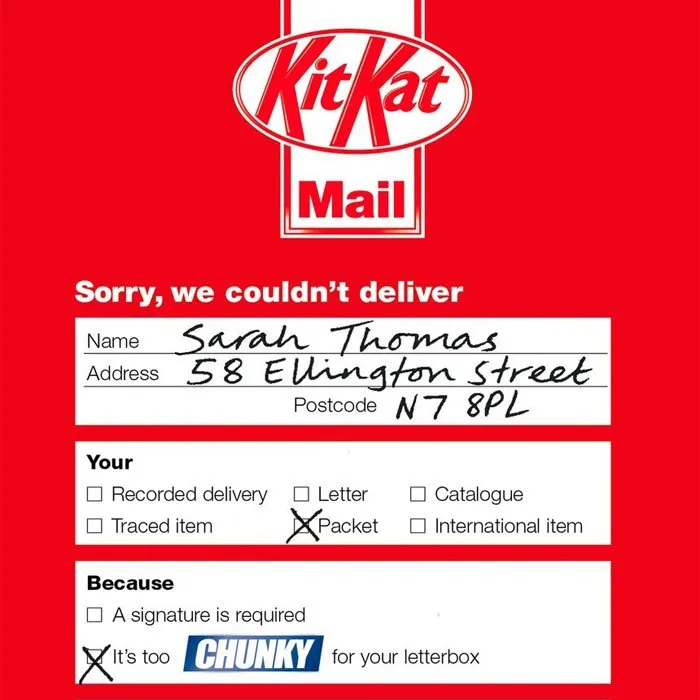
The classic direct mail example is the "oversized sorry we missed you" campaign. Perion describes how KitKat Chunky sent envelopes that looked like failed delivery notices, inviting recipients to pick up a free candy bar at a local store. 87% of recipients redeemed the offer—an extraordinary response rate driven by curiosity, tangibility, and a zero-friction offer.
Digital direct response (Email, PPC, social media ads)
Digital channels are where most direct response happens today, because the economics are more favorable (lower cost per impression) and the tracking is more precise (you can measure every click and conversion).
- Email is still one of the highest-ROI channels for direct response. You're reaching people who've already opted in, so the audience is warm. The format forces clarity—subject line, preview text, body copy, CTA button—and performance is easy to measure (open rate, click rate, conversion rate). The best email direct response campaigns are segmented by behavior: cart abandoners get one message, past buyers get another, engaged subscribers who haven't purchased get a third. Amazon is famous for this—personalized product marketing based on browsing and purchase history that feel like a personal shopper nudging you toward the next purchase.
- PPC (pay-per-click) search and display ads let you reach people at the moment they're searching for a solution. The direct response formula is the same: headline that calls out the problem or audience, body copy that highlights the benefit, clear CTA, and a landing page that matches the promise. You're paying only for clicks, so every visitor is someone who expressed interest, and you can track exactly which keywords, ads, and landing pages generate conversions at what cost.
- Social media ads (Facebook, Instagram, LinkedIn, TikTok) combine targeting precision with visual storytelling. You can segment by demographics, interests, and behavior, and test dozens of creative variants quickly. The format varies—carousel ads, video ads, lead forms—but the direct response principles stay the same: specific offer, clear CTA, urgency, and tracking. CB insight’s study show how companies like Casper, Harry's, and Allbirds used targeted social ads to grow their customer base quickly, relying on direct response mechanics (limited-time discounts, free shipping, risk-free trials) to convert cold traffic.
Television and radio infomercials
Infomercials and direct response TV (DRTV) are long-form ads—usually 30 minutes to an hour—that walk through a problem, demonstrate a solution, build credibility, and ask for a phone call or website visit. The format feels dated to some, but it still works for products that need demonstration or explanation.
The structure is formulaic: identify the problem (often with exaggerated demonstrations of how hard the current solution is), introduce the product, show testimonials, demonstrate results, stack the offer (the product plus bonuses), introduce urgency (limited time, call now), and repeat the call-to-action dozens of times. The repetition isn't accidental—it's designed to make sure that whenever the viewer decides to act, they know exactly what to do.
Radio works similarly but relies entirely on the copy, voice, and offer. Radio direct response best practices emphasize a memorable phone number or simple URL, repetition of the offer, and a reason to act now (first 50 callers, mention this ad for a discount). The limitation is that listeners can't click—they have to remember the number or URL—so simplicity is even more critical.
Print advertising with response mechanisms
Print ads in magazines and newspapers can function as direct response if they include a clear mechanism for tracking: a unique URL, a QR code, a coupon with a code, or a phone number. Without that mechanism, you're running brand advertising and hoping people remember you later.
The advantage of print is targeting through placement—an ad in a trade magazine reaches a specific professional audience, an ad in a local newspaper reaches a geographic market. The disadvantage is cost (print ads are expensive per impression) and lack of real-time feedback (you won't know how the ad performed until responses trickle in over days or weeks).
The best print direct response ads follow the same formula as digital: attention-grabbing headline, benefit-focused body copy, clear offer, and prominent CTA. The format can range from a small classified ad with a phone number to a full-page advertorial that reads like an article but ends with an offer.
Direct response marketing examples
Classic direct response campaigns
Some of the most famous direct response campaigns became templates that marketers still study and copy today.
Dollar Shave Club's launch video
Dollar Shave Club's launch video is a modern classic. The video was funny, memorable, and specific: $1/month for razors delivered to your door, no commitments, cancel anytime. The CTA was simple—go to the website and sign up. The video went viral, but the structure underneath was pure direct response: specific offer, clear value proposition, low-friction CTA, and a business model that relied on converting viewers into subscribers immediately.
Similarly, KitKat's "sorry we missed you" direct mail campaign used physical mail that looked like a delivery notice. When recipients opened it, they learned they could claim a free KitKat Chunky bar at a nearby store.
Uber's referral program turned existing customers into a direct response channel. Give a friend a free ride credit, get a credit yourself when they sign up and take their first ride. The offer was specific, the value was clear to both parties, and the tracking was automatic. This as a case where the direct response mechanism (the referral code) is built into the product itself, making growth measurable and scalable.
Modern digital examples
Digital channels let brands test and optimize direct response at a speed and scale impossible with offline media.
- Amazon's personalized recommendation emails are direct response disguised as helpful service. "Based on your recent purchase of X, you might also like Y" is a specific, personalized offer with one-click ordering. The email tracks whether you click and whether you buy, feeding that data back into the recommendation engine. The result is a continuous direct response loop that generates billions in incremental revenue.
- MeUndies' post-purchase referral emails ask customers to invite friends immediately after buying. Neil Patel describes how the company uses direct response tactics—clear incentives for both referrer and friend, simple sharing mechanism, time-limited bonuses—to turn satisfied customers into a performance marketing channel.
- Lyft's driver recruitment campaigns show that direct response isn't just for selling products. The company used targeted ads and landing pages to recruit drivers, with offers like "Earn $X in your first month" and application CTAs designed for mobile. The tracking measured cost per driver application and cost per active driver, treating recruitment as a direct response funnel.
Industry-specific use cases
Direct response adapts to virtually any industry, though the channel mix and offer types vary.
- E-commerce and DTC brands rely heavily on Facebook and Instagram ads with discount codes, free shipping offers, and limited-time sales. The funnel is simple: ad → landing page → checkout, with abandoned cart emails as a follow-up direct response tactic. Companies like Casper, Bonobos, and BarkBox grew fast using this model.
- B2B SaaS companies use direct response to generate demos and free trials. LinkedIn ads targeting specific job titles, search ads targeting problem-related keywords, and email campaigns to segmented lists all drive to landing pages with lead forms or "Start free trial" CTAs. The offer is usually educational (white papers, webinars, calculators) or risk-free (free trial, free tool, free audit).
- Insurance, financial services, and education are classic direct response verticals because the products are high-consideration and benefit from immediate follow-up. The typical flow: ad or direct mail with a compelling offer ("See how much you could save in 5 minutes") → landing page with a short form → phone call from a salesperson. The lead is the conversion event, and the sales team closes the deal.
- Local services (HVAC, plumbing, legal, dental) use direct response to generate calls and appointments. Google search ads, local service ads, direct mail with coupons, and "call now" radio spots all point to a phone number or booking page. The offer might be a discount, a free consultation, or simply fast service ("Same-day appointments available").
How to create a direct response campaign
building a direct response campaign follows the same five steps regardless of channel.
skipping step five is the most common reason teams can't tell if a campaign worked.
Step 1: Define your target audience
You can't write effective direct response copy if you don't know who you're talking to. The message that resonates with a first-time buyer is different from the message that works for someone who's bought from you three times. The language that lands with a CFO is different from what works with a marketing manager.
Start by answering:
- Who are they? (demographics, job title, industry, company size if B2B)
- What problem are they trying to solve right now?
- What language do they use to describe that problem?
- What objections or fears are stopping them from acting?
- Where do they spend time online or offline? (which channels will reach them)
The more specific your target, the more precise your message can be. "Small business owners" is too broad. "Owners of local service businesses with 5-15 employees who are too busy to handle their own bookkeeping" is specific enough to write copy that feels like you're speaking directly to them.
Segmentation is critical when you're working with an existing customer list. The ResearchGate research found that 80% of consumers are more likely to do business with brands that personalize interactions. Segmenting by purchase history, engagement level, or behavior (cart abandoners, lapsed customers, frequent buyers) lets you tailor the offer and message to where each person is in their relationship with you.
Step 2: Craft your irresistible offer
Your offer is what you're giving in exchange for the action you want. It needs to be specific, valuable, and aligned with your business model.
- For lead generation, the offer is usually educational or diagnostic: a guide, checklist, template, webinar, assessment, or audit. The value needs to be high enough that someone will trade their contact information for it, and the topic needs to be directly related to the product or service you'll eventually sell. A financial advisor might offer "The 10-Minute Retirement Readiness Quiz." A marketing agency might offer "Free 30-Minute Website Audit."
- For e-commerce and direct sales, the offer is usually economic: a discount (20% off, $10 off your first order), free shipping, a bonus (buy one get one, free gift with purchase), or a bundle. The discount or bonus needs to be significant enough to overcome price objections and trigger action.
- For subscription or trial-based businesses, the offer is usually risk reduction: free trial (14 days, 30 days), freemium tier, or money-back guarantee. The lower the perceived risk, the higher the conversion rate.
- Layer in urgency: "Offer expires Friday." "Only 50 available." "First 100 customers get the bonus." Real deadlines and real scarcity work; fake ones backfire when people catch on.
Step 3: Write compelling direct response copy
Direct response copy has one job: make the reader take the action you want. Everything else—cleverness, brand voice, storytelling—is secondary.
The structure that works is:
- Headline: Call out the audience or the problem. "Struggling to convert website traffic into leads?" "For SaaS founders who need predictable pipeline growth."
- Problem amplification: Make the cost of inaction clear. "Every day you wait, your competitors are capturing the leads you're missing."
- Solution introduction: Introduce your offer as the answer to that problem. "That's why we built the 7-Step Conversion Playbook—it shows you exactly how to turn visitors into qualified leads in 30 days."
- Proof: Testimonials, case study results, numbers. "Used by 1,200+ SaaS companies. Average increase in lead volume: 43%."
- Offer details: Spell out what they're getting and what it costs (time, money, information). "Download it free. No credit card required. 15-page PDF delivered instantly."
- Urgency: Give a reason to act now. "Only available until Friday."
- CTA: Tell them exactly what to do next. "Enter your email below and we'll send the playbook to your inbox in 60 seconds."
- The copy should be benefit-focused, not feature-focused. Don't say "Our software has automated workflows." Say "Save 5 hours a week by automating repetitive tasks." Benefits answer the question "What's in it for me?"
- It should be specific. Don't say "Increase your revenue." Say "Companies using this system added an average of $47,000 in new revenue in the first 90 days."
- It should be simple. Short sentences, plain language, no jargon. If a seventh-grader can't understand it, rewrite it.
Step 4: Choose your channels and media
The channel you choose depends on where your audience is and what action you're asking them to take.
- For B2B audiences, LinkedIn ads, Google search ads, email, and webinars tend to work well. These are channels where people are already in work mode and open to professional content.
- For consumer audiences, Facebook and Instagram ads, email, direct mail, and video platforms (YouTube, TikTok) are more effective. These are channels where people are in browsing or entertainment mode, so your ad needs to interrupt with relevance and value.
- For local businesses, Google Local Services Ads, direct mail to targeted zip codes, and local radio or print can drive calls and foot traffic efficiently.
- The mistake is trying to be everywhere. Start with one or two channels where your audience spends time, test your offer and copy there, and scale what works before expanding.
- Match the channel to the complexity of your offer. A simple discount code works fine in a social ad. A complex B2B solution might need a longer-form asset like a webinar or white paper, promoted through email and LinkedIn.
Step 5: Set up tracking and measurement
Before you launch anything, decide what you're measuring and how you'll measure it.
The minimum viable tracking setup:
- Unique URLs with UTM parameters for every ad, email, and external link so you know which source drove the traffic
- Conversion tracking (pixel, tag, or form submission) so you know who completed the desired action
- CRM or database that captures lead source and ties it to downstream outcomes (demo, purchase, LTV)
The metrics you track depend on your goal:
- If you're running lead gen, you care about cost per lead, lead-to-opportunity conversion rate, and cost per opportunity.
- If you're running e-commerce, you care about click-through rate, landing page conversion rate, cost per purchase, and ROAS.
- If you're running trial or demo campaigns, you care about cost per trial signup, trial-to-paid conversion rate, and payback period.
Set up a dashboard that shows these numbers daily. The advantage of direct response is speed—you know within hours or days if something is working, so you can adjust fast. If an ad variant has half the conversion rate of another, pause it and reallocate budget. If one landing page is converting at 8% and another at 3%, send all traffic to the winner.
Run A/B tests on one variable at a time: headline, offer, CTA, image, audience. Let each test run until you have statistical significance (usually at least 100 conversions per variant), then implement the winner and test the next variable.
Direct response copywriting best practices
The direct response formula
Experienced direct response copywriters use frameworks that guide them from attention to action. The most common is some variation of AIDA: Attention, Interest, Desire, Action.
- Attention: Your headline and opening need to stop the scroll or catch the eye. Call out the audience, state the problem, or make a bold promise. "
- founders: Stop losing 60% of your free trial signups."
- Interest: Show the reader why this matters to them specifically. Amplify the problem, introduce a surprising insight, or contrast their current state with where they could be. "Most SaaS companies watch trial users sign up, poke around, and disappear—because they don't have a systematic onboarding sequence."
- Desire: Introduce your solution and paint a picture of life after they have it. Use proof, specifics, and benefits. "Our 7-email onboarding sequence activates 54% more trial users in the first 72 hours. You'll see more demos booked, more questions answered, and more trials converting to paid."
- Action: Tell them exactly what to do next and why they should do it now. "Download the sequence template free—it takes 10 minutes to customize and install."
- Another framework is Problem-Agitate-Solve. Identify the problem, make it feel urgent or painful, then present your offer as the solution.
- The underlying principle is always the same: meet the reader where they are (with a problem or goal), show them a better future, and give them a clear path to get there (your offer).
Headline writing for maximum impact
The headline is the most important sentence you'll write. If the headline doesn't capture attention, nothing else matters because nobody will read it.
Effective direct response headlines do one or more of these:
- Call out the target audience explicitly. "Attention small business owners." "For marketing managers at B2B SaaS companies."
- State a compelling benefit or outcome. "Cut your ad spend in half while doubling leads." "Book 10 more demos this month without spending more."
- Ask a provocative question that implies a problem. "Are you losing 80% of your leads because your follow-up is too slow?"
- Make a bold promise with a specific number. "How we added $100K in revenue in 60 days using one email sequence."
What doesn't work: generic statements ("Grow your business"), clever wordplay that obscures the point, or headlines that could apply to any company in your industry.
Test multiple headlines. Small changes—swapping one benefit for another, adding a number, changing the framing from negative (avoid this mistake) to positive (achieve this outcome)—can move response rates by 20% or more.
Building trust and overcoming objections
People don't respond to offers from strangers unless they trust that you'll deliver what you promise and that the risk of acting is low.
Trust signals that work:
- Social proof: "Used by 5,000+ companies." "1,200 five-star reviews." Testimonials that describe specific outcomes, not just "great service."
- Guarantees: Money-back, satisfaction, or performance guarantees. "If you don't see results in 30 days, we'll refund every penny."
- Authority markers: Certifications, awards, media mentions, partnerships. "As seen in Forbes." "Certified by [industry body]."
- Transparency: Clear pricing, no hidden fees, easy-to-understand terms. Anything that feels like fine print or a trick kills trust.
Objections are the unspoken reasons someone hesitates. Common objections:
- "This won't work for me / my situation is different."
- "I don't have time to implement this."
- "It's too expensive."
- "I've tried things like this before and they didn't work."
Address objections directly in your copy. If people worry about time, say "Takes less than 10 minutes to set up." If they worry about cost, emphasize ROI or compare the price to the cost of inaction. If they've been burned before, explain what makes your approach different.
The power of specificity
Vague claims sound like marketing. Specific claims sound like facts.
Compare these:
- Vague: "Our clients see great results."
- Specific: "Our clients generate an average of 340 qualified leads in the first 90 days."
- Vague: "Most people love our product."
- Specific: "94% of customers rate us 4 or 5 stars. Average satisfaction score: 4.7 out of 5."
- Vague: "You'll save time."
- Specific: "Automate the tasks that currently take you 6 hours a week—project updates, status reports, and follow-ups."
Specificity makes your copy more believable and more memorable. It also forces you to know your numbers, which is a useful discipline. If you can't quantify the value you deliver, you'll struggle to write effective direct response copy.
Use real customer names (with permission), real results, and real examples. "Sarah, a marketing director at a 50-person SaaS company, used this playbook to increase her demo bookings from 12 to 31 per month in 60 days." That's more persuasive than "One customer increased demo bookings significantly."
Measuring direct response marketing success
Key performance indicators (KPIs)
The whole point of direct response is measurability, so you need to know which numbers matter.
the article's own example — a $50 CPA against a $500 LTV is a healthy 10:1 ratio, while a $50 CPA against a $120 LTV barely breaks even — comes down to one ratio: what share of a customer's lifetime value you spend acquiring them.
- Conversion rate is the percentage of people who complete your desired action. If 1,000 people visit your landing page and 30 fill out the form, your conversion rate is 3%. This tells you how effective your offer, copy, and design are at turning interest into action. Track conversion rates at every stage of your funnel (click-through rate from ad to landing page, form completion rate, lead-to-opportunity rate) to identify where you're losing people.
- Cost per acquisition (CPA) is how much you spend to get one customer or lead. If you spend $2,000 on ads and generate 40 leads, your CPA is $50. This is the number you compare to your customer lifetime value (LTV) to determine whether your campaign is profitable. If your average customer is worth $500 and your CPA is $50, you have a healthy 10:1 ratio and room to scale.
- Return on ad spend (ROAS) is revenue generated divided by ad spend. If you spend $1,000 on ads and generate $4,000 in revenue, your ROAS is 4:1 (or 400%). This is the clearest measure of campaign profitability. ROAS is one of the core KPIs because it directly answers "Are we making money?"
- Customer lifetime value (CLV or LTV) is the total revenue a customer will generate over their entire relationship with you. This is especially critical for subscription or repeat-purchase businesses. If your CPA is $100 and your LTV is $600, you can afford to spend aggressively on acquisition. If your LTV is only $120, you need to either lower your CPA or increase customer retention and upsells.
- Click-through rate (CTR) measures how often people click your ad relative to how many times it's shown. Low CTR means your headline or offer isn't resonating. High CTR but low conversion rate means your ad is attracting attention but your landing page or offer is broken.
ROI calculation methods
The simplest ROI formula for direct response is:
If you spend $5,000 on a campaign and it generates $20,000 in revenue, your ROI is ($20,000 - $5,000) ÷ $5,000 = 3, or 300%.
That's the top-line calculation. To be accurate, you also need to factor in:
- Cost of goods sold (COGS) or fulfillment cost, so you're measuring profit, not just revenue
- Attribution window: did the revenue come immediately, or are you tracking sales over 30, 60, or 90 days?
- Lifetime value: for subscription or repeat businesses, are you counting only the first purchase or the full projected LTV?
For campaigns where the conversion happens offline (a lead form that feeds to a sales team), you need to track lead-to-customer conversion rate and average deal size to calculate true ROI. If you generate 100 leads at $50 each ($5,000 total cost), and 10 of those leads become customers worth $2,000 each, your revenue is $20,000 and your ROI is 300%. If only 2 become customers, your revenue is $4,000 and your ROI is negative.
The faster you can measure ROI, the faster you can optimize. Daily or weekly tracking lets you shift budget from low-ROI campaigns to high-ROI campaigns before you burn through your budget.
Tools for tracking and analytics
You don't need expensive enterprise platforms to track direct response campaigns. The essentials:
- Google Analytics (or any web analytics tool) tracks traffic, behavior, and conversions on your site. Set up goals for key actions (form submissions, purchases, page views) and use UTM parameters to identify which campaigns drove each conversion.
- Ad platform dashboards (Facebook Ads Manager, Google Ads, LinkedIn Campaign Manager) show impressions, clicks, CTR, and conversions at the campaign and ad level. Connect conversion tracking (pixels, tags) so you can see which ads drive results, not just clicks.
- CRM or email platform (HubSpot, Salesforce, ActiveCampaign, etc.) tracks leads and customers through the funnel. Tag each lead with source and campaign so you can measure lead-to-opportunity and lead-to-customer rates by channel.
- Call tracking software (CallRail, CallTrackingMetrics) gives you unique phone numbers for different campaigns and tracks which ads or pages drove each call. Critical for industries where phone calls are the primary conversion event.
- Landing page builders with A/B testing (Unbounce, Instapage, Leadpages) let you test variants of your landing pages and measure conversion rates for each.
- The sophistication of your stack should match the complexity of your campaigns. If you're running a simple email-to-landing-page funnel, Google Analytics and your email platform are enough. If you're running multi-channel campaigns with phone calls, in-person visits, and long sales cycles, you'll need a more integrated setup.
Direct response vs. brand marketing
When to use direct response
Direct response makes sense when:
- You need measurable results quickly. You can't wait months to see if a campaign is working; you need to know this week whether you're generating leads or sales at an acceptable cost.
- You have a clear, immediate offer. You're selling something people can buy or sign up for right now, not building long-term awareness for a future purchase.
- You can track actions. The technology and systems exist to measure who responded, which channel they came from, and what they did.
- Your economics support it. You know your cost per acquisition and lifetime value, and there's a profitable gap between them.
Direct response is the default for performance marketing, lead generation, e-commerce, subscription businesses, and sales-driven organizations that need predictable pipeline growth.
When to use brand marketing
Brand marketing makes sense when:
- The purchase cycle is long and complex. High-consideration purchases (enterprise software, luxury goods, cars, homes) involve multiple touchpoints over weeks or months. Direct response alone won't close the deal; you need brand awareness and trust built over time.
- You're building a new category or shifting perception. If people don't know they have the problem you solve, or if your brand is associated with the wrong thing, you need messaging that shifts how people think before you can ask them to act.
- You want to charge a premium. Strong brands command higher prices because customers perceive more value. Brand marketing builds that perception; direct response harvests it.
- Your product benefits from word of mouth and cultural momentum. Some brands (Nike, Apple, Patagonia) are as much about identity and values as product features. Brand marketing creates the emotional resonance that makes people want to be associated with you.
McKinsey points out that brand campaigns are judged on long-term indicators—awareness, consideration, preference—while direct response is judged on short-term metrics. That difference in time horizon is what determines which approach fits.
Integrating both approaches
The best companies don't choose between direct response and brand—they use both strategically.
- Brand marketing builds the pipeline; direct response harvests it. Run brand campaigns (content, thought leadership, sponsorships, awareness-focused ads) to make sure people know you exist and trust you. Then run direct response campaigns (targeted offers, retargeting, email) to convert that awareness into leads and sales.
- Direct response tests messages; brand marketing scales them. Use direct response campaigns to test different value propositions, audiences, and offers. When you find what works (high conversion rate, low CPA), invest in brand campaigns that amplify that message to a broader audience.
- Brand reduces friction in direct response. People are more likely to respond to an offer from a brand they recognize and trust. The higher your brand awareness, the better your direct response metrics will be because people don't need to evaluate you from scratch every time they see an ad.
- The split doesn't have to be 50/50. Early-stage companies and lean teams usually tilt heavily toward direct response because they need measurable growth now. Established companies with strong cash flow can afford to invest more in brand because they're playing a longer game.
Common direct response marketing mistakes to avoid
Weak or unclear offers
The offer is the core of any direct response campaign, and a weak offer tanks performance no matter how good the rest of your execution is.
- A weak offer is vague: "Learn more about our services." "Contact us for details." "Sign up for updates." These don't give people a concrete reason to act, and they don't create urgency.
- A weak offer is also undifferentiated: "10% off" when every competitor offers 10% off. "Free consultation" when free consultations are standard in your industry. If your offer doesn't stand out, you're competing purely on brand and luck.
Fix it by making your offer specific, valuable, and exclusive. Instead of "Learn more," offer "Download the 12-page guide to cutting your logistics costs by 20%." Instead of generic "10% off," offer "Get 20% off plus free shipping—only available to first-time customers this week."
Test different offers against each other. Sometimes a free trial outperforms a discount. Sometimes a lead magnet (guide, checklist, tool) outperforms a direct sales offer. The only way to know is to test.
Multiple calls-to-action
Every additional CTA you add splits attention and reduces the likelihood that anyone takes any action.
Direct response best practice is one primary action per page or campaign. If the goal is to generate leads, the only prominent CTA should be "Download the guide" or "Get the free audit." Everything else—social follow buttons, navigation menu, footer links—should be de-emphasized or removed entirely.
The exception is long-form pages where you repeat the same CTA multiple times (top, middle, bottom). That's not offering multiple actions; it's giving people multiple opportunities to take the one action you want.
Ignoring testing and optimization
Most direct response campaigns don't perform well on the first try. The winners are found through systematic testing.
The mistake is launching one version of an ad or landing page, seeing mediocre results, and concluding "direct response doesn't work for us." What doesn't work is assuming you'll nail it on the first attempt.
Test one variable at a time so you know what caused the change in performance:
- Headline: Test 3-5 different headlines that emphasize different benefits or frame the problem differently
- Offer: Test discount vs. free trial vs. bonus vs. risk-free guarantee
- CTA: Test different button copy ("Get started free" vs. "Start your trial" vs. "Download now")
- Audience: Test different segments, lookalikes, or targeting parameters
- Creative: Test different images, video vs. static, long-form vs. short-form
Run each test until you have enough conversions to declare a statistically significant winner (usually 100+ conversions per variant, depending on your baseline conversion rate). Then implement the winner and test the next variable.
Poor targeting and segmentation
Sending the same message to every person on your list or targeting the broadest possible audience is a recipe for low response rates and wasted spend.
The problem is that people at different stages of awareness need different messages:
- Unaware prospects don't know they have the problem you solve; they need education before they're ready for an offer.
- Problem-aware prospects know they have the problem but don't know your solution exists; they need to understand why your approach works.
- Solution-aware prospects know your category exists but haven't chosen you; they need differentiation and proof.
- Product-aware prospects know about your product but haven't bought; they need an offer and urgency.
- Most-aware prospects are past customers or highly engaged leads; they need upsells, retention offers, or referral incentives.
Segmenting your audience by behavior (past purchasers, cart abandoners, engaged email subscribers, cold traffic) and awareness level lets you tailor the message and offer to where they are. ResearchGate’s research on direct mail found that campaigns delivering the same message to everyone underperform badly compared to segmented campaigns, and the same principle applies across all channels.
Run direct response campaigns without the agency retainer
Direct response marketing rewards speed and accountability — but executing it well across copy, targeting, tracking, and optimization is a lot for a lean team to carry alone.
That's where Tenet comes in. Tenet is an AI marketing agent built for lean teams that need to ship high-quality work without the headcount. It covers the full scope of what direct response demands: strategic positioning, research-backed copy, demand generation campaigns, landing page content, email sequences, and performance-focused ad variants — all on your brand, from day one.
You tell Tenet who you're targeting and what you want them to do. It handles the rest — writing the offer, structuring the funnel, and making sure everything from the headline to the CTA is built to convert. And because Tenet learns your brand voice and positioning upfront, every output sounds like you, not like a generic AI template.
For solo marketers, small teams, and founders running marketing themselves, Tenet means you can run the kind of systematic, multi-channel direct response campaigns that used to require an agency — without the six-figure invoice. Setup takes 30 minutes. Most teams have their first output within the hour.
Ready to see it in action? Book a 20-minute demo and watch Tenet build something on your positioning, live.