

For a team of one to five, the platform that wins is the one that removes the most decisions - not the one with the longest feature list. Small teams fail with best-of-breed stacks because every integration becomes someone's part-time job, and on a lean team there is no spare someone. This is a comparison written around that constraint. For the wider category, see our guide to what an AI marketing platform is and what it costs.
 Tenet
TenetTL; DR
- The best AI marketing platform for a small team isn't a single product — it's the smallest stack that covers drafting, optimization, distribution, and measurement without burying you in tool management.
- The category has split into three tiers: general-purpose assistants, marketing-native platforms and agentic tools that execute full campaign sequences autonomously.
- Small teams get the most from AI because they lack specialists — a two-person team using the right stack can match the output of a team twice its size, primarily by cutting repetitive production work.
- Match tools to maturity: solo teams need an LLM + Surfer + Mailchimp + Buffer (~$80–150/month); larger small teams add automation and brand voice tools; three-to-five person teams graduate to agentic workflows. The most common failure isn't picking the wrong tool — it's tool sprawl. Four to five tools is a reasonable ceiling for a solo marketer; beyond eight, overhead starts eating the time savings.
There's a problem hiding inside most "AI tools for marketing" lists. They're written as if the goal is to collect tools, the way someone might collect stamps.
But that's not how small teams work. A founder running marketing solo doesn't need seventeen tabs open. A two-person B2B team doesn't need an enterprise suite that takes a quarter to implement. What lean teams need is a compact system that handles the repetitive, high-volume work so humans can focus on the decisions that require judgment.
The good news: according to SBE Council data, the median small business is already running five AI tools in 2026. Access isn't the problem anymore. Building a stack that functions as a system — rather than a pile of overlapping subscriptions — is.
This guide does something most tool roundups skip. It tells you not just which platforms exist, but which ones to pair, how to wire them together, and when you've hit the point of diminishing returns. The thesis is simple: the best AI marketing platform for a small team isn't a single product. It's the smallest possible stack that covers drafting, optimization, distribution, and measurement without burying your team in tool management.
What "AI marketing platform" means in 2026
The phrase gets used loosely, so let's be precise. An AI marketing platform uses machine learning or generative AI to handle tasks that previously required a person sitting at a desk: writing copy, structuring content, segmenting audiences, scheduling posts, optimizing send times, generating reports.
Two shifts have reshaped the category since 2024.
The shift from features to workflows
Two years ago, "AI in marketing" mostly meant a button inside your email tool that could suggest a subject line. Now the category spans three distinct types of products:
- General-purpose AI assistants like ChatGPT and Claude handle the widest range of tasks. They're flexible, fast, and cheap. They're also generic by default, which means they require more human direction to produce on-brand output.
- Marketing-native AI platforms embed AI directly into a specific workflow: email, CRM, SEO, social scheduling. Mailchimp with Intuit Assist, and Surfer SEO fall into this category. They're more opinionated, which makes them faster to use for the specific job they're designed for.
- Agentic platforms go further. Instead of generating one piece of content at a time, they execute sequences: research a topic, draft the article, create social posts from it, schedule distribution, and report on performance. McKinsey describes this well: there isn't one best platform; the strongest setup is a workflow stack built around complementary tools, each doing what it does best.
Why small teams are the biggest beneficiaries
Large marketing teams already have specialists — a copywriter, an SEO lead, a social media manager, someone managing email. AI makes those specialists faster, but it doesn't restructure their operations.
Small teams are different. A two-person team doesn't have those specialists. Every hour spent writing a first draft is an hour not spent on strategy or customer conversations. That's where AI changes the math most dramatically. Small business guides suggest that thoughtful AI implementation can save 10–20 hours per employee per week, primarily by cutting repetitive tasks like content creation, email drafting, and reporting setup. Even a conservative eight hours per week represents a significant capacity lift for a team of two.
The core categories (and which ones small teams need)
Not every category in a comprehensive AI marketing taxonomy matters equally for lean teams. Here's an honest assessment of what to prioritize and what to skip until you're larger.
AI content and copywriting
This is where most small teams start, and for good reason. First-draft writing is high-volume, repetitive, and time-consuming. AI handles it well — especially when given clear instructions.
ChatGPT / Claude: The two most useful general-purpose tools for small teams. ChatGPT is the more flexible starting point; Claude tends to produce cleaner long-form prose with less editing required. Neither will produce on-brand content without guidance, but both reward teams that invest in solid prompt systems and style guides.
Surfer SEO is the most frequently recommended tool in this category for small teams. It analyzes top-ranking results for your target keyword, generates a content brief, and provides a real-time editor that scores your draft as you write. The practical workflow recommended by multiple sources is to use Surfer for the brief and structure, an LLM for the draft, and then run the draft back through Surfer's editor before publishing.
Semrush and NeuronWriter are solid alternatives with different emphasis. Semrush is stronger on competitive research and keyword discovery; NeuronWriter focuses on semantic optimization.
AI email, CRM, and lifecycle platforms
For most small teams, email is the highest-ROI marketing channel. The AI features embedded in major email platforms are now substantial enough that standalone AI tools often aren't necessary here.
Mailchimp with Intuit Assist handles subject line generation, send-time optimization, copy drafting, and segment suggestions. For budget-conscious small teams, it's the most accessible starting point.
Campaign Monitor and ActiveCampaign sit between those two options. Campaign Monitor's pricing runs $12–159 per month and includes AI personalization, automated journeys, and bot-click filtering. ActiveCampaign is stronger on automation logic for teams with complex nurture sequences.
AI social media and scheduling
Buffer is the practical choice for most small teams. Its AI Assistant helps with caption drafts, repurposing existing content into social formats, and scheduling across platforms. It's less feature-rich than enterprise tools like Sprout Social, but considerably cheaper and faster to set up.
Sprout Social makes sense once you have dedicated social ownership and need listening, sentiment analysis, and deeper analytics alongside scheduling.
Canva deserves mention here alongside social tools because most small teams use it for social graphics, ad creatives, and presentation assets. Canva's AI features now include image generation, background removal, and design suggestions, which eliminates the need for a separate AI design tool at this scale.
AI automation and agent platforms
This is the category that changed most dramatically in 2026. Instead of just generating content, agentic platforms can now execute sequences autonomously: research, draft, publish, report, repeat.
Gumloop and similar newer platforms are more fully agentic. They can run recurring marketing workflows autonomously, including campaign loops described where specialized agents handle research, drafting, distribution, and reporting as a coordinated sequence.
For small teams not ready to build custom agent workflows, start with Zapier for basic automation, then graduate to a more capable agentic tool once you know which workflows are stable enough to run with minimal supervision.
All-in-one vs best-of-breed: the decision that matters most
Every small team eventually faces this fork in the road. Do you consolidate into one platform, or assemble the best individual tools?
For most small teams, best-of-breed wins at low headcount and all-in-one wins as you add complexity. The inflection point is usually when more than three people are actively using the marketing tools and an established sales team needs connected data.
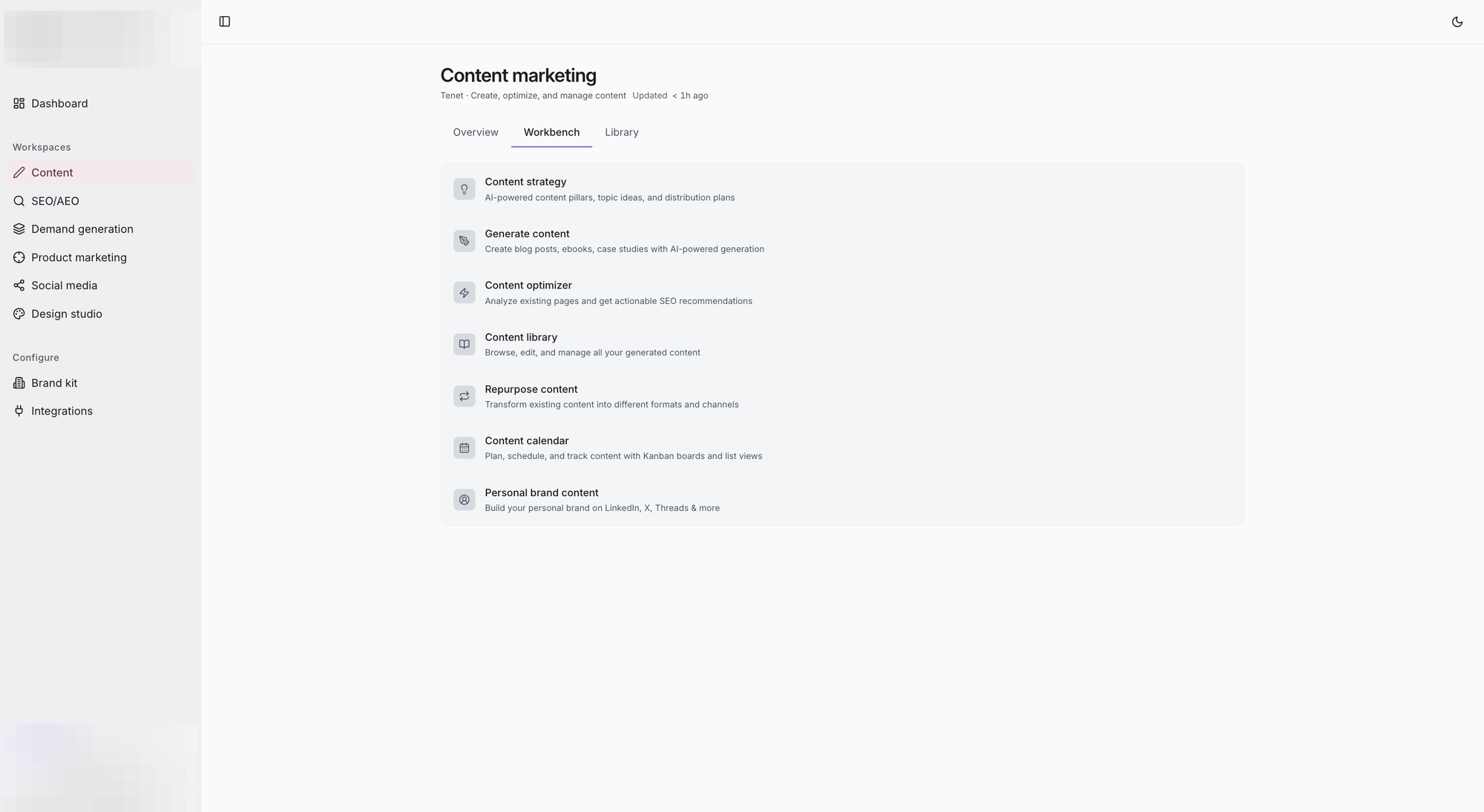
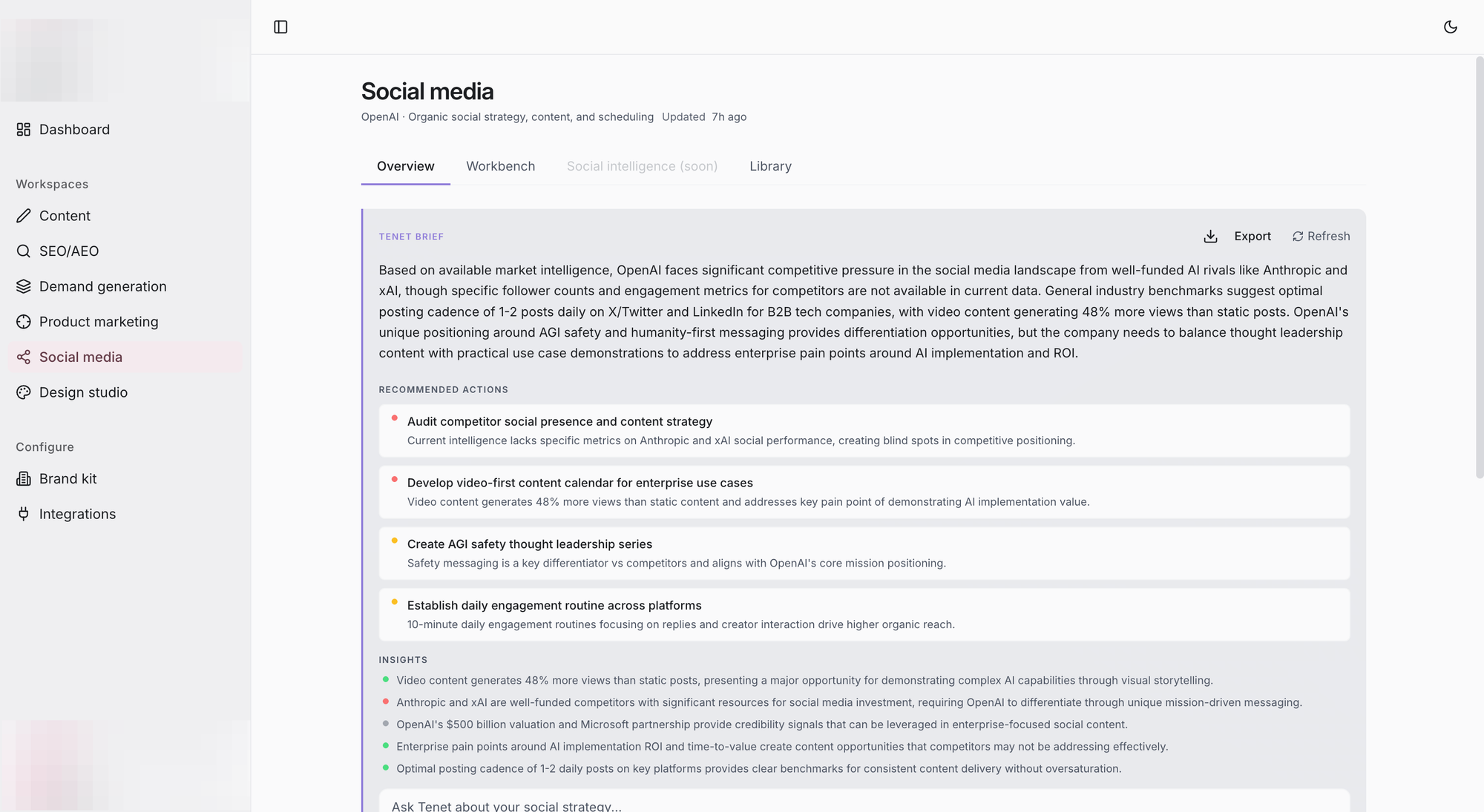
The emerging middle option is purpose-built AI marketing agents that handle end-to-end execution without requiring you to manage integrations. That's exactly what Tenet is designed for: you set up your brand voice, choose your focus areas (content, SEO, demand gen, social), and it runs research, drafting, optimization, and distribution without requiring a Zapier workflow to connect five separate subscriptions.
Small-team AI stack maturity model
Here's how the stack actually grows as your team goes from one person to five.
the stack grows with the team — never ahead of it.
Level 1: Solo or one-person team ("AI sidekick")
Your goal at this stage is consistency. You're probably publishing irregularly, handling email campaigns manually, and spending more time on production than on strategy.
The right stack: one general LLM (Claude or ChatGPT), Surfer SEO for content briefs, Mailchimp for email, Buffer for social, and Canva for creative testing. Total cost: $80–150/month.
That said, Tenet can nearly all of this in one platform — campaign planning, content creation, social media posts and creatives, performance analysis, and more.
The typical first workflow for most users has been to automate is the blog-to-social pipeline: write one article, use the LLM to generate five social posts from it, schedule them in Buffer, and repurpose the article into an email. It's a simple workflow that can save five to eight hours a week. But if your daily scope extends beyond social media, you may want to invest in a full-stack AI agent like Tenet.
Level 2: Two-to-three-person team ("AI-powered pod")
Your team now has some specialization — maybe one person focused on content and another on demand gen or email. The bottleneck shifts from raw output to coordination and consistency.
This is what a four-hour day looks like when AI drafts the fifteen-hour version overnight.
active production time is the number that matters.
Add Tenet to handle lead routing, content repurposing, and weekly reporting automatically. If you're doing SEO seriously, Surfer should now be a core part of your content workflow rather than an occasional check.
A realistic day for a two-person team at this level: one person reviews the week's AI-drafted articles (generated overnight), refines two for publish, and queues social posts from them. The other sets up a new email nurture sequence using Mailchimp's AI drafts as a starting point. Total active production time: roughly four hours for what used to take fifteen.
Level 3: Three to five person team ("autonomous AI marketing team")
At this stage, you're running multi-channel campaigns with enough volume that manual coordination becomes the bottleneck. Agentic tools become worth the setup cost.
Your stack should now include a CRM-connected platform like HubSpot for lifecycle orchestration, an agentic workflow tool that can run campaign loops autonomously, and a dedicated analytics layer to measure what's driving pipeline.
Human roles shift in this model. People become "commanders" who set strategy, review outputs, and adjust direction while agents handle execution and iteration.
 Tenet
TenetHow to choose AI tools that help you rank in AI search
Most tool lists ignore this entirely. In 2026, a significant slice of search traffic flows through AI assistants that surface specific answers rather than lists of links. Getting your content cited in those answers requires different thinking than traditional SEO.
AI search engines prioritize content with clear structure, direct answers, and trustworthy signals. Your AI marketing tools should help you produce content with explicit question-and-answer sections, clean heading hierarchies, FAQ blocks, and schema markup. Arvix’s content marketing guide is one of the few sources that explicitly addresses structuring content for both traditional SEO and AI citations.
Practically, this means three things:
Surfer SEO is useful not just for traditional ranking but because its content structure guidance naturally produces the kind of organized, scannable content that AI systems can parse and cite. Tools that produce dense, unstructured prose work against you in AI-mediated search.
Building FAQ sections into every major content piece isn't just a UX choice. It's a citation opportunity. AI assistants frequently pull direct answers from FAQ-style sections because the question-answer format maps cleanly to how queries are structured.
Keep your content factually accurate and updated. AI systems cross-reference claims, and content with verifiable, current information performs better as a citation source than content that's vague or outdated.
Agentic workflow playbooks for small teams
Playbook 1: Autonomous content and distribution loop
This is the most accessible agentic workflow for small teams. Here's how it runs:
An SEO tool (Surfer or Semrush) identifies your top five content opportunities based on search volume and competition. An LLM drafts the articles using those briefs. An automation layer (Zapier or Gumloop) routes the drafts to your CMS, generates social variants, and schedules them in Buffer. A simple analytics integration tracks performance weekly and flags which topics should be developed further.
Where human review fits: topic selection and final approval before publishing. The agent handles volume; the human handles judgment.
Playbook 2: Lead nurture email campaigns
New leads come in from a form or ad. Zapier routes them into your CRM and assigns them to a segment based on source or self-reported data. Your email platform's AI drafts a personalized nurture sequence. Predictive lead scoring flags contacts who show buying signals.
The guardrails: cap email frequency at reasonable intervals, keep a human-reviewed template for key touchpoints like demo invitations, and audit segment logic monthly.
Playbook 3: B2B account-based micro-campaigns
For teams selling into specific accounts, AI enables a level of personalization that was previously only realistic at large enterprises. Choose ten target accounts. Use AI to research each company's recent activity, challenges, and priorities. Generate individualized outreach sequences, LinkedIn content, and one-pagers from those inputs. Coordinate email, social, and sales touchpoints through your CRM automation.
This workflow doesn't fully run itself yet. But it compresses what used to be a week of research and drafting into a few hours of AI-assisted work.
Risks, limitations, and where humans still need to be in the loop
Speed is both the strongest argument for AI marketing tools and a genuine warning. AI can produce more content faster than any small team could manually. That's an advantage when the content is good. It compounds mistakes when it isn't.
More tools help, until they don't — here's roughly where that line sits.
more tools help, until they don't.
- Generic output is the most common failure mode. An LLM given no context about your brand marketing, audience, or competitive position will produce content that sounds like every other company in your category. The fix is front-loaded: invest time in your brand voice setup, your prompt library, and your editorial standards before you scale output.
- Automation without governance creates compliance and quality risks. If you're sending AI-drafted emails to thousands of customers without a review step, one bad sequence can cause real damage. Keep humans in the approval loop for anything that touches customers directly, at least until you've tested the workflow thoroughly.
- Data privacy deserves explicit attention. If you're pasting customer data, internal strategy documents, or competitive intelligence into consumer AI tools, you may be sharing information you didn't intend to share. Enterprise tiers of most platforms offer stronger data controls; for sensitive categories, those aren't optional.
- Tool sprawl kills small teams. The Smarketers note that small teams often overbuy point solutions and end up managing ten subscriptions that partially overlap. Four or five tools is a reasonable ceiling for a solo marketer. For a three-person team, eight is about as many as you can actively manage before overhead starts eating the time savings.
Comparison table: Top AI marketing platforms for small teams in 2026
Putting it together: Start with what's breaking, then build from there
Every useful piece of research on these points the same direction. The teams that get the most out of AI don't start by rebuilding their entire stack — they find the one thing that's slowing them down the most and fix that first. Then they expand.
For most small teams, that looks like this: get your brand voice and messaging locked in, get your content and SEO running consistently, and get campaigns shipping on a regular cadence. That foundation covers the vast majority of what lean marketing actually requires. The more advanced stuff — attribution modeling, full-funnel ABM, video production at scale — can wait until the core is working and you've got results to reinforce the direction.
What AI delivers in 2026 isn't a magic button that conjures a marketing department. It's the ability for a small team with the right setup to do what a much larger team did two years ago — with better consistency and sharper output. That's a real and available advantage right now, and you don't need a big headcount to access it.
 Anjana Vasan
That's what Tenet is built for. The platform handles the strategy and execution across content, SEO, campaigns, and social — and if you want someone to actually run it for you, Tenet Operator pairs the software with a dedicated person who owns your marketing week to week. They plan it, ship it, and report back on what's working. You approve the direction and watch the results. No agency handoffs, no managing a freelancer across other clients, no standing calls.
Start with your biggest bottleneck. Get one workflow running end to end. Then expand from there — with a system that's already doing the work.
Tenet