


An AI marketing platform is software that executes marketing work end to end - strategy, content, campaigns, and reporting - rather than assisting with a single task the way a writing tool or a scheduler does. The distinction matters commercially: point tools reduce the time a marketer spends on a task, while a platform reduces how many marketers you need in the first place. Expect to pay between $200 and $2,000 a month depending on how much of the function it actually owns.
 Tenet
TenetTL; DR
- The platform isn't the strategy. AI marketing tools amplify what you already have — clean data and clear goals produce results; poor data and vague goals produce faster versions of the same problems.
- The category is real and the numbers are measurable. Content production, email optimization, paid media bidding, and customer segmentation all have documented ROI — but only for teams that deploy narrowly and measure carefully.
- Most implementations fail for the same reason. Teams buy before auditing their data, deploy everywhere at once, and skip the controlled pilot. Starting with one specific bottleneck beats launching five use cases simultaneously.
- Free tools cover more than most people think. Google Analytics 4, Meta Advantage+, and Canva's free tier collectively handle analytics, paid social optimization, and content — before you spend anything on software.
- The next shift is from AI tools to AI agents. The platforms generating decisions autonomously — identifying underperforming campaigns, running tests, declaring winners — are already here. The teams winning long-term are building governance systems now, not after the fact.
There's a problem with how most companies buy software. They fall in love with the demo, sign the contract, and then spend six months trying to make the tool fit their actual workflow. Nowhere is this more expensive than in AI marketing, where the gap between what platforms promise and what they deliver can cost you not just money, but months of misaligned campaigns and bad data decisions.
The AI marketing platform category has exploded. The global AI-in-marketing market sits at roughly $36 billion today, projected to reach $107.5 billion by 2028. That growth has produced hundreds of tools, each claiming to be the answer. Some genuinely are. Many are not.
This guide cuts through the noise. You'll find real comparisons, honest assessments of what the data actually shows, a practical framework for choosing the right platform, and a step-by-step process for getting real results from whichever tool you pick. If you're evaluating options for the first time or reassessing what's in your current stack, this is where to start.
What is an AI marketing platform?
That's how fast this category is actually growing.
the category is growing fast enough that the tooling decisions made now compound.
Definition and core functionality
An AI marketing platform is software that uses machine learning, predictive analytics, and (increasingly) generative AI to automate, optimize, and personalize marketing activities. That's the textbook answer. The more useful way to think about it: it's the difference between reacting to what customers did last week and predicting what they'll do next week.
Traditional marketing tools record data and execute instructions. AI marketing platforms analyze patterns in that data, make predictions, and in many cases take action automatically. When Starbucks sends you a personalized offer at 8 AM on a Tuesday because their system predicted you're likely to stop in that morning based on your past behavior across 35 million app users, that's an AI marketing platform doing its job.
The core functions most platforms cover:
- Predictive segmentation: identifying which customers are likely to buy, churn, or respond to specific offers
- Content generation and optimization: producing first-draft copy, subject lines, ad variants, and images
- Campaign automation: triggering messages across channels based on behavioral signals
- Performance analytics: analyzing which campaigns, channels, and creatives are actually driving revenue
- Personalization: delivering different experiences to different users based on their behavior, preferences, and stage in the customer journey
How AI marketing platforms differ from traditional marketing tools
The key distinction isn't automation. Rule-based marketing automation has existed for decades. You could set up an email drip sequence in 2010. What's different now is the ability to move from "if X then Y" logic to genuine prediction and adaptation.
A traditional email tool sends everyone in a segment the same message at the same time because a human scheduled it. An AI email platform determines the optimal send time for each individual subscriber, selects content variants likely to perform best for each person, and updates its predictions continuously as new engagement data comes in. The output quality improves the longer it runs, which is fundamentally different from rule-based systems that stay static until a human updates them.
Key technologies powering AI marketing platforms
The three technologies doing the actual work are machine learning (the pattern recognition engine), natural language processing (the text understanding and generation layer), and generative AI (the content creation piece). They're often combined in a single platform. When you use an AI tool to generate a product description, NLP interprets your prompt, generative AI produces the text, and ML models have been trained on millions of examples to make the output coherent and relevant.
Does AI marketing really work? what the data says
Real-world performance statistics and case studies
The headline numbers are genuinely impressive, and worth citing precisely because they're specific. According to Mckinsey Global Survey, 65% of sales teams using AI saw revenue growth, compared with 66% of teams not using AI. That's not a marginal difference. Across multiple surveys, 64% of marketers are actively using AI tools, and 88% report using AI in day-to-day work.
The case studies get more specific. Sojern, an AI-driven audience targeting system built for travel marketing, processes billions of real-time intent signals and generates more than 500 million daily predictions. AdVon Commerce processed a 93,673-product catalog in under a month using AI-generated content. IBM and Adobe generated over 200 original images and more than 1,000 variations for a single ad campaign using AI, without losing brand consistency.
These aren't edge cases. They're the scale at which AI marketing operates when it's set up correctly.
Common wins: time savings, cost reduction, and revenue lift
The most consistent wins practitioners report fall into three categories. Content velocity, meaning the ability to produce more variants, formats, and channels without proportionally growing headcount. Targeting precision, meaning lower cost per acquisition because the system knows who to reach and when. And optimization speed, meaning the cycle from "launch campaign" to "this version performs better" shrinks from weeks to days.
Data shows 80% of marketers now use AI for content creation and 75% for media production. The reason is simple: a task that took a writer three hours now takes 30 minutes of prompting and editing. At scale, that difference is enormous.
Honest limitations and when AI marketing falls short
AI doesn't fix a broken strategy. That deserves to be stated plainly, because it's the most expensive misconception in this space. If your messaging is unclear, your targeting is wrong, or your product-market fit is weak, an AI marketing platform will execute those problems faster and at greater scale. It amplifies inputs, not judgment.
The other major failure point is data quality. Consumer trust in AI has actually fallen, dropping from 57% comfort with brand AI usage in 2023 to 46% in 2024. Part of that decline traces back to bad AI outputs, which usually trace back to bad input data. Garbage data produces garbage predictions.
What marketers are actually saying in 2026
Angela Ridpath, a marketing executive who has tested dozens of AI tools, put it best:
"AI helps us get to the starting line faster. It does not replace experience. And it certainly doesn't replace a human who knows the client, knows the market, and knows the difference between a real insight and a plausible-sounding fabrication."
That's the working consensus among senior practitioners. AI is a force multiplier for good marketers, not a replacement for marketing knowledge.
The best AI marketing platforms and tools in 2026
This is where most guides go wrong: they list 30 tools with identical three-sentence descriptions and call it a comparison. Instead, here's a category breakdown organized by what you're actually trying to accomplish.
Best overall AI marketing platforms (full-suite solutions)
Full-suite platforms try to handle multiple functions in a single environment. The trade-off is that breadth sometimes comes at the cost of depth in any single capability.
Tenet: Tenet is the AI marketing agent for lean SMBs — solo marketers, small teams, and founders still running marketing themselves. It handles go-to-market strategy and execution end to end: positioning, content, SEO, social, demand gen, and design.
Where enterprise platforms assume a marketing function already exists, Tenet replaces one. It learns your brand voice fast and produces on-brand, verified work without requiring you to manage it like a tool. For businesses that can't justify an agency retainer or a new hire, it's the practical alternative.
Salesforce Marketing Cloud + Einstein AI is the enterprise standard. Einstein's predictive capabilities for email send-time optimization, engagement scoring, and customer journey orchestration are genuinely mature. The downside is complexity; full deployment requires significant technical resources and often a consulting partner.
Adobe Experience Platform is the most powerful customer data layer available. GWI describes it as "an AI-driven data management and customer experience powerhouse" that consolidates B2C and B2B data into a single customer view. It's enterprise-only in both capability and price.
Klaviyo has carved out a dominant position in eCommerce. Its predictive analytics for customer lifetime value, churn risk, and purchase timing are well-regarded by DTC brands. More accessible than enterprise platforms, with pricing that scales based on contact volume.
Best AI advertising and paid media platforms
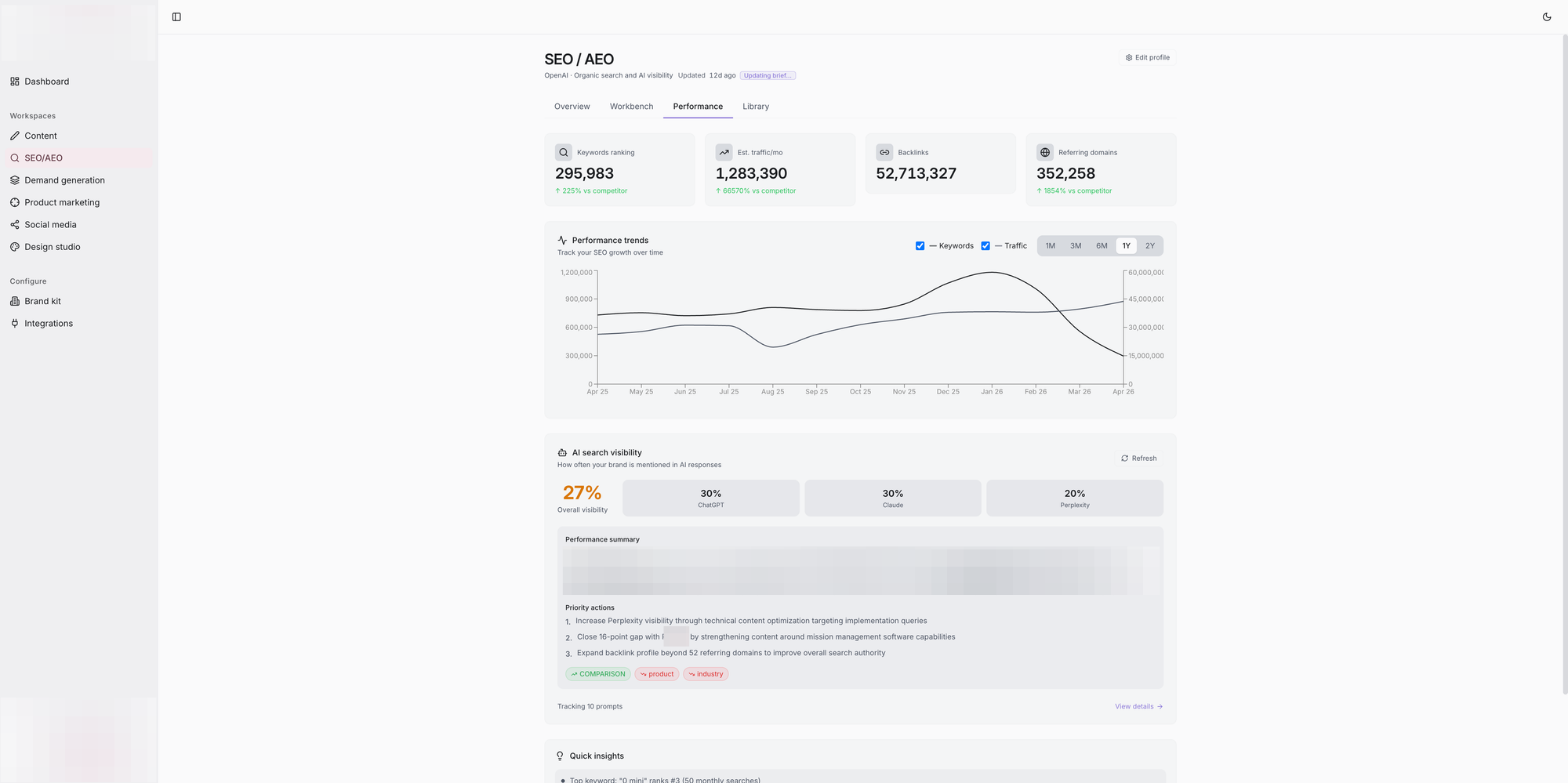
Tenet handles SEO and content strategy as a connected system rather than separate tasks. It researches keywords, builds content briefs, and produces optimized articles — then runs each piece through fact verification, originality checks, and quality scoring before publishing. It's also built for answer engine optimization (AEO) structuring content to perform in AI-generated search results, not just traditional rankings. For lean teams without a dedicated SEO specialist, Tenet handles the thinking and the execution together.
Best AI SEO and content strategy platforms
Google Performance Max is technically an AI advertising system rather than a standalone platform, but its automated asset generation, audience targeting, and cross-channel optimization across Google's inventory makes it central to any serious paid media strategy. The AI-driven bidding alone justifies its use.
The Trade Desk is the leading independent demand-side platform. Its AI for audience prediction, real-time bidding, and cross-channel attribution is well-developed and used by major brands for programmatic buying.
Albert AI is a fully autonomous digital advertising platform that manages paid campaigns across channels without requiring manual bidding decisions. It's polarizing: some teams love the autonomy, others find it too opaque.
Semrush has added substantial AI features to its already strong keyword research and content optimization tools. The AI writing assistant and content brief generation are practical additions to an already comprehensive SEO suite.
Surfer SEO focuses specifically on content optimization. It analyzes top-ranking pages and provides real-time guidance on structure, keyword usage, and content depth. Useful as a complement to a writing tool rather than a replacement for one.
Clearscope serves a similar function with stronger integrations for content teams already using Google Docs or WordPress.
BrightEdge is the enterprise SEO platform with the deepest AI-driven insights for large sites, including automated content recommendations, competitive share-of-voice tracking, and search performance forecasting.
Worth noting: Nearly 24% of marketers are already exploring SEO strategy updates specifically for generative AI search, and over 92% plan on or already use optimization for both traditional and AI-powered search engines. The SEO category is shifting fast.
Best AI email marketing platforms
Tenet is the strongest fit for lean B2B SaaS teams, SMBs, and solo marketers who need the output of a full marketing department without the headcount. Its AI marketing agent covers the entire function — strategy, SEO, content, demand gen, product marketing, and social — in one connected system. Where point tools hand you a blank page, Tenet researches, writes, scores, and verifies before you ever review, keeping work on-brand and ready to ship from day one.
Klaviyo leads eCommerce. Its behavioral triggers, predictive send-time optimization, and customer lifetime value modeling are the right combination for DTC brands.
ActiveCampaign is strong for B2B and service businesses, with solid automation workflows and AI features for contact scoring and segmentation.
Mailchimp has added AI content suggestions and subject line optimization. It's not the most powerful option, but its accessibility makes it a reasonable starting point for small teams.
Best AI analytics and insights platforms
Tenet is the go-to marketing intelligence layer for lean B2B SaaS and SMB teams, pulling SEO rankings, AI search visibility, competitor movements, and content performance into one place. Where Mixpanel tells you what users do inside your product, Tenet tells you what's working across your entire marketing function — and then acts on it, closing the loop between insight and execution without needing a separate analyst or agency.
Mixpanel and Amplitude are the leading product and user analytics platforms with AI-driven cohort analysis and retention insights. Essential for SaaS companies measuring activation and retention.
Tableau and Looker (Google) are the enterprise business intelligence platforms with growing AI features for automated insight discovery.
Triple Whale has become the eCommerce attribution standard, offering AI-driven multi-touch attribution when Meta and Google's own attribution numbers conflict (which they always do).
Best free AI marketing platforms and tools
Google Analytics 4 is free and includes AI-powered insights, anomaly detection, and predictive audiences. If you're not using it, start there.
Google Search Console is free and provides AI-backed search performance data that should inform any content strategy.
Meta Advantage+ is built into Meta's ad platform at no extra cost. It automates audience targeting, placement, and creative optimization for Facebook and Instagram campaigns.
Canva's AI features (free tier available) include text-to-image generation and design suggestions that are genuinely useful for social media content.
Worth upgrading to: full-stack AI marketing platforms
If the free tools above cover your data and creative basics, the next step is a platform that connects strategy to execution. Tenet is built for lean B2B SaaS teams and solo marketers who need the output of a full marketing department without the headcount — handling SEO, content, demand gen, product marketing, and social in one connected system, with every output researched, scored, and verified before you review it.
Top 3 AI marketing platforms: deep-dive comparison
#1: Tenet
- Best for: Solo marketers, small teams, and founders running marketing themselves — without the budget for an agency or the headcount for a marketing hire.
- AI features: Go-to-market strategy, brand voice learning, content production, SEO and AEO optimization, fact verification and quality scoring, social, demand gen, and design.
- Pricing: Designed for lean SMB budgets; no enterprise contracts or custom implementation required.
- Pros: Handles strategy and execution together, so you don't need marketing figured out before you start; learns your brand voice fast; produces verified, on-brand work across channels; replaces agency overhead at a fraction of the cost.
- Cons: Built for lean teams, not enterprise; not the right fit if you have a large in-house marketing function already.
- Verdict: The right choice for a business that needs a real marketing function but isn't ready — or doesn't want — to hire one. Where enterprise platforms assume marketing expertise exists, Tenet provides it.
#2: Salesforce marketing cloud with Einstein
- Best for: Enterprise organizations with complex customer journeys, large contact databases, and technical resources for implementation.
- AI Features: Einstein Send Time Optimization, Engagement Scoring, Einstein Recommendations, Predictive Audiences, Einstein Copy Insights.
- Pricing: Custom enterprise pricing; typically $1,250-$3,750+/month depending on edition and contacts.
- Pros: Most mature AI for email and journey optimization; deep data capabilities; integrates with Salesforce CRM and Service Cloud natively; extensive partner ecosystem.
- Cons: Complex to implement and maintain; expensive; requires technical resources or a Salesforce partner; steep learning curve.
- Verdict: The right choice for enterprise marketing teams with large contact volumes and the technical infrastructure to support it. Overkill for most mid-market companies.
#3: Klaviyo
- Best for: eCommerce brands (DTC and marketplace sellers) focused on email and SMS marketing with strong personalization needs.
- AI Features: Predictive analytics (CLV, churn risk, next purchase date), AI-powered segmentation, send-time optimization, product recommendations.
- Pricing: Free up to 250 contacts; scales based on contact volume. Around $45/month for 1,000 contacts, $700/month for 50,000 contacts.
- Pros: Purpose-built for eCommerce; predictive CLV and churn models are genuinely accurate; deep integrations with Shopify, WooCommerce, BigCommerce; accessible pricing for growing brands.
- Cons: Less suited for B2B or non-eCommerce use cases; SMS costs extra; limited in social and paid media features.
- Verdict: The clearest choice for eCommerce brands. Few platforms match its combination of email, SMS, and predictive analytics at this price point.
Head-to-head comparison table
Match your team and budget against what these actually cost.
 Tenet
TenetWhat is the best AI platform for marketing? how to choose
There's no universal answer, and any guide claiming otherwise is selling you something. The right platform depends on three variables: what marketing problems you're actually trying to solve, what data infrastructure you already have, and what your team can realistically operate.
4 key criteria to evaluate any AI marketing platform
- Data integration: Does the platform connect with your CRM, eCommerce system, and ad platforms? AI quality degrades significantly when it's working with incomplete data, and incomplete data is what you get when systems don't talk to each other. GWI's team emphasizes this directly: "For bigger organizations, integration capabilities are a must."
- AI transparency: Can you see why the platform is making a recommendation? Black-box AI is dangerous in marketing. If you can't understand why a segment was created or why a campaign was paused, you can't debug it or improve it.
- Use-case specificity: Broad platforms that do everything often do nothing exceptionally well. If your primary need is email personalization, a platform built specifically for that will usually outperform a generic suite.
- Data governance and compliance: If the platform handles customer data, it must comply with GDPR, CCPA, and whatever regulations apply to your industry. This isn't optional, and it's worth verifying rather than assuming.
Questions to ask before you commit
Before signing any contract, get specific answers to these:
- What data does the AI actually need to generate useful predictions, and do we have it?
- Can you show us a case study from a company our size, in our industry?
- What does implementation actually take (weeks, months, dedicated internal resources)?
- If we want to leave, how do we export our data and what happens to our models?
- What does your AI do when data is sparse or incomplete?
The last question is particularly revealing. Platforms that have good answers tend to be honest about their capabilities. Those that dodge it often overpromise.
Pricing models explained
Most AI marketing platforms use one of three pricing structures. Subscription-based pricing (fixed monthly fee regardless of usage) is predictable but can become expensive if you scale usage. Usage-based pricing (pay per email sent, per prediction generated, per API call) keeps costs aligned with actual use but can surprise you. Enterprise tiers (custom pricing based on contacts, features, and support level) are the norm for platforms like Salesforce and Adobe.
For most mid-market teams, a subscription-based platform with contact-volume scaling models may be more cost-efficient.
How to get started with AI marketing: a step-by-step guide
Step 1: Audit your current stack and identify the real gaps
Before you add any new tool, map what you already have. List every platform in your current stack, what it does, and whether it's actually being used. You'd be surprised how many teams are already paying for AI features they haven't activated.
Then identify your three biggest marketing bottlenecks. Not goals, bottlenecks. Things that are slowing you down or costing you conversions today. Poor email open rates? High cost per lead? No time for testing? Your AI use case should solve one of those specific problems.
Step 2: Define specific goals and kpis
Vague goals produce vague results. "Improve our marketing with AI" is not a goal. "Use AI send-time optimization to increase email open rates by 15% in 90 days" is a goal. The difference matters because it determines what success looks like, which determines whether your AI investment was worth it.
For each use case you're considering, write down: what's the current baseline metric, what improvement would you need to see in what timeframe to justify the cost, and how will you measure it?
Step 3: Fix your data before you buy the platform
This is the step most teams skip, and it's the reason most AI marketing implementations underperform. AI platforms need clean, complete, consistently formatted data. Duplicate contacts, missing attribution, broken event tracking, and inconsistent IDs all degrade AI output quality.
Run a one-time data audit before activating any AI features. Identify your most common data quality issues and fix the top three. Then build a minimal customer profile that every system shares: unique ID, email, key behavioral events, last activity date, and revenue contribution.
Step 4: Set up your first AI-powered campaign as a controlled pilot
Resist the urge to deploy AI everywhere at once. Pick one use case, run a controlled pilot with a representative sample, and compare results against your existing baseline.
A good 60-day pilot structure: define the hypothesis, split your audience into a test group (AI-driven) and a control group (existing approach), set a predefined decision rule (if open rate increases by 10% with statistical significance, expand), and measure. This approach gives you real evidence instead of gut feeling.
Step 5: Train your team and build human-in-the-loop workflows
Decide explicitly what AI is allowed to do autonomously and what requires human review. A useful framework: AI handles drafts, variations, scheduling recommendations, and testing; humans review any content before it goes live, make final decisions on budget allocation, and own all brand-critical creative work.
Document this. Teams that write down their AI governance policies deploy more confidently and make better decisions about when to override the system.
Step 6: Measure, learn, and expand methodically
After your pilot, run a proper retrospective. What did the AI actually improve? What didn't work and why? What data quality issues did you discover? Use those answers to refine your approach before expanding to additional use cases.
Research shows that 97% of marketers say AI has affected their work. The teams getting the most value are those treating AI adoption as an ongoing process of iteration, not a one-time implementation.
AI marketing platform uses cases by channel and industry
AI for content marketing and SEO
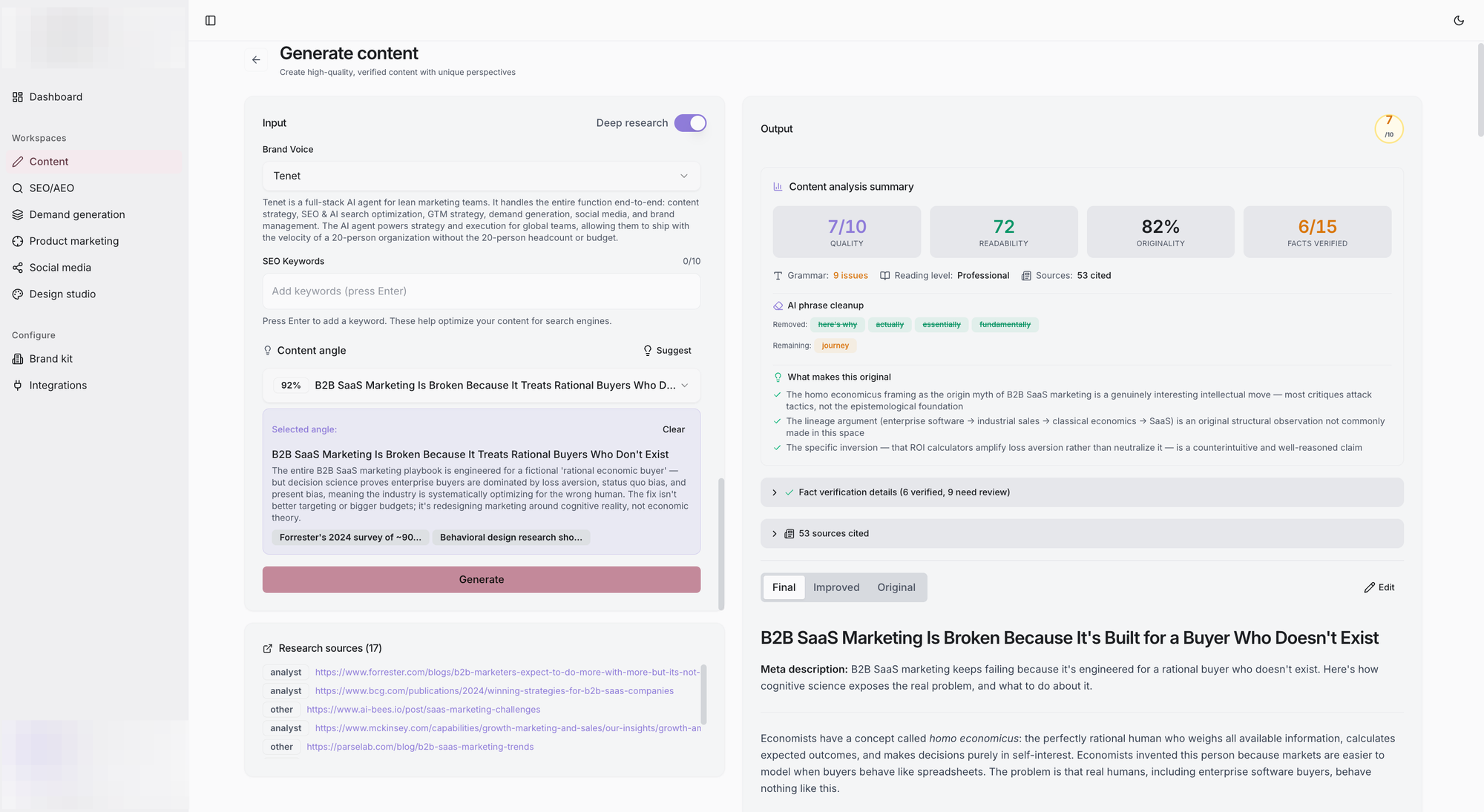
AI's role in content marketing has moved well beyond "write me a blog post." The sophisticated use cases are around strategy and optimization: using AI to identify content gaps in your category, cluster keywords by topic and intent, generate content briefs that ensure consistency across writers, and analyze which published content is driving conversions versus just traffic.
Data shows 80% of marketers now use AI for content creation. The teams getting the best results aren't replacing their writers; they're using AI to give writers better raw material to work from and to scale production without scaling headcount.
For SEO specifically, the emerging challenge is optimizing for AI-powered search engines, not just traditional search. The content strategies that perform well in AI search tend to favor clear, authoritative, well-sourced answers over SEO-optimized thin content. That's actually good news for brands willing to invest in substance.
AI for paid advertising
Paid media is where AI has had the longest deployment history and the most measurable results. Google's Smart Bidding, Meta's Advantage+ campaigns, and programmatic platforms like The Trade Desk have been using ML for auction bidding for years. The newer development is AI-generated creative at scale.
IBM's partnership with Adobe to generate 200+ original images and 1,000+ variations for a single ad campaign illustrates the direction of the category. Creative testing velocity, once limited by production cost and time, is now limited primarily by your ability to generate and evaluate creative concepts.
The practical implication: performance marketing teams that manually manage creative testing are at a structural disadvantage against teams using AI for variation generation and automated winner selection.
But there's a catch most coverage glosses over.
The AI running your paid campaigns is a black box. Google Performance Max and Meta Advantage+ optimize on your behalf — impressions climb, spend accelerates — and when something underperforms, the algorithm doesn't explain itself. You can't see which audiences it chose, why it pulled back on a placement, or what creative signal it was optimising toward. You just see the outcome.
This is where the smartest lean teams are finding an edge: pairing black-box paid AI with transparent AI on the strategy and content side. Tools like Tenet handle the upstream work — positioning, messaging, creative briefs, ad copy — with full visibility into the reasoning, so you're feeding the paid algorithm with high-quality, strategically grounded inputs rather than hoping the machine figures it out from scratch.
The teams that win aren't just running AI ads. They're running AI ads built on AI-powered strategy where a human stays in the loop on why decisions are being made — not just what the outputs are.
AI for email and marketing automation
Email is probably the highest-ROI application for AI in most companies' existing stacks, because the data is already there. Behavioral data, purchase history, engagement patterns, and lifecycle stage are all captured in your ESP and CRM. AI can turn those signals into accurate predictions about who to message, with what content, and when.
The most impactful capabilities in practice: send-time optimization (typically 10-20% open rate lift), churn prediction (allowing proactive re-engagement before customers lapse), and predictive product recommendations (proven to increase average order value in eCommerce).
AI for customer segmentation and personalization
According to McKinsey’s research, 71% of marketers say AI plays a role in delivering personalized customer experiences. The companies doing this best are treating personalization as infrastructure, not a campaign tactic.
Starbucks is the canonical example: using purchase history, location, and time of day to send personalized offers to nearly 35 million mobile app users. Verizon went further, enabling real-time personalization so that when a customer walked into a store, the staff could see tailored promotions relevant to that specific customer's history.
These aren't experimental projects. They're core business operations built on AI marketing platforms.
Industry-specific applications
eCommerce: Predictive CLV modeling, cart abandonment recovery, product recommendation engines, and AI-driven inventory-based promotions. Klaviyo and Triple Whale are central to the modern DTC stack.
SaaS: Behavioral lead scoring, product-usage-triggered campaigns, churn prediction based on feature adoption patterns, and AI-written onboarding sequences. For lean B2B SaaS teams — the one-person marketing departments and founder-led GTM motions — platforms like Tenet are built specifically for this segment: running end-to-end strategy, content, SEO, and demand gen without requiring a full team to operate.
Healthcare: AI-driven patient communication (appointment reminders, follow-up sequences), content personalization for different patient populations, and compliance-aware campaign management.
Finance: AI for hyper-targeted financial product recommendations, fraud signal detection in marketing data, and compliant automated outreach. Heavy regulatory constraints apply; platform governance features matter more here than in other industries.
Agencies: AI platforms that enable agencies to serve more clients without proportionally growing headcount. Tenet fits this model well — agencies use it to run full-stack marketing execution (briefs, SEO content, demand gen, battlecards, social) across multiple client accounts from a single platform, without needing to hire specialists for each function.
Free AI marketing platforms: what you can get without paying
What free tools actually cover
Free AI marketing tools are more capable than most people assume. Google Analytics 4, Google Search Console, and Meta's Advantage+ system are free and collectively give you AI-powered analytics, search performance data, and paid social optimization without spending a dollar on software.
For content, ChatGPT's free tier is a real productivity tool for drafting, brainstorming, and research. Canva's free tier includes AI image generation and design suggestions.
Where most lean teams struggle isn't access to free tools — it's knowing what to do with the data those tools surface. That's where a platform like Tenet earns its place early: it sits on top of your existing stack, pulls in signals from GA4 and Search Console, and turns raw performance data into a prioritized marketing plan — so you're not just collecting data, you're acting on it.
Where free plans fall short
The consistent limitations of free plans are volume, automation depth, and analytics sophistication. Free email tools cap contacts. Free content tools limit generation volume. Free analytics tools lack predictive features. If you're running a meaningful marketing operation, you'll hit those limits fairly quickly.
The gap isn't just feature access — it's execution bandwidth. A solo marketer or founder using only free tools can draft content and check rankings, but they can't run a coordinated strategy across SEO, demand gen, product marketing, and social simultaneously. That coordination layer is what purpose-built platforms provide.
The upgrade decision
The upgrade decision becomes straightforward when you can measure the output of the paid features against their cost. If send-time optimization in Klaviyo's paid tier produces a 15% open rate lift on a list of 50,000 contacts and each percentage point of lift is worth $2,000 in revenue, the math is obvious.
The same logic applies to your marketing operations layer. When the cost of stitching together free tools — in time, inconsistency, and missed execution — exceeds the cost of a platform that handles strategy and execution end-to-end, the upgrade pays for itself. For lean teams running on ChatGPT, GA4, and Canva, Tenet is typically where that inflection point lands: it replaces the coordination overhead without replacing the free tools that are already working.
AI marketing platform integrations and tech stack compatibility
Why integration matters more than features
A feature-rich AI marketing platform that doesn't integrate with your CRM, eCommerce system, or ad platforms is worth significantly less than a simpler platform that does. The reason is data flow. AI predictions are only as good as the data they see, and if that data lives in siloed systems that don't communicate, the AI is working with an incomplete picture.
The practical test for any platform you're evaluating: can it natively connect to your CRM, your eCommerce platform, your analytics system, and your primary ad channels? If the answer requires custom API work for more than one of those, factor the engineering cost into your total cost of ownership calculation.
CRM integrations
Most major AI marketing platforms have native integrations with both. For less common CRMs (Zoho, Pipedrive, Microsoft Dynamics), verify integration depth before committing; native integrations typically sync in real time, while third-party connectors often have data lag.
Ad platform connections
For paid media, you need direct connections to Google Ads, Meta Ads Manager, and increasingly LinkedIn and TikTok. Platforms like Smartly.io and The Trade Desk have deep, real-time connections built specifically for ad optimization. General marketing platforms often have shallower integrations that support reporting but not optimization.
Building a connected ai marketing ecosystem
A practical framework for thinking about your stack in layers:
Here's how data actually moves through a working AI marketing stack.
the most resilient stacks are the ones where each layer has a clear owner and the connections between layers hold.
- Data and identity layer: CRM, CDP, or data warehouse (where the single customer record lives)
- Execution layer: Email platform, SMS platform, ad management tools
- Intelligence layer: AI predictions, recommendations, scoring
- Reporting layer: Analytics and attribution
The most resilient stacks are those where each layer has a clear owner and the connections between layers are reliable. Tools that try to own all four layers often do none of them as well as specialized tools.
The future of AI marketing platforms: trends to watch
Autonomous AI marketing agents
The most significant near-term shift is the move from AI tools that assist marketers to AI agents that operate independently. Rather than generating a subject line suggestion for a human to approve, an agent might identify an underperforming campaign, generate test variants, run the test, declare a winner, and update the campaign, all without human intervention.
This is already happening at the edges. The practical question for marketing teams isn't whether this technology will arrive; it's how to build governance systems that let agents operate autonomously on low-stakes decisions while flagging high-stakes ones for human review.
Hyper-personalization at scale
The gap between "personalization" (inserting a first name) and genuine hyper-personalization (delivering meaningfully different experiences based on real-time behavioral context) is closing. Verizon's real-time in-store personalization is the direction the category is moving. Within two to three years, real-time personalization will be expected rather than exceptional.
Multimodal AI: text, image, video, and audio in one platform
The Adobe Firefly + IBM case study (200+ images, 1,000+ variations for one campaign) is a preview. eToro is already using AI video generation for advertising campaigns. The trajectory is toward platforms that can produce an entire campaign asset set, text, images, video, and audio, from a single brief, at production quality.
The implication for marketers: creative production workflows built around human-only creation will become a bottleneck. Teams that integrate AI into their creative process early will have a structural production advantage.
Ethical AI marketing: the constraint that gets more important
Consumer comfort with brand AI usage fell from 57% to 46% in a single year. That number will either stabilize (if brands build trust through transparency) or continue declining (if brands treat customer data carelessly). The brands that win long-term will be those that use AI to genuinely serve customers better, not just to optimize for short-term conversion metrics. Transparency about how AI is used in personalization and content will become a differentiator rather than a PR afterthought.
TenetWork with Tenet
If your challenge isn't just choosing the right AI marketing platform — but actually building the strategy, running the campaigns, and getting real results from it week over week — that's exactly what Tenet is built for.
 Anjana Vasan
Tenet Operator is the done-for-you tier: you get the AI agent plus one dedicated Marketing Operator who owns your marketing and runs it for you, every week. They keep the engine moving, report back on what's working, and handle everything from content and SEO to campaigns and distribution — all inside your own account, where you can see it any time. Because Tenet does the heavy lifting underneath, a single Operator can do what normally takes a whole team.
If you ever leave, you take a fully working marketing setup with you. Not a folder of PDFs.The AI marketing platform category is real, mature, and producing measurable results — for the companies using it correctly.
But the platforms are still just tools. They amplify good strategy and clean data; they don't replace them. The teams winning with AI marketing in 2026 aren't the ones with the biggest tool stacks. They're the ones who identified specific problems worth solving, chose platforms that actually solve them, built the data infrastructure to support them, and kept human judgment in the loop for when the machine gets it wrong.
That's harder than it sounds. Most companies either underinvest in the foundation or overbuild the stack and wonder why nothing's compounding.
The approach that actually works is simple to say and harder to do: start narrow, measure what matters, expand once you've proven it. If you want that engine running without having to build and manage it yourself, Tenet Operator exists for exactly that reason — one person, one platform, your marketing running every week.