


TL;DR
- A complete marketing function in 2026 covers seven distinct disciplines: brand, content, SEO and AI search, demand generation, social, product marketing, and analytics. Most lean teams own all seven — and 83% of marketers report burnout, the highest rate of any corporate function.
- The math doesn't work without the right technology. Done manually, the seven functions consume 60–80 hours per week. McKinsey estimates that agentic AI workflows will accelerate marketing campaign creation and execution by 10 to 15 times, which is the only realistic path to running the full function with one or two people.
- AI marketing agents are different from general conversational AI tools. An agent reasons across your brand context, plans multi-step workflows, and executes them end to end — running keyword research, building campaigns, optimizing landing pages, and reporting on what worked. A conversational tool answers whatever you ask it in the moment.
- The difference is architectural: agents operate on goals and adapt their steps, while conversational tools operate on instructions and stop when the reply is done.
- The right framework for building a powerful marketing function has three phases. Foundation first: brand positioning, ICP definition, and your keyword universe. Technology second: the stack that produce work repeatedly, like your content engine, demand gen channels, and social presence. Execution third: shipping consistently against both, at scale.
- Your job in 2026 is not to execute everything — it's to direct. Think CMO, not coordinator. So AI handles roughly 70% of the workflow, while you own strategy, judgment, and final approval.
- Tenet is built specifically for this problem: an AI marketing agent that handles your entire marketing function based on your brand, so a lean team of one or two can ship like a team of twenty.
The two-pizza marketing team is finally real
Jeff Bezos once coined a management principle called the two-pizza rule: if a team can't be fed by two pizzas, it's too big. Smaller teams move faster, communicate better, and ship without the drag of consensus-building. Most marketing leaders nod along to this in theory and then immediately start headcount planning for a team of twelve.
The irony is that the two-pizza marketing team has never been more achievable than it is now — and most companies are still building like it's 2018.
Conventional wisdom says you need specialists:
- A content writer
- An SEO person
- Someone for paid
- A demand gen manager
- A social media coordinator
- A brand strategist
- Maybe a designer.
By the time you've assembled the org chart, you've hired eight people to produce work that could, with the right operational setup, be done by one or two.
Here's the specific claim worth making:
A solo marketer or two-person team running on the right system can match the output and strategic quality of a five-to-ten person marketing organization. Not by working 80-hour weeks. Not by cutting corners. By being clear-eyed about which parts of marketing require human judgment and letting everything else run on automation.
This is the operating model recently funded SaaS companies are using to build marketing functions before they hire. It's also the model that turns headcount into a strategic choice instead of a default.
This article is the playbook.
What "running a full marketing function" means
Most people underestimate the scope. When someone says "marketing," they picture content and maybe some ads. The modern marketing function is seven distinct disciplines, each with its own strategy, execution cadence, and set of outputs. Here's what you own as a marketing team of one.
1. Brand management
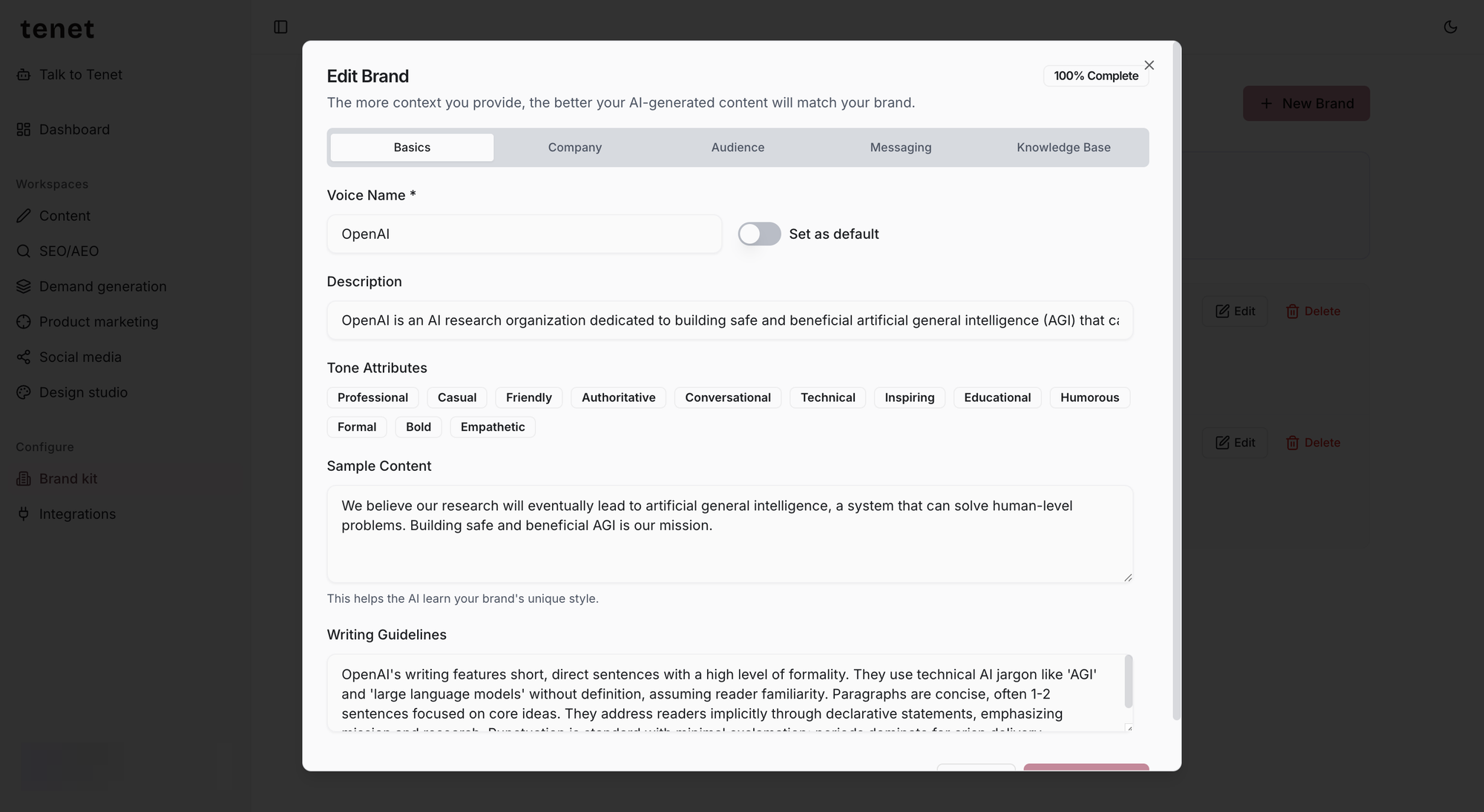
Your positioning, your voice, your visual identity, and your competitive differentiation. It means defining what your company stands for, how you sound, who you're for, and why someone should choose you over everyone else.
Without a documented brand foundation, every piece of content you produce is a coin flip — sometimes on-message, sometimes not. Brand management is the function that makes everything else coherent.
2. Content marketing
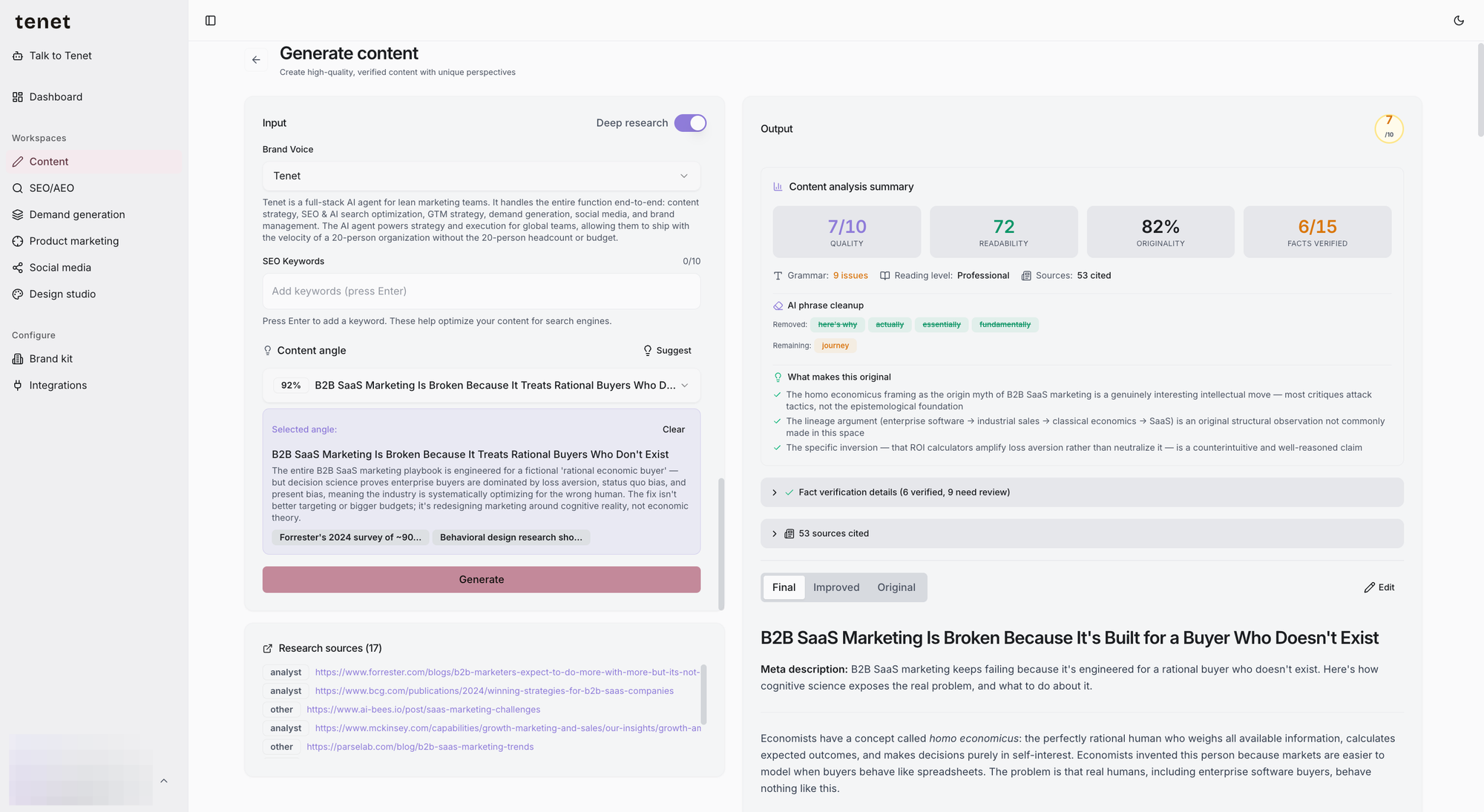
Strategy, creation, distribution, and repurposing across every channel. Blog posts, emails, landing pages, case studies, video scripts, webinar content.
For startups, content marketing is the core of how you build organic authority, educate your ICP, and generate inbound demand over time. It's also the function that tends to collapse first under the weight of everything else, because it's time-intensive and the results compound slowly.
3. SEO and AI search optimization
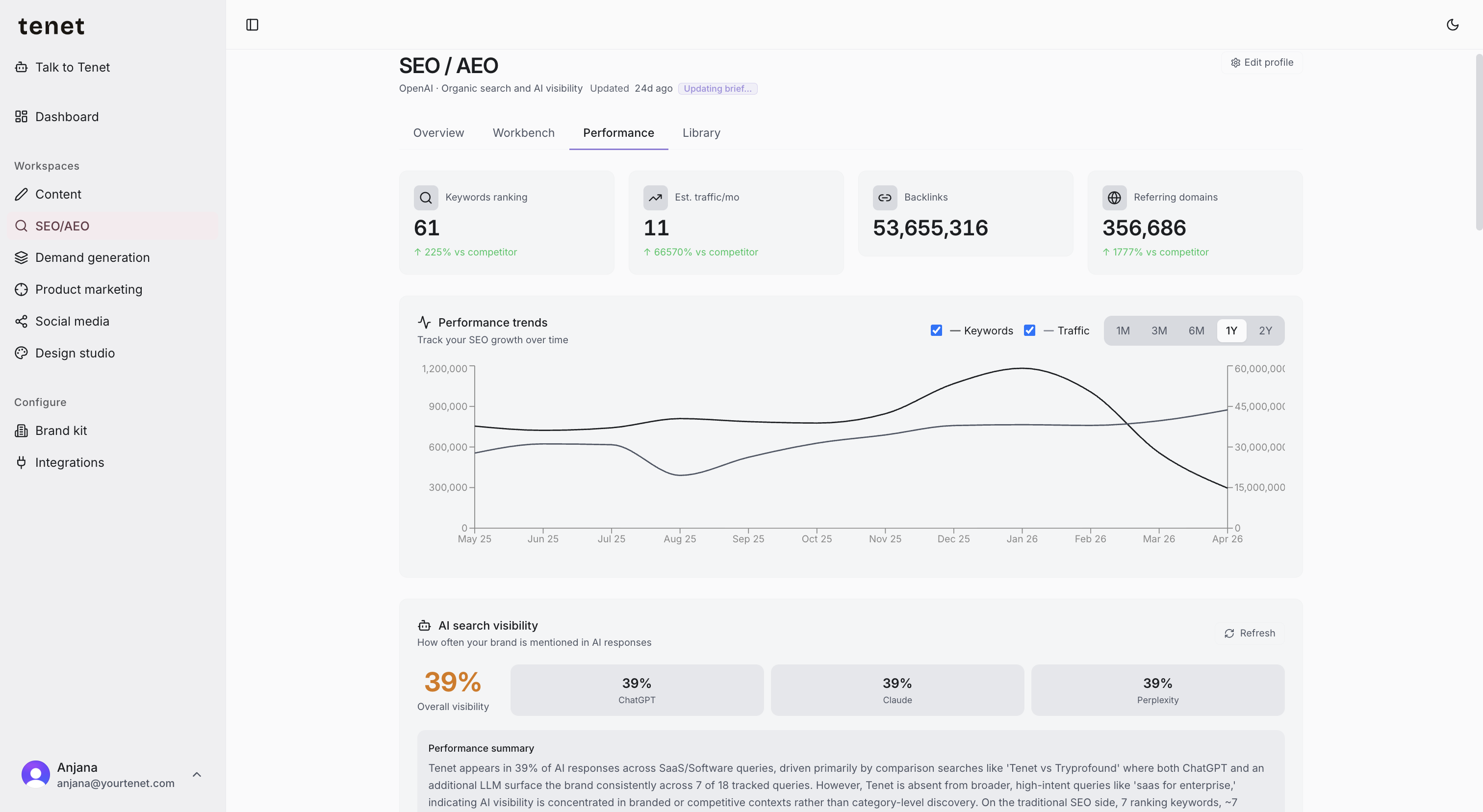
Keyword research, on-page optimization, technical audits, and — increasingly in 2026 — AI engine optimization (AEO). Being visible not just on Google but on AI search platforms like Perplexity, ChatGPT, and Google's AI Overviews, which are now routing a meaningful share of buying-stage queries.
According to a Branch enterprise survey, 89% of enterprise leaders say AI-powered search and LLM platforms improved marketing performance in 2025, and 87% expect those platforms to directly close sales within the next 12 months. AI search optimization is no longer optional.
4. Demand generation
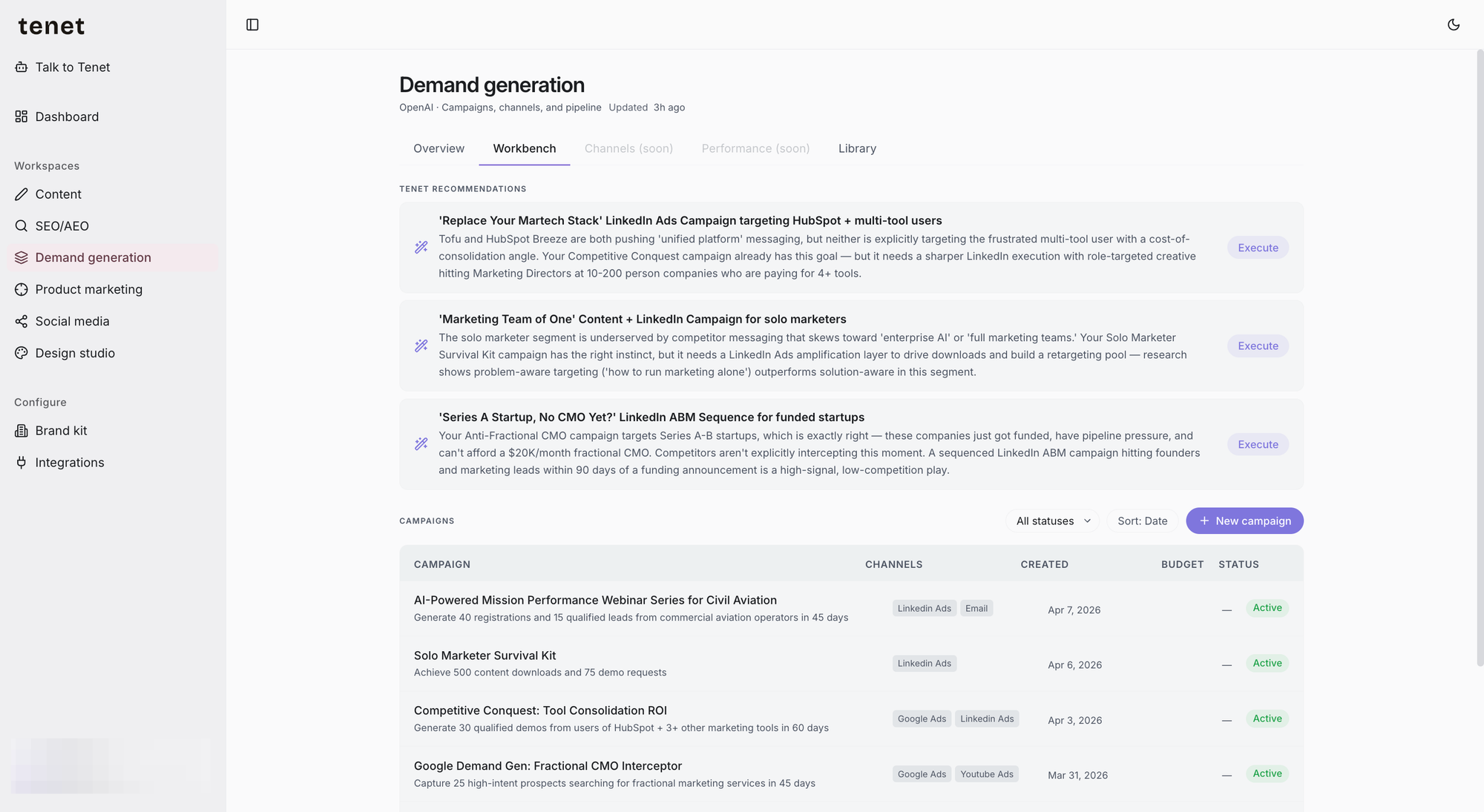
This is pipeline. Lead nurturing sequences, email automation, paid media across LinkedIn, Google, and Meta, conversion rate optimization, and the ability to show your CEO a number called "marketing-sourced pipeline."
Demand gen is often the most neglected function on lean teams because it requires the most coordination — between channels, between marketing and sales, and between short-term spend and long-term results.
5. Social media
Organic social presence, platform-specific strategy, community engagement, and a content calendar that doesn't run out every three weeks.
This function is deceptively time-consuming — you're not just posting, you're building an audience that trusts you, and that requires consistency and channel-native content, not repurposed blog excerpts.
6. Product marketing
ICP research, competitive battlecards, positioning documents, GTM strategies, sales one-pagers, objection guides, and demo scripts. Product marketing is the connective tissue between your product and your market.
Without it, your sales team is winging it, your messaging is generic, and you're running campaigns against the wrong audience.
7. Analytics and reporting
Tracking what's working, understanding why, and iterating fast. Core traffic and engagement metrics, pipeline contribution, SEO rankings, paid media performance, and the weekly or monthly report that keeps leadership aligned. Analytics is what separates marketing that compounds from marketing that spins its wheels.
Seven workstreams; each one with genuine consequences if you ignore it.
The math problem every lean team faces
Done manually across all seven functions at a quality level that moves the needle, the honest answer is 60–80 hours per week.
Stack up what each function actually costs in hours, and the 60-to-80-hour week explains itself.
- Content creation alone (writing, editing, formatting, publishing) averages 5 hours per week for a single marketer producing baseline output.
- SEO work easily consumes another 8–10 hours when done properly.
- Demand gen adds another 10–12.
- Social with any real intentionality runs 6–8.
- Product marketing assets don't get built in an afternoon; a solid battlecard or positioning doc takes 4–6 hours of focused work.
- Analytics and reporting: 3–4 hours per week minimum.
Add brand management on top — the positioning conversations, the content reviews, the consistency audits — and you're well past 50 hours per week before you've attended a single meeting.
The consequences are well-documented: solo marketing roles "rely on unsustainable workloads that result in burnout and decreased productivity." Gallup data on solopreneurs puts the burnout-from-overload risk at 72%.
Seven functions multiplied by real time requirements equals a workload that exceeds what one person can execute manually at any meaningful quality level.
Something always gets dropped. Either you post inconsistently on social, or SEO slips to "I'll get to it next month," or your nurture sequences never get built, or analytics stays a spreadsheet you update quarterly. Every trade-off has a cost — in pipeline, in organic traffic, in brand consistency, in competitive positioning.
This is the core problem Tenet was built to solve. Not by making you faster at execution, but by changing the model entirely.
How AI agents are changing the equation
There's an important distinction that gets lost in the noise around AI tools right now: the difference between an AI writing assistant and an AI marketing agent.
An AI writing assistant generates content when you prompt it. You ask, it answers. You copy, paste, edit, publish. The tool doesn't know your brand, doesn't hold context between sessions, doesn't connect to your analytics, and doesn't build strategy. It's a faster keyboard.
An AI marketing agent works differently. It reasons, plans, and executes multi-step workflows. It holds your brand context persistently — your voice, your ICP, your competitors, your positioning — and applies it across every function.
It doesn't just write a blog post. It researches the topic, identifies the angle most likely to rank and resonate with your audience, drafts in your voice, optimizes for both Google and AI search, and connects the output to your broader content strategy.
The economic case is significant
McKinsey's research on agentic marketing workflows estimates that agentic systems will accelerate the creation and execution of marketing campaigns by 10 to 15 times, with organizations seeing 10–30% revenue growth from hyperpersonalized marketing enabled by agents. The same research describes the operating model directly: "one marketing professional can supervise a team of agents, potentially driving growth, boosting productivity, and freeing human colleagues to focus on higher-level tasks like creativity and strategy."
Salesforce's State of Marketing 2026 report shows 87% of marketers now using generative AI in at least one workflow, up from 51% in 2024. According to the same dataset, the average marketer recovers 6.1 hours per week using AI tools, with senior practitioners saving 8–10..
The shift is from "using AI tools" to "running an AI-powered marketing function." One is a productivity hack. The other is a structural advantage — and the gap between teams that have made the shift and teams that haven't is widening fast.
The honest case for AI-powered execution (and where it falls short)
The skeptics aren't entirely wrong, so it's worth taking them seriously.
The critique usually sounds like this: AI can't build trust. It can't read the room in a sales conversation. It can't develop the kind of deep customer relationship that drives referrals. All true — and none of that is what you should be automating.
AI marketing agents handle the execution layer well
research synthesis, first drafts, content reformatting across channels, keyword clustering, performance monitoring, A/B variant generation, consistency enforcement. What they don't replace is your strategic judgment, your read on customer sentiment, and the human moments that create genuine brand loyalty.
The real failure mode for solo marketing isn't that the model can't work. It's that most people set it up badly.
They stitch together disconnected point solutions: one tool for content, another for SEO, a third for social scheduling, a spreadsheet for analytics, a Zapier flow holding it all together.
The cognitive overhead of managing all that eats up whatever efficiency they gained. The teams that make lean marketing actually work are running a unified system where strategy, creation, optimization, and distribution all connect.
That's what Tenet is built to do
Tenet is an AI marketing agent — not a bundle of features, but a single system that carries strategy through to execution across every function. It learns your brand voice, creates a strategy based on your ICP, drafts content, optimizes for both traditional SEO and AI search citation, and tracks performance over time. Roughly 70% of your workflows run autonomously, so your working hours go toward the 30% that benefits from a human in the chair.
A function-by-function playbook for the team of one
Here's how to run each of the seven functions at a high level with a lean team — what's minimum viable, what to automate, what to keep in human hands, and how Tenet handles each one.
Brand management
Content marketing
SEO and AI search optimization
Demand generation
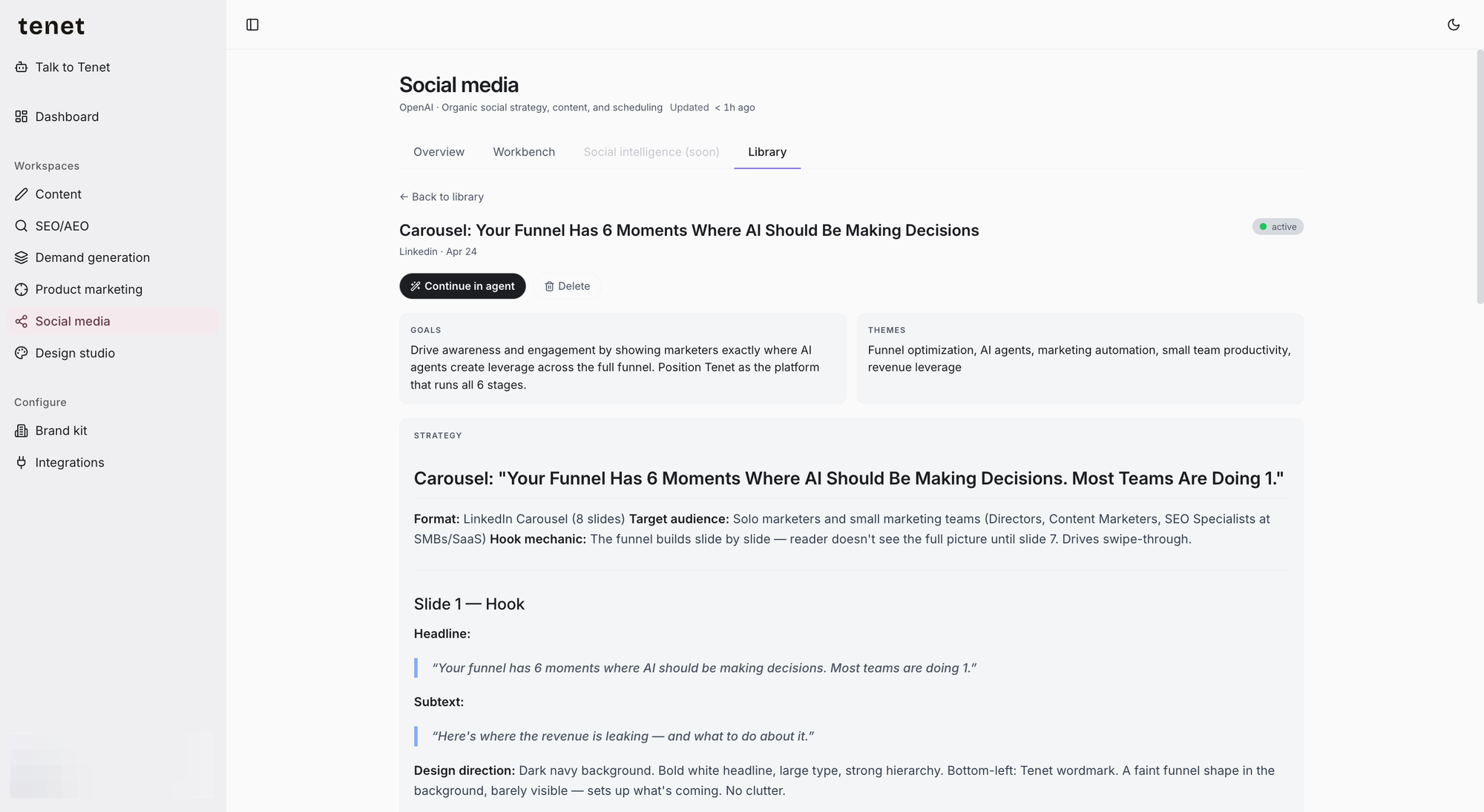
Social media
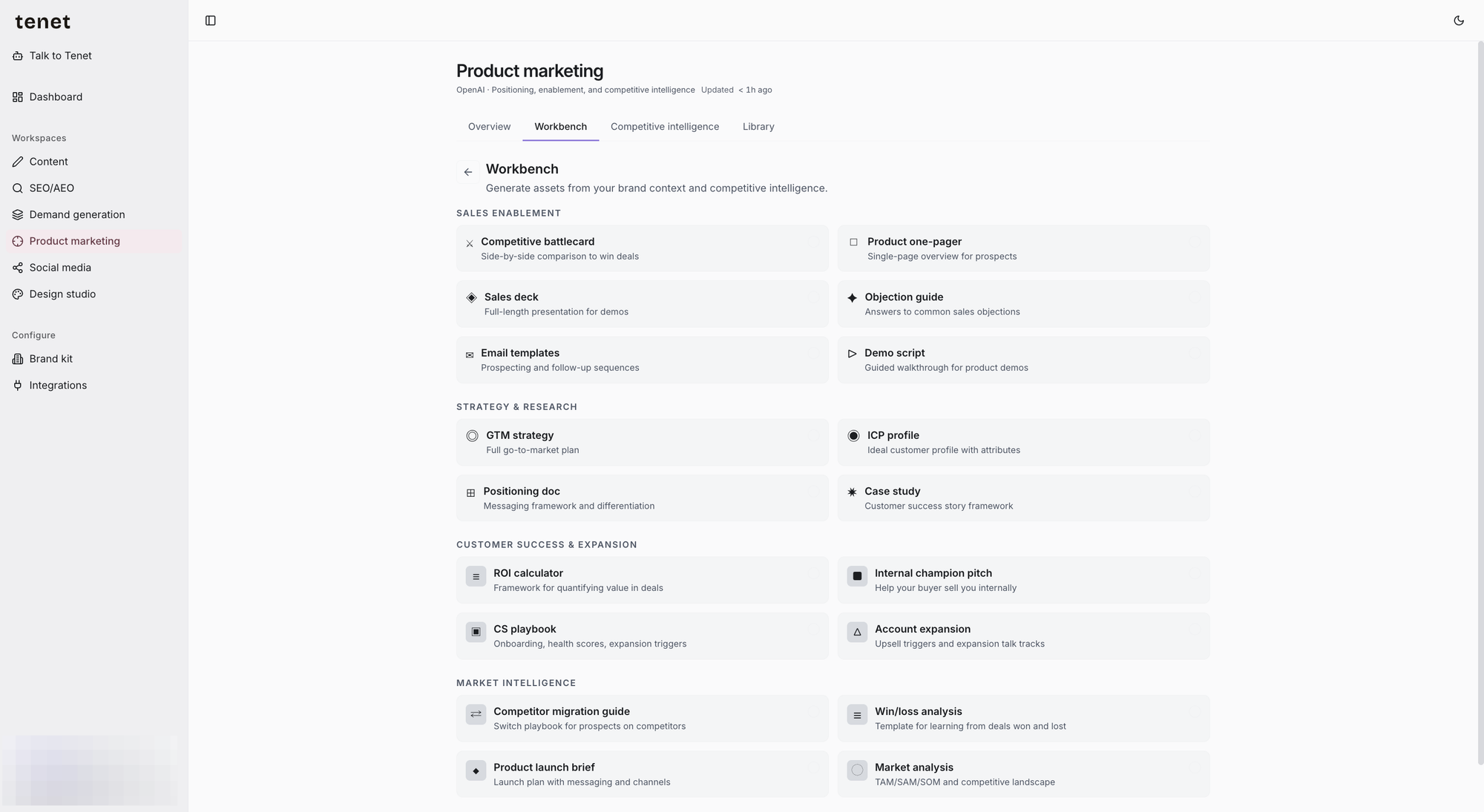
Product marketing
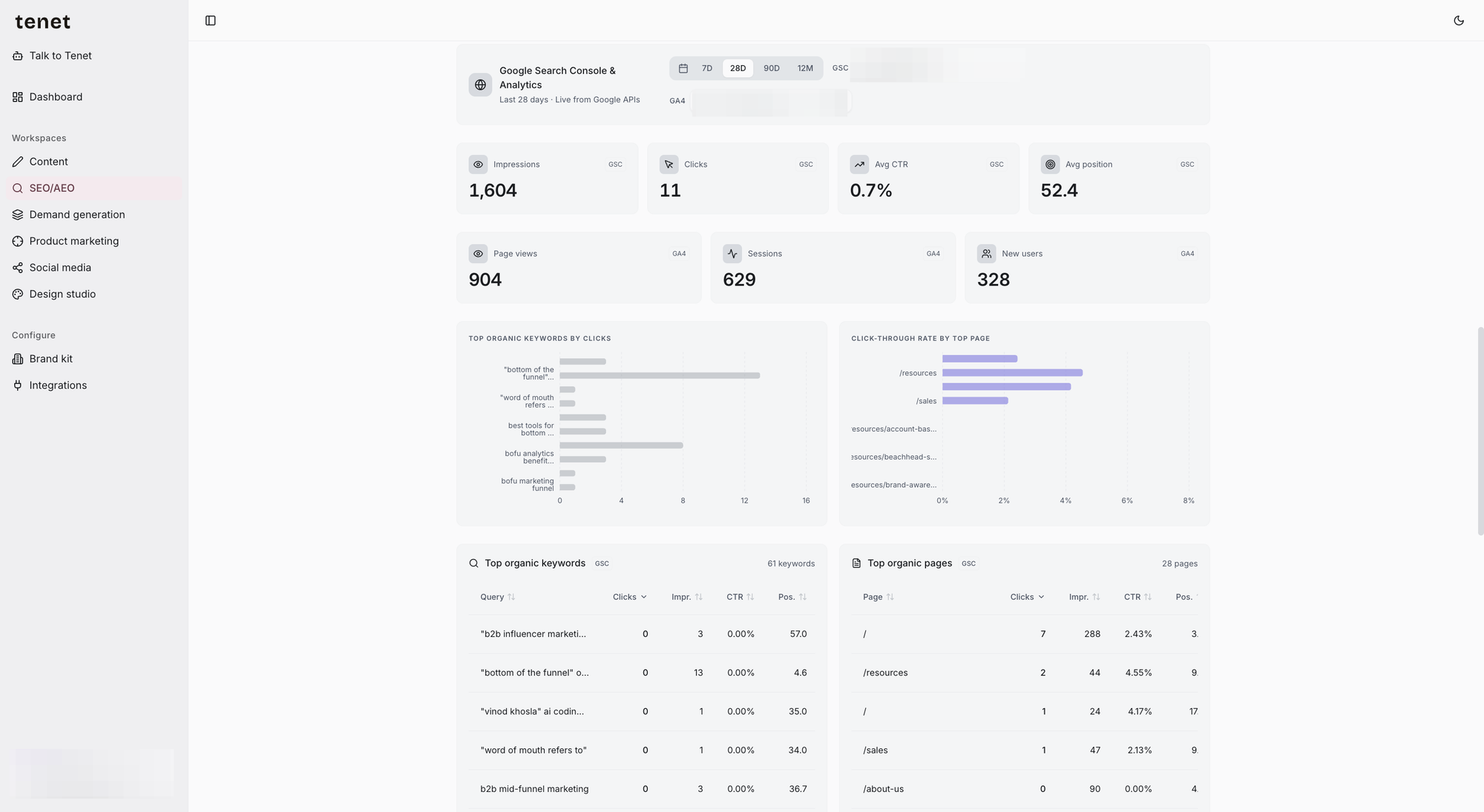
Analytics and reporting
How traditional search and AI citation are different problems
One of the structural changes a lean marketing team has to absorb in 2026 is that search is now two distinct disciplines, not one. Optimizing for Google blue links and optimizing for AI citation are different problems with different signals.
Two different games are being played on the same page — here's what each one actually rewards.
traditional search and ai citation reward different things on the same page.
Practically, this means your content program needs two tracks running in parallel.
For AI citation specifically, what matters is:
- Placing definitive, sourced answers in the first 20% of your content
- Earning mentions in publications that AI engines already trust
- Building a consistent authority signal across multiple domains.
- Pages that lead with a one-paragraph direct answer followed by supporting detail are cited 2.1x more often than pages with meandering leads. Use of structured data, named entities, and first-party data increases citation rates by a combined 2.6x in controlled AEO studies.
For a solo marketer, this would take weeks to operationalize manually. Configured as a workflow inside Tenet, it runs continuously — without you having to remember it.
The prioritization framework: what to do first, second, and third
If you're joining a new company or building marketing from scratch, the biggest mistake is trying to do everything at once. Here's a three-phase framework that sequences the work correctly.
The three phases only work in this order — watch what happens if you try to skip ahead.
the phases only work in order — jump to execution before foundation is set and you end up rebuilding later.
Phase 1 — Foundation (weeks 1–2)
Before you write a single blog post or run a single ad, lock down the foundation: brand voice and positioning, ICP definition, competitive mapping, and your keyword universe.
These decisions shape every output that follows. Skipping this phase means rebuilding later. Tenet's brand setup compresses this from weeks to hours — ingesting your inputs and producing a documented foundation you can start applying immediately.
Phase 2 — Infrastructure (month 1)
With the foundation set, build the infrastructure: your content strategy with an editorial calendar, your demand gen channels live with tracking in place, and your social presence established on your primary channels. The goal of this phase isn't output. It's systems. You're building the machinery that will produce results in phase 3.
Phase 3 — Execution at scale (months 2–3)
Now you execute consistently. Publishing cadence holds, SEO starts compounding, demand gen campaigns are optimized based on real data, and AI search visibility builds as your content accumulates citations. Realistic phase 3 goal: meaningful organic traffic growth within the first quarter — achievable when the foundation and infrastructure are right.
The mindset shift: Operate like a CMO, not a coordinator
The most important skill for a solo marketer in 2026 isn't writing speed, or SEO expertise, or knowing every ad platform. It's knowing what to direct.
A CMO doesn't write every email — they set the strategy, define the standards, and review the outputs. The execution happens around them. When AI automates the bulk of the marketing workflow, your job description changes. You're not the person who does the marketing. You're the person who runs the marketing function.
That's a different skill set and a different mindset. It means spending more time on the questions that require human judgment — what story are we telling this quarter, what's our competitive angle, where is the market going — and less time on tasks that just require hands.
The solo marketers who thrive in this model make this shift early. The ones who stay stuck in task-switching mode — writing posts, pulling reports, building briefs, back to writing posts — never get the altitude to see the function clearly.
Direct. Don't just do.
What you still have to own
This model only works if you show up with actual strategic conviction. The solo marketer who gets the most out of it is the one who comes in with a clear ICP, a defensible positioning, and strong opinions about what good content looks like. The system amplifies your direction. It doesn't generate one for you.
The most common failure mode with lean marketing teams is treating AI as a substitute for strategy rather than an accelerant for it. You still need to decide which markets matter, which channels deserve investment, and what makes your product genuinely compelling.
That thinking lives in customer conversations, in competitive analysis sessions, in the judgment calls you make when the data points in two directions at once. Tenet handles what comes after those decisions are made.
Gartner predicts that 40% of enterprise applications will feature task-specific AI agents by the end of 2026 — an 8x increase from 2025. The teams building their operational foundation now, running connected systems instead of stitching together disconnected tools, will be operating from a position that's genuinely difficult to close on once the gap widens.
The team of one is a strong competitive advantage — if you build it right
The companies winning in 2026 aren't the ones with the biggest marketing teams. They're the ones with the best marketing systems.
A marketing team of one with a powerful AI marketing agent behind them can outpublish, outrank, and out-position teams ten times their size — because they're operating with structural advantage, not just effort.
Tenet was built for exactly this: a full-stack AI marketing agent that handles all seven marketing functions in your voice, on your strategy, toward your pipeline goals. An AI agent that runs your marketing function the way a twenty-person team would — except you're directing it from a team of one.