

TL; DR
- Brand marketing shapes what your company means to people — not just what it looks like — and that meaning drives pricing power, loyalty, and long-term revenue that performance marketing alone can't build.
- Trust is the mechanism: consumers need repeated, consistent exposure before they'll choose you, which means brand marketing isn't a campaign you run but a posture you maintain across every touchpoint.
- The four core branding strategies — product, corporate, personal, and umbrella — aren't mutually exclusive; the best brands pick the approach that matches their audience structure and execute it without compromise.
- Building a brand strategy follows a clear sequence: define your purpose, research your audience, map competitor positioning, develop your identity, choose 2–3 channels, and measure awareness and perception — not just conversions.
- The companies that win long-term aren't always the ones with the biggest budgets; they're the ones with the clearest positioning and the discipline to express it consistently, whether they're Nike or a solo founder.
There's a reason Coca-Cola spends billions on advertising when almost everyone on earth already knows what Coke is. They're not buying awareness. They're buying meaning — the feeling that a cold Coke belongs at a barbecue, a birthday, a celebration. The product hasn't changed much in over a century. What Coca-Cola sells, ultimately, is the story people tell themselves when they reach for it.
That's brand marketing.
Most companies treat branding as a design problem: get a good logo, pick some colors, write a mission statement. Then they wonder why customers choose competitors with inferior products at higher prices. The answer is almost always that the competitor has done the harder, less tangible work of shaping what their brand means to people, not just what it looks like.
And the business results are measurable. Consistent branding across all channels can increase revenue by up to 48%. Consumers are 71% more likely to choose a brand they already recognize. Those aren't soft metrics — those are competitive advantages that compound over years.
This guide covers what brand marketing actually is, how it works, and how to build a strategy that produces lasting results.
What is brand marketing?
Brand marketing definition in simple terms
Brand marketing is the ongoing practice of shaping how a company is perceived, remembered, and chosen. Where performance marketing asks "how do we get someone to buy today?", brand marketing asks "what do we want people to feel and think about us every time they encounter us?"
Brand consultant Matt Davies describes branding as "the attempt to manage that meaning... we define what we want people to attach to us — and then we apply it to our marketing and look and feel." Brand marketing is the system that does this managing, consistently, across every touchpoint.
That definition matters because it changes what you optimize for. Brand marketing isn't a campaign you run. It's a posture you maintain.
Brand marketing vs. product marketing: what's the difference?
Product marketing is about a specific product: its features, its audience, its positioning in the market. It answers "why should someone buy this thing?" Brand marketing is broader — it answers "why should someone trust and choose this company?"
Apple runs both simultaneously. "Shot on iPhone" is product marketing: it demonstrates a specific capability to a specific audience. "Think Different" was brand marketing: it told a story about the kind of person who chooses Apple. One sells the camera. The other sells the identity.
In practice, the best brand marketing makes product marketing easier. When your brand stands for something clear — quality, reliability, adventure, innovation — your products inherit that meaning before the sales conversation starts.
Brand marketing vs. general marketing: understanding the distinction
General marketing is an umbrella term covering everything from SEO to paid ads to PR. Brand marketing sits within that umbrella but has a specific purpose: building recognition, trust, and preference over time rather than driving immediate conversion.
The practical distinction matters for budgeting and measurement. Marketing managers spend roughly 62.6% of their marketing budget on brand awareness and engagement, according to Gartner. That's a significant resource allocation toward activities whose payoff is measured in months and years, not days and weeks.
Why brand marketing matters for business growth
The business case for investing in brand marketing
Here's a number worth sitting with: 81% of consumers say they need to trust a brand before they'll buy from it. Trust isn't built by a single ad or a clever landing page. It's built by repeated, consistent exposure to a brand that says the same thing, looks the same way, and delivers the same experience every time.
This is why brand marketing pays dividends that performance marketing can't. Every dollar you spend on paid acquisition works harder when the audience already recognizes and trusts your brand. Familiar brands get the benefit of the doubt; unknown brands have to earn every click.
77% of B2B marketing leaders say branding is critical to growth. In competitive markets, where products often reach feature parity quickly, brand becomes the primary differentiator.
How brand marketing impacts customer loyalty and retention
Loyalty isn't just about a points program or a subscription. According to research, 54% of consumers define brand loyalty as a positive relationship that drives repeat purchases. Four qualities drive that relationship: cost, experience, quality, and consistency. Notice that three of those four are directly shaped by brand marketing decisions.
Brands that create emotional connections with customers don't just retain them — they convert them into advocates. 92% of consumers trust recommendations from people they know more than any form of advertising. Word-of-mouth doesn't happen accidentally; it's the downstream effect of brand experiences that exceed expectations.
Brand marketing and its effect on revenue and pricing power
Strong brands charge more. That's not an opinion — 13% of consumers say they'd pay up to 50% more for products from companies they believe make a positive impact on the world. And 55% of consumers are willing to pay a premium for brands committed to social and environmental responsibility.
This pricing power is the compounding return on brand investment. When your brand stands for something, you exit the race to the bottom on price. You attract customers who choose you because of what you represent, not because you're cheapest.
Short-term sales vs. long-term brand equity
There's a real tension here that most companies resolve in the wrong direction. Short-term performance metrics are easier to measure, easier to justify in a budget meeting, and deliver faster feedback. Brand equity is harder to quantify and takes years to build.
This is the tradeoff most companies resolve in the wrong direction.
But companies that chronically under-invest in brand — chasing conversion metrics while neglecting perception — eventually find that their paid acquisition costs rise as organic demand weakens. 44% of businesses lack a quantitative idea of their marketing impact, which means many are flying blind on the brand-building side of their strategy.
Key elements of a successful brand marketing strategy
Brand identity: logo, colors, typography, and visual language
Visual identity is the most visible layer of brand marketing, but it's also the most misunderstood. Companies treat it as decoration when it's actually a memory system. Using a consistent brand color can increase brand recognition by 80%. Eighty-one percent of consumers are more likely to recall a brand by its color than by its name.
Your visual identity should be distinctive, not just attractive. The goal isn't to look good in isolation — it's to be immediately recognizable in a crowded feed, on a shelf, or in a search result.
Brand voice and messaging
If your brand identity is how you look, your brand voice is how you sound. It should be as distinctive and consistent as your visual system. Patagonia sounds different from The North Face. Slack sounds different from Microsoft Teams. That difference isn't accidental; it's engineered through deliberate choices about vocabulary, tone, and what the brand chooses to talk about.
A useful test: cover your logo on any piece of content you've created and ask whether a reader could identify it as yours. If the answer is no, your voice isn't differentiated enough.
Brand values and mission statement
Values aren't just wall art for the office. They're decision filters. When Patagonia commits to environmental activism — including suing the U.S. government and stitching "Vote the assholes out" into clothing tags — that's not a PR stunt. It's brand values expressed without compromise. The result is fanatical loyalty from customers who share those values.
The mistake most companies make is writing values that sound good but commit to nothing. Generic values ("innovation," "integrity," "excellence") offer no differentiation and no signal about what the company will actually do when faced with a difficult decision.
Target audience and brand positioning
Positioning expert April Dunford makes a distinction that most marketers miss:
Positioning defines where you win — the differentiated value you can deliver that no competitor can.
Branding then expresses that product positioning across every channel.
You can't brand your way out of a positioning problem. If you haven't decided who you're for and what makes you different, no amount of visual polish will fix it.
Brand storytelling
Red Bull doesn't sell an energy drink. It sells access to a world of extreme sports, adrenaline, and pushing human limits. The product is the entry point; the story is the actual brand. Red Bull has built that story through F1 sponsorships, extreme sports events, and direct sampling where their target market gathered — not through product features.
Your brand story should answer three things: why you exist (beyond profit), what problem or status quo you're fighting against, and what life looks like better on the other side.
Consistency across all touchpoints
71% of U.S. millennials expect consistent experiences from brands whether they interact online, in-store, or by phone. Consistency isn't just about using the right logo size. It's about delivering the same promise — the same feeling, the same values, the same level of care — regardless of the channel.
Here's what that consistency compounds into, in numbers pulled straight from the research.
same ad, same package, same storefront, same post — repetition is the whole mechanism
Inconsistency is expensive. It erodes the trust you've built. It forces every new interaction to start from scratch rather than building on previous ones.
The 4 branding strategies
Hover each strategy to see the brand that built it and why.
hover each one for the company that built it this way
Product branding strategy
Product branding treats each product as its own brand with its own identity. Nike's Air Jordan line is the textbook example: Nike aligned the line with Michael Jordan and built a sub-brand so strong it operates with near-total independence. People who would never buy "Nike basketball shoes" will buy Jordans. The product brand carries its own meaning, its own community, and its own pricing power.
Product branding works when you have products serving genuinely different audiences, where a unified corporate brand would dilute appeal to each.
Corporate branding strategy
Corporate branding puts the company front and center. Everything the organization does reflects back on one central brand identity. Apple does this well: every product release, every store opening, every keynote reinforces a single set of brand associations (premium, simple, creative). The corporate brand is the product brand.
The risk with corporate branding is that a single product failure or PR crisis hits the entire portfolio. The benefit is that brand investment compounds across everything you sell.
Personal branding strategy
Personal branding centers on an individual: a founder, CEO, or public figure whose identity becomes inseparable from the company's. Elon Musk's personal brand once carried enormous positive weight for Tesla. Richard Branson's adventurous, irreverent persona is the Virgin brand made human.
Personal branding amplifies reach and authenticity, but it creates dependency. When the person's reputation shifts, the brand shifts with it.
Umbrella (family) branding strategy
Umbrella branding uses one brand across multiple products or categories. Amazon is the clearest modern example: the same brand covers e-commerce, cloud computing, streaming, and physical retail. Each new product inherits the brand equity of the parent while also contributing to it.
This strategy works when the brand stands for a consistent promise (reliability, convenience, value) that applies across categories. It breaks down when new products are inconsistent with the core brand promise.
How to build a brand marketing strategy step by step
Step 1: Define your brand purpose and mission
Start with the question that most teams skip because it feels abstract: why does this company exist beyond making money? Purpose isn't a slogan. It's an answer to the question your team should be able to give in plain language.
Dove's purpose — championing real beauty and positive body image — predated their campaigns. The campaigns succeeded because the purpose was genuine and specific. Generic purpose statements ("we help businesses grow") don't give brand marketing anything to work with.
Step 2: Research your target audience
"Everyone" is not an audience. Before you can build a brand that resonates, you need specific answers to specific questions: who are these people, what do they care about, where do they spend their attention, and what does "better" look like to them?
The most reliable way to get these answers is talking to actual customers. Run 10-20 interviews. Review support tickets. Read the one-star reviews. Recurring language in those sources will tell you more about your audience's mental model than any persona template.
Step 3: Analyze your competitors and market positioning
Positioning happens relative to alternatives. You can't know where to differentiate until you know where everyone else is positioned. Map your top 5-10 competitors across three dimensions: what they claim, who they serve, and what they charge.
Gaps in that map are positioning opportunities. If every competitor in your market sounds serious and corporate, accessible and human might be a differentiator. If everyone is fighting on features, price might not be the answer — but trust might be.
Step 4: Develop your brand identity and messaging
With purpose, audience, and positioning defined, brand identity becomes a translation problem: how do we express these choices visually and verbally? This is where visual designers and copywriters come in. But the work they do needs to follow from strategic decisions already made, not precede them.
A useful internal positioning statement follows the form: "For [specific audience], [brand] is the [category] that [primary benefit] because [proof/differentiator]." Write this before you write any customer-facing copy.
Step 5: Choose the right marketing channels
There's no universal right answer here. The right channels are where your specific audience already spends attention, at a depth you can execute well and consistently. A brand can be destroyed by showing up on every channel at low quality just as easily as by ignoring the right channels entirely.
For B2B brands, research suggests the top ROI channels are website/blog/SEO, paid social, and social shopping tools. For B2C brands, email marketing, paid social, and content marketing lead the returns. Start with 2-3 channels and do them well before expanding.
Step 6: Create a brand style guide
A brand style guide is the document that operationalizes your brand decisions. It should cover logo usage, color palettes, typography, image style, voice and tone guidelines, and examples of on-brand versus off-brand execution.
The guide is only valuable if people use it. That means it needs to be accessible, practical, and specific enough to actually resolve real questions that come up in production.
Step 7: Measure, iterate, and optimize
Brand marketing isn't a set-it-and-forget-it exercise. Track branded search volume, direct traffic, and unaided awareness as leading indicators. Track NPS, customer lifetime value, and revenue per customer as lagging indicators. Run "how did you hear about us?" surveys with every new customer.
The goal is to build a feedback loop between your brand activities and measurable outcomes, so you can make strategic adjustments without waiting for annual reviews.
Brand marketing channels and tactics
Content marketing and blogging
Content marketing costs 62% less than traditional marketing and generates roughly 3x the demand. More relevantly for brand purposes: 67% of marketers say content marketing generates demand, 72% say it educates their audience, and 63% say it builds loyalty. Those outcomes map directly onto brand goals.
The brands that treat blogging seriously see outsized returns. Marketers who prioritize blogging are 13 times more likely to see positive ROI. The mechanism isn't mysterious: consistent, high-quality content on a topic you own establishes authority in that space. Authority translates to trust. Trust translates to preference.
Social media brand marketing
76% of marketers say social media has increased their brand exposure. That's nearly universal adoption as a brand channel. But exposure isn't the same as impact. The brands that get results from social are those that show up with a consistent voice, a genuine point of view, and content that earns attention rather than demanding it.
The tactical advice here is simple: know your platform. LinkedIn rewards expertise and professional insight. Instagram rewards visual storytelling. TikTok rewards personality and entertainment. The same content doesn't work everywhere, and adapting isn't optional.
Video marketing and YouTube
72% of consumers prefer to learn about a product or service via video. That's a preference so strong it should inform content strategy for almost every brand. Video allows you to compress emotional storytelling into minutes, demonstrate product value, and show the humans behind the brand in ways that text can't replicate.
For brand-building specifically, documentary-style storytelling, customer success stories, and founder narratives tend to outperform product feature demos. Show the world your brand inhabits, not just the thing you sell.
Email marketing for brand building
Email is systematically under-valued as a brand channel. It's where your most engaged customers already live — the people who opted in and haven't left. The brand job in email isn't just conversion; it's reinforcing the relationship and delivering consistent value that reminds subscribers why they chose you.
B2C brands see email conversion rates around 2.8%; B2B around 2.4%. But the real brand value of email is the compounding familiarity it builds through regular, high-quality contact.
Brand marketing examples (real-world case studies)
Nike: emotion-driven brand marketing
Nike's brand doesn't sell shoes. It sells the aspiration of athletic greatness. "Just Do It" works because it's not about Nike's products — it's about the customer's potential. Every campaign, every athlete partnership, every product release is filtered through that lens.
The Air Jordan story shows how far this can go. By aligning a product line with Michael Jordan's identity, Nike created a sub-brand whose cultural relevance has outlasted Jordan's playing career by decades.
Apple: simplicity and premium positioning
Apple's "Shot on iPhone" campaign is a masterclass in product-led brand marketing. It turns every iPhone user into a brand ambassador and simultaneously demonstrates product capability and reinforces brand values (creativity, quality, elegance) without a single corporate talking point.
"Think Different," the 1997 campaign that marked Apple's revival, never mentioned a product. It spent two minutes explaining what kind of person chooses Apple. The brand positioning was the entire message.
Dove: purpose-led brand marketing
Dove's "Real Beauty" campaign launched in 2004 and is still cited as a benchmark 20 years later. The reason it worked: the purpose (challenging narrow beauty standards) was specific, genuine, and countercultural. It wasn't a feel-good add-on to a product pitch — it was the actual brand position.
The lesson for smaller brands isn't to adopt a social cause. It's to have a genuine point of view that your target audience shares, and to build your brand marketing around that alignment.
Red bull: content and lifestyle brand marketing
Red Bull's marketing budget goes primarily into creating and sponsoring content: Felix Baumgartner's stratosphere jump, the Red Bull Air Race, Formula 1 team ownership. These aren't sponsorships in the traditional sense. Red Bull creates media that its audience would seek out whether or not Red Bull was involved.
This is the brand marketing insight worth extracting: the best brand content isn't about the brand. It's about the world the brand belongs to.
Lessons small businesses can learn from big brands
Big-brand case studies aren't just inspiration. They're proof of mechanism. The principles that made these campaigns work — clear positioning, genuine purpose, emotional relevance, consistency over time — aren't dependent on large budgets. They're dependent on clarity.
A small business that knows exactly who it serves, what it stands for, and why it's different can execute brand marketing that punches above its weight. The brands that fail aren't usually the ones with small budgets; they're the ones with vague positioning.
What do brand marketers actually do day to day?
Core responsibilities of a brand marketer
Brand marketers are in the business of managing perception. That involves research (understanding how the brand is currently perceived and by whom), strategy (deciding how you want it to be perceived and why), execution (creating and distributing content that shapes that perception), and measurement (tracking whether it's working).
On any given day, a brand marketer might be reviewing creative for brand consistency, briefing an agency on a campaign, analyzing competitor positioning, writing brand guidelines, reviewing customer research, or presenting brand performance metrics to leadership.
Skills required for brand marketing roles
Effective brand marketers combine strategic thinking with creative judgment. You need to be able to hold a positioning framework and a customer interview in the same mental space, and translate insights from one into decisions about the other.
Specific skills: market research and audience analysis, copywriting and messaging, visual communication (not necessarily design, but design judgment), campaign planning, data analysis, and cross-functional communication (brand touches product, sales, customer success, and leadership).
Brand marketing career path and job titles
Entry-level roles typically carry titles like Brand Coordinator or Brand Marketing Associate. Mid-level roles include Brand Manager and Brand Marketing Manager. Senior roles include Senior Brand Manager, Director of Brand Marketing, VP of Brand, and Chief Marketing Officer.
The career path usually runs through either an agency (where you gain exposure to multiple brands and industries quickly) or an in-house role at a larger company with a mature brand function.
How to measure brand marketing success
Key brand marketing kpis and metrics
Brand measurement is harder than performance measurement, but not unmeasurable. Useful metrics fall into three buckets.
- Awareness metrics: branded search volume (tracked via Google Search Console), direct traffic, share of voice in your category, unaided brand recall (via survey).
- Engagement metrics: time on site, content consumption depth, social engagement rate, email open and click rates.
- Perception metrics: Net Promoter Score, brand sentiment in social listening tools, "how did you hear about us?" survey responses, customer retention rate.
Quantitative vs. qualitative brand measurement
Quantitative metrics tell you that something is happening. Qualitative research tells you why. Both are necessary. An NPS score tells you customers are less satisfied than last quarter; exit interviews tell you what changed.
87% of marketers say data is their most underutilized asset. Most companies have more brand data than they're using — customer reviews, support ticket themes, sales call recordings, social mentions. Mining that data for perception signals is free and often more revealing than expensive brand tracking studies.
How to conduct a brand audit
A brand audit asks: is who we say we are consistent with how we're actually experienced? It covers four areas: visual identity consistency across touchpoints, message consistency across channels, customer perception (what do customers actually associate with us), and competitive position (how do we compare to alternatives in customers' minds).
Running a brand audit annually keeps your brand strategy grounded in reality rather than internal assumptions.
Common brand marketing mistakes to avoid
Inconsistent brand identity across channels
This is the most common and most costly brand mistake. Different fonts on the website versus the sales deck. A casual tone on social and a formal tone in emails. Customer service that contradicts the "friendly and helpful" brand promise.
Inconsistency kills the trust you're trying to build. Consumers develop brand recognition through repeated, consistent exposure. Every inconsistency is a tax on that process, forcing the audience to re-evaluate rather than simply reinforce an existing association.
Prioritizing short-term sales over long-term brand building
Performance marketing optimization has a natural bias toward immediate returns. Brand marketing has a natural bias toward long-term compounding. The companies that get this wrong optimize exclusively for conversion and gradually erode their brand equity until their acquisition costs rise and customer lifetime value falls.
The balance isn't 50/50. It depends on business stage and category dynamics. But almost every company under-invests in brand relative to the long-term returns it generates.
Ignoring your target audience's evolving needs
Brand strategy documents are written at a point in time. Customers change. Markets change. A brand built around a specific insight from five years ago might be operating on assumptions that no longer hold.
The brands that stay relevant build regular audience research into their process — not just annual surveys, but ongoing conversations with customers, sales team feedback loops, and social listening.
Failing to differentiate from competitors
Generic positioning — "we're customer-centric," "we're innovative," "we deliver quality" — is the most expensive mistake in brand marketing. It's expensive because it's invisible. Undifferentiated brands compete on price by default, because there's nothing else to compete on.
As April Dunford argues, most companies "just don't think about positioning at all." The biggest mistake isn't bad positioning — it's absent positioning, where the brand drifts into whatever the market categorizes them as rather than staking a deliberate claim.
Neglecting internal brand culture
Your employees are the brand's most visible expression. A company that claims to be customer-obsessed but treats customer service as a cost center rather than a brand investment will have those values reflected in every customer interaction.
Internal alignment — ensuring that everyone who touches a customer understands and believes in the brand promise — is as much a brand marketing investment as any campaign.
Brand marketing trends to watch
AI and personalization in brand marketing
Personalization is moving from a nice-to-have to a baseline expectation. 73% of people prefer brands that personalize the shopping experience. The brands that figure out how to do this at scale — delivering personalized content, recommendations, and communications without losing brand coherence — will have a structural advantage.
The risk is that personalization tools optimize for individual behavior data at the expense of brand consistency. The challenge is using technology to feel more human, not less.
Purpose-driven and sustainable branding
55% of consumers are willing to pay a premium for brands committed to positive social and environmental impact. That premium represents real competitive advantage. But purpose-driven branding only works when the purpose is genuine and specific, not a PR layer over business-as-usual.
Patagonia's environmental commitments have real operational consequences — it affects product design, supply chain decisions, and political positions. That specificity is what makes the brand credible. Vague purpose statements don't drive consumer behavior; specific, costly commitments do.
Community-led brand growth
The most resilient brands today have communities, not just audiences. The difference: a community participates and contributes; an audience consumes. Brands like Peloton, Notion, and Figma have built enormous competitive moats through community, where the users themselves become the brand's most effective advocates.
Community takes longer to build than a follower count, but it's dramatically harder for a competitor to replicate.
Audio branding and sonic identity
Sonic identity is the audio equivalent of your visual identity: a distinct sound that triggers brand recognition without visual cues. Netflix's "ta-dum," Intel's chime, and McDonald's "I'm Lovin' It" hook are all sonic brand assets worth more than most people realize.
As voice interfaces and audio content grow, sonic identity will become more important. The brands investing in it now will have an advantage as the channel matures.
 Anjana Vasan
Tenet marketing: brand marketing infrastructure for lean teams
Building a strong brand requires consistent execution across dozens of channels and touchpoints, with a coherent voice and on-brand messaging every time. For solo marketers, founders, and small teams, that's an enormous operational challenge. The work is real, but the headcount to do it isn't always available.
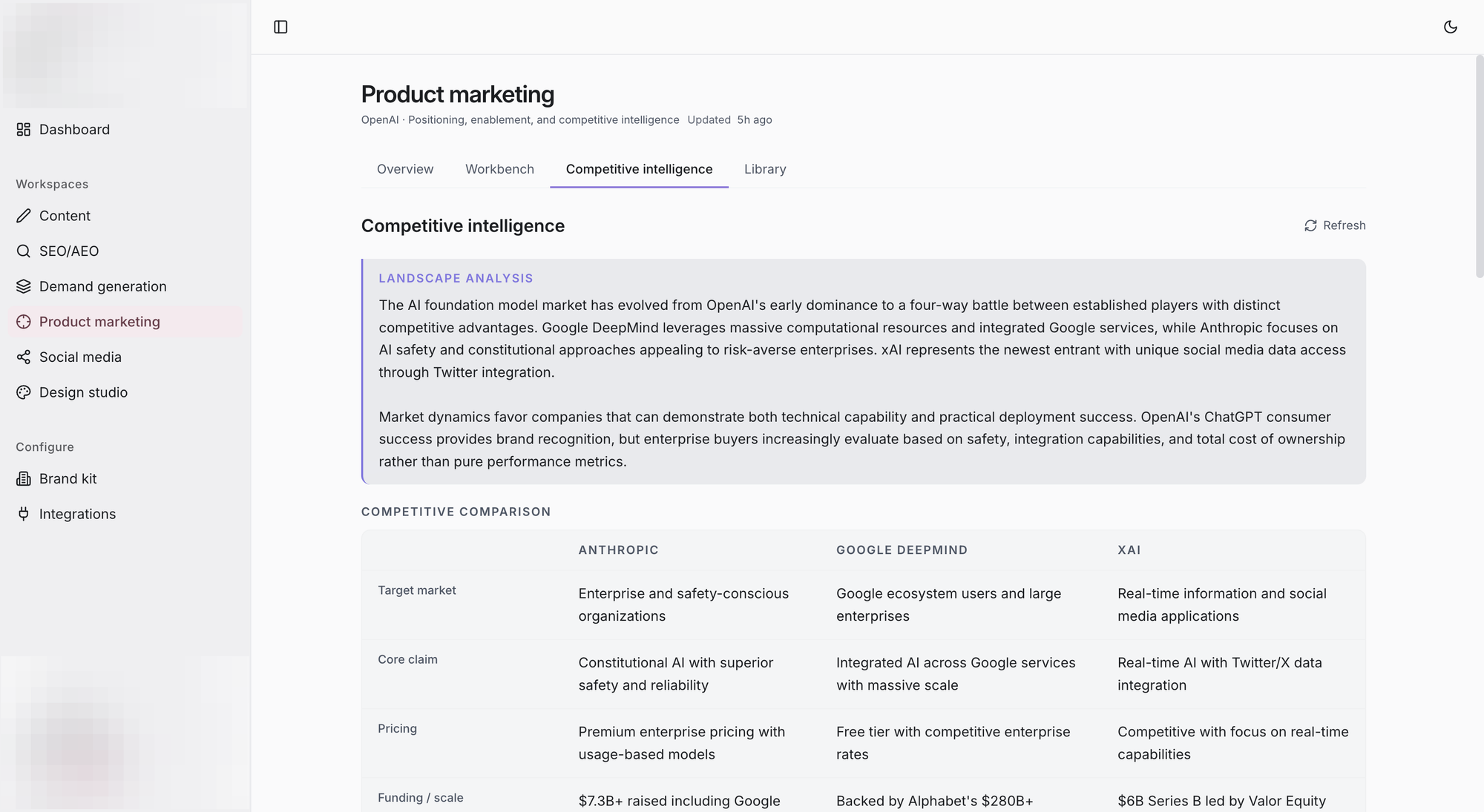
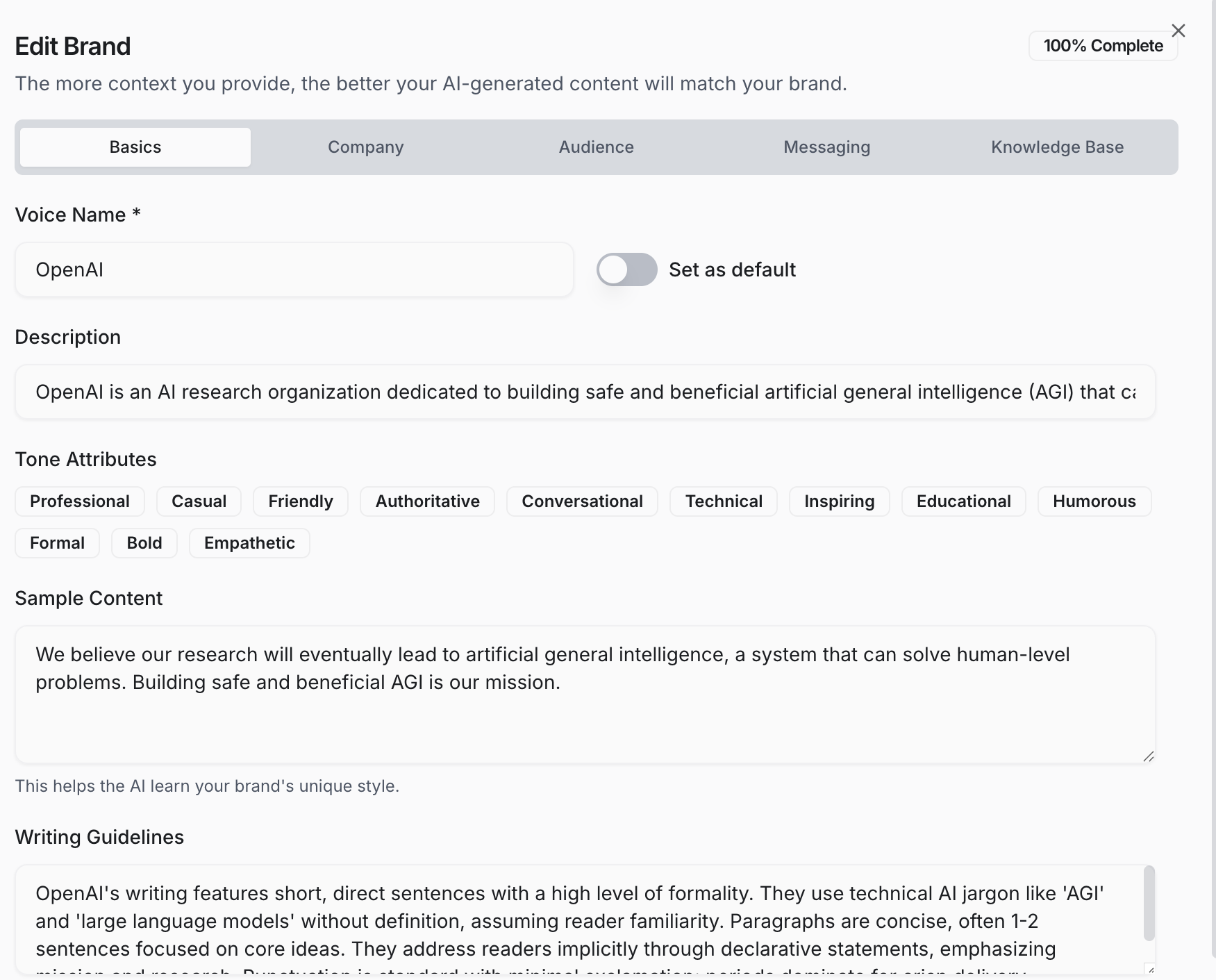
Tenet Marketing is built for exactly this situation. Tenet is an AI marketing agent that runs brand, content, SEO, product marketing, and demand generation end-to-end. You define your brand once: your voice, your positioning, your audience. Tenet applies it consistently across every output it produces.
What makes it worth noting in the context of brand marketing specifically: Tenet isn't a generic content generator. It builds a brand model from your inputs, verifies its research before surfacing content to you, and removes the kind of generic, off-voice output that erodes brand consistency. The result is brand-aligned content, battle cards, email sequences, landing page copy, and competitive analysis produced at a speed and scale that lean teams couldn't otherwise reach.
If you're a founder or solo marketer who needs serious brand marketing done without agency invoices or additional headcount, Tenet is worth exploring.
What brand marketing actually requires
Brand marketing is not the logo and not the ad campaign. It's the total body of work that shapes what people associate with your company every time they encounter it. Done well, it creates pricing power, customer loyalty, and competitive differentiation that compound over years. Done poorly, or not done at all, it leaves a vacuum that competitors, random customer experiences, and market perception fill on your behalf.
The practical path forward is simpler than it often appears: get your positioning right, express it consistently, deliver on your promise, and track the signals that show whether it's working. The brands that win over the long term aren't always the ones with the biggest budgets. They're the ones with the clearest sense of who they are and the discipline to express it without compromise.