

TL; DR
The "human vs AI" framing is a false choice. The best-performing teams in 2026 use both — humans for strategy and judgment, AI agents for execution at scale.
- Hire a human marketer when you need strategy, brand leadership, creative direction, or cross-functional ownership — positioning, relationship-driven sales cycles, and high-stakes brand work that requires context and accountability.
- Use AI marketing agents for high-volume, repeatable work — ad optimization, reporting, lead routing, content drafting — where they handle ~70–80% of execution at a fraction of the cost.
- The cost gap is real but capability differs. A human marketer runs $85K–$160K all-in per year; an AI agent stack runs roughly $3K–$30K — but only the human provides strategic judgment.
- The hybrid model wins: one strategic marketer (in-house or fractional) overseeing 2–5 AI agents, with a weekly human review cycle. This typically saves 60–80% over a full agency retainer without losing the strategy layer.
There's a concept in economics called the opportunity cost trap (also known as the sunk cost fallacy). It describes what happens when you spend so much time evaluating two options that the real cost isn't the choice itself; it's the delay. Businesses fall into this trap constantly with marketing decisions, and nowhere more acutely than in 2026, when the question has shifted from "should we try AI?" to "do we still need a human marketer at all?"
The answer is more nuanced than either camp wants to admit. The "AI will replace marketers" crowd is wrong, but so is anyone who thinks human marketers can work the way they did three years ago without integrating AI into their workflows. Recent data shows that 88% of marketers now use AI in their day-to-day roles, and 70% expect AI to play a larger role. The question isn't whether to use AI; it's how to allocate human versus AI effort to get the best return.
This guide is for founders, marketing directors, and business owners trying to make a concrete, defensible decision with real budget. We'll break down costs, capabilities, where each option genuinely excels, and the hybrid approaches that are quietly outperforming both pure strategies.
What is an AI marketing agent?
Most people conflate "AI marketing" with tools like ChatGPT that generate content when you type a prompt. AI marketing agents are categorically different.
The key distinction: autonomous vs. prompted
A standard generative AI tool is reactive. You input something, it outputs something. An AI marketing agent is proactive. It monitors data, interprets signals, makes decisions within predefined rules, and executes actions without you typing a prompt every time. The difference matters enormously for workload.
A concrete example makes this clearer. A demand base case study describes a scenario where a Solutions Architect from a target account spends 12 minutes on a product's website reading technical documentation. Traditionally, a human marketer or SDR would need to notice that behavior, assess intent, update CRM fields, alert the right salesperson, and send a tailored follow-up email. That's 30 to 45 minutes of skilled human time per account, and it only works if someone is watching.
An AI marketing agent handles that entire sequence automatically. It identifies the session as a high-intent signal, pushes the lead into the right segment, assigns a technical sales specialist, and sends a contextually appropriate follow-up email, all within minutes of the session ending.
What AI marketing agents can actually do
According to Improvado's research, effective AI marketing agents operate across:
- Campaign execution and optimization: spinning up ad variants, shifting budget from underperforming channels to better ones based on real-time data
- Lead routing and scoring: updating qualification status, triggering nurture sequences, escalating high-value prospects
- Reporting and analytics: pulling data across 10+ platforms, surfacing anomalies, generating "what changed and why" summaries
- Content production at volume: generating 50 email subject line variations in the time a human writes 3, drafting social posts and ad copy at scale
What AI marketing agents cannot do
They cannot set strategy. They cannot tell you whether to position your product as a premium solution or a cost-effective alternative. They don't understand that your biggest competitor just pivoted, that your sales team is hearing a new objection on every call, or that your brand should not make a joke in the current news cycle. Those are judgment calls that require context, experience, and accountability, none of which agents have.
What does hiring a human marketer actually cost?
The salary figure you see on job boards understates the real cost of a human marketing hire by roughly 30 to 40%.
The true cost of employment
 Anjana Vasan
A mid-level digital marketing manager in most Western markets commands somewhere between $65,000 and $120,000 in base salary. Add employer taxes, benefits, equipment, software licenses, and the cost of their ramp-up time, and you're realistically looking at $85,000 to $160,000 in total annual cost before they've produced a single campaign.
That ramp-up period is frequently underestimated. Most marketing hires need 60 to 90 days to understand the product, the customers, the competitive positioning, and the internal workflows before they're operating at full capacity. For a startup that needed results last month, this timeline is painful.
What you get that AI cannot replicate
The case for a human marketer isn't sentiment; it's function. Human marketers provide:
Strategic judgment under uncertainty. When your paid acquisition costs spike 40% in a week, a human marketer evaluates whether that's a targeting problem, a landing page problem, a competitive bid change, or a broader market signal. An AI agent can flag the anomaly; a human marketer decides what to do about it.
Brand voice that doesn't drift. Emarketed's analysis notes directly that humans win on originality and brand voice. This matters because brand consistency compounds over time. The tone your company uses in a crisis response should sound like the same company that writes your product launch emails.
Cross-functional coordination. Marketing doesn't operate in isolation. A skilled marketer understands what the sales team is hearing, translates changes into product positioning updates, and manages the internal politics of campaign approvals. No agent navigates a disagreement between a CEO and a VP of Sales about messaging.
Head-to-head cost comparison
The cost comparison looks lopsided on the surface, but the hidden costs on both sides change the math.
Line up the actual numbers side by side and the gap explains why the hybrid model keeps winning.
The economic case for AI agents is strongest when you have high-volume, repeatable work. Samuel Woods' analysis found that AI agents can automate around 80% of repetitive, data-driven marketing content, leaving humans to focus on the 20% requiring genuine insight.
If that 80% of work was costing you $80,000 of a marketer's time, and an AI agent stack costs $15,000 to configure and maintain, the math is straightforward.
But if the work is primarily strategic, relationship-driven, or brand-sensitive, the math inverts.
Performance comparison: where each wins
Content creation and copywriting
AI agents can produce volume at a speed humans cannot match. But volume without quality standards degrades brand credibility fast. The pattern that actually works, seen consistently across teams using AI for content, is AI drafts followed by human editing for voice and quality. Neither pure approach produces the best results consistently.
Paid advertising management
This is where AI agents have the clearest performance edge. Real-time bid optimization requires processing data faster than any human can. LeewayHertz's case studies show AI agents automatically reallocating budgets across channels based on performance signals, identifying cost-effective strategies, and adjusting tactics without waiting for a Monday morning campaign review.
Human performance marketers still add value in the creative strategy, audience selection, and "when to pause entirely" judgment, but the tactical execution layer is genuinely better handled by agents.
Social media and community engagement
Scheduling, posting cadence, and variant testing belong to AI. Community management, responding to a brand crisis, deciding whether to wade into a cultural conversation, and building genuine relationships with advocates belong to humans. The failure mode of over-automating social is real and visible: brands that sound like bots in comment sections don't recover quickly.
Data analysis and reporting
This is arguably AI's strongest domain in marketing. Marketing teams are dealing with 230% more data than they were a few years ago, flowing from 120-plus tools. An AI agent that synthesizes Google Analytics, Meta Ads Manager, HubSpot, and a CRM into a weekly "here's what changed, here's why, here's what to do" report saves 5 to 10 hours of analyst time per week. That's not theoretical; teams using dedicated reporting agents report exactly this.
Decision framework: when to hire a human marketer
Some situations make the human hire the clear answer.
You're building long-term brand identity
Brand positioning is the kind of work that looks simple on the surface but determines whether your marketing compounds or evaporates over time. If you're trying to establish what your company stands for, who it's for, and why it matters in a crowded market, that requires a human who can sit with the complexity, interview customers, argue with leadership, and make judgment calls that aren't in any dataset.
Your sales cycle is relationship-driven
High-ACV B2B sales, professional services, and regulated industries don't close on nurture sequences alone. The marketing that moves these deals forward involves thought leadership that earns genuine credibility, events and introductions that require human presence, and content that demonstrates expertise a machine can pattern-match but not actually possess. Buyers in these contexts are sophisticated enough to tell the difference.
You need strategic leadership, not execution
If your marketing problem is that you don't know what strategy to pursue, which channels to prioritize, or why your current approach isn't working, hiring an AI agent to execute faster is the wrong solution. You'd be scaling a direction before you know it's right. A fractional CMO or experienced marketing strategist, even at $150 to $300 per hour, provides more immediate value in that situation.
Decision framework: when to use an AI marketing agent
You have high-volume, repeatable work
Gumloop's internal use case is instructive. Their team runs 15 marketing AI agents, including a Google Ads agent that manages campaign performance, turns off underperforming ad sets, launches new campaigns, and answers performance questions through a chat interface. This isn't hypothetical; it's a small team achieving the operational coverage of a larger marketing department.
The threshold for when this makes economic sense, according to Improvado's ROI framework, is roughly 10 or more active campaigns across five-plus platforms, with data refreshing at least daily. Below that threshold, the setup and maintenance overhead may exceed the value.
Your budget doesn't support a full-time salary
A small business owner who needs consistent blog content, email sequences, social posts, and ad copy faces a real math problem.
A full-time content marketer costs $55,000 to $75,000 per year. An AI agent stack configured for content production costs a fraction of that. SearchLab's analysis found that for execution-heavy tasks on a small marketing footprint, modern AI tools can handle 70 to 90% of the work at 5 to 10% of the cost. The trade-off is quality and originality at the margin; if you're producing high-stakes brand content, you'll notice it. If you're producing lead nurture emails and social updates, you may not.
You want to augment an existing marketer
This is the highest-leverage use case. A skilled marketer who spends 60% of their time on mechanical execution (pulling reports, setting up campaigns, writing first drafts, scheduling posts) has 40% left for strategy. Give that marketer AI agents that handle the execution layer, and you've effectively doubled their strategic output without hiring anyone new.
The 7-figure coaching business case from The AI Founders Hive illustrates this directly: by deploying three agents (content amplification, lead follow-up, and systems coordination), they eliminated the operational fragmentation that was eating their marketing capacity, without expanding headcount.
The hybrid model: how the best teams are actually structured
The framing of "hire a marketer or use an AI agent" is a false choice that almost every expert in this space explicitly rejects. Emarketed states it directly: "The businesses getting the best results right now are the ones that have figured out how to use both, playing to the strengths of each while covering for the other's weaknesses."
What does that look like in practice?
The lean hybrid structure
The pattern that appears consistently across effective small-to-mid-size marketing teams in 2026:
- One strategic marketer (in-house, fractional, or agency) who owns positioning, messaging, channel strategy, and oversight
- Two to five AI agents handling specific execution layers: content drafting, paid optimization, reporting, lead routing
- A weekly human review cycle where the marketer evaluates agent outputs, catches errors, and adjusts strategy based on results
SearchLab's research describes this succinctly: "Most businesses end up on a hybrid model: AI for execution, a human specialist for 5 to 10 hours a month." That formula, they note, typically saves 60 to 80% over a full agency retainer without losing the strategic layer.
Which tasks stay human, which go to AI
The cleanest way to think about this is risk and repeatability. Tasks that are low-risk and highly repeatable (ad variants, report generation, email scheduling, lead scoring updates) are prime AI territory. Tasks that are high-risk or require genuine contextual judgment (brand crisis responses, new product positioning, influencer relationships, senior stakeholder communication) stay human.
Hover each task to see which side of the line it actually falls on.
low-risk, repeatable tasks go to AI. high-risk, judgment-heavy tasks stay human.
Accenture's approach at scale
For a large-scale example, Accenture built an internal "AI Refinery" platform that uses AI agents to handle content adaptation, data analysis, campaign optimization, and routine reporting. Human marketers at Accenture focus on strategy, brand positioning, and conceptual creative work. The result isn't a smaller marketing team; it's a marketing team that can handle significantly more campaigns, markets, and channels without proportionally increasing headcount.
Is hiring a marketing agency worth it?
The three-way comparison of agency vs. in-house marketer vs. AI agent is worth addressing directly because the right answer changes significantly based on what you're trying to accomplish.
Traditional agencies bring integrated teams, accumulated playbooks, and accountability. They also bring overhead, account management layers, and the inherent principal-agent problem of a vendor whose incentives don't perfectly align with yours. For brand strategy, PR, high-touch B2B programs, and work that requires senior creative judgment, a strong agency justifies its cost.
But the Fractional Growth Exchange notes that for production-oriented services like content marketing, paid media, and email automation, AI agencies (agencies that have rebuilt their production stacks around AI workflows) now deliver comparable output at significantly lower cost than traditional retainers.
The emerging model that makes sense for most growing businesses: an AI-native agency or fractional strategist for direction, and AI agents for execution volume. This is precisely the structure RZLT recommends for AI-era founders: "At Series A and beyond, most AI startups eventually want both an in-house growth lead plus agency execution layers, with the agency handling content velocity while the in-house lead owns strategy and reporting."
The 70/20/10 rule and how it applies here
Applied to staffing instead of budget, the same 70/20/10 split tells you where to put your attention.
most businesses put their attention on the 70% and starve the 20% and 10% of the strategic thought they need.
The 70/20/10 rule in digital marketing traditionally refers to budget allocation: 70% to proven channels, 20% to emerging approaches, and 10% to experimental bets. Applied to the human-AI question, it offers a useful mental model.
For most businesses, roughly 70% of marketing execution work is proven and repeatable: publishing content, running ads, sending emails, pulling reports. AI agents handle this well and at scale. About 20% is contextual and iterative: refining positioning, testing new audiences, analyzing nuanced results. This benefits from human judgment augmented by AI analysis. The remaining 10% is genuinely creative or strategically novel, requiring human expertise, relationships, and original thinking.
The mistake most businesses make is applying human attention to the 70% and starving the 20% and 10% of the strategic thought they need. AI agents exist, in practical terms, to fix exactly that misallocation.
ROI measurement: knowing whether your choice is working
Whichever option you choose, you need a 90-day evaluation framework before you can judge performance fairly.
For a human marketer hire, the first 30 days should be spent on onboarding and strategy development, not campaign production. Judge the first 90 days on the quality of strategic output (positioning documents, channel frameworks, campaign plans) rather than immediate revenue attribution. Revenue impact from a new marketer typically takes four to six months to show.
For an AI marketing agent, the first four to six weeks are calibration.
The agent is learning your data patterns, and you're adjusting its rules and guardrails. Don't evaluate performance at week three. At 90 days, measure hours saved per week, cost per content output, lead routing accuracy, and campaign optimization efficiency. If a reporting agent isn't saving at least two to three hours per week, the configuration needs work.
For a hybrid setup, measure both independently and then measure the combination. The key question at 90 days: is your human marketer spending more time on high-value strategic work than they were before the agents were introduced? If yes, the hybrid is working. If the human is spending more time correcting agent errors than they saved, the agents need reconfiguration.
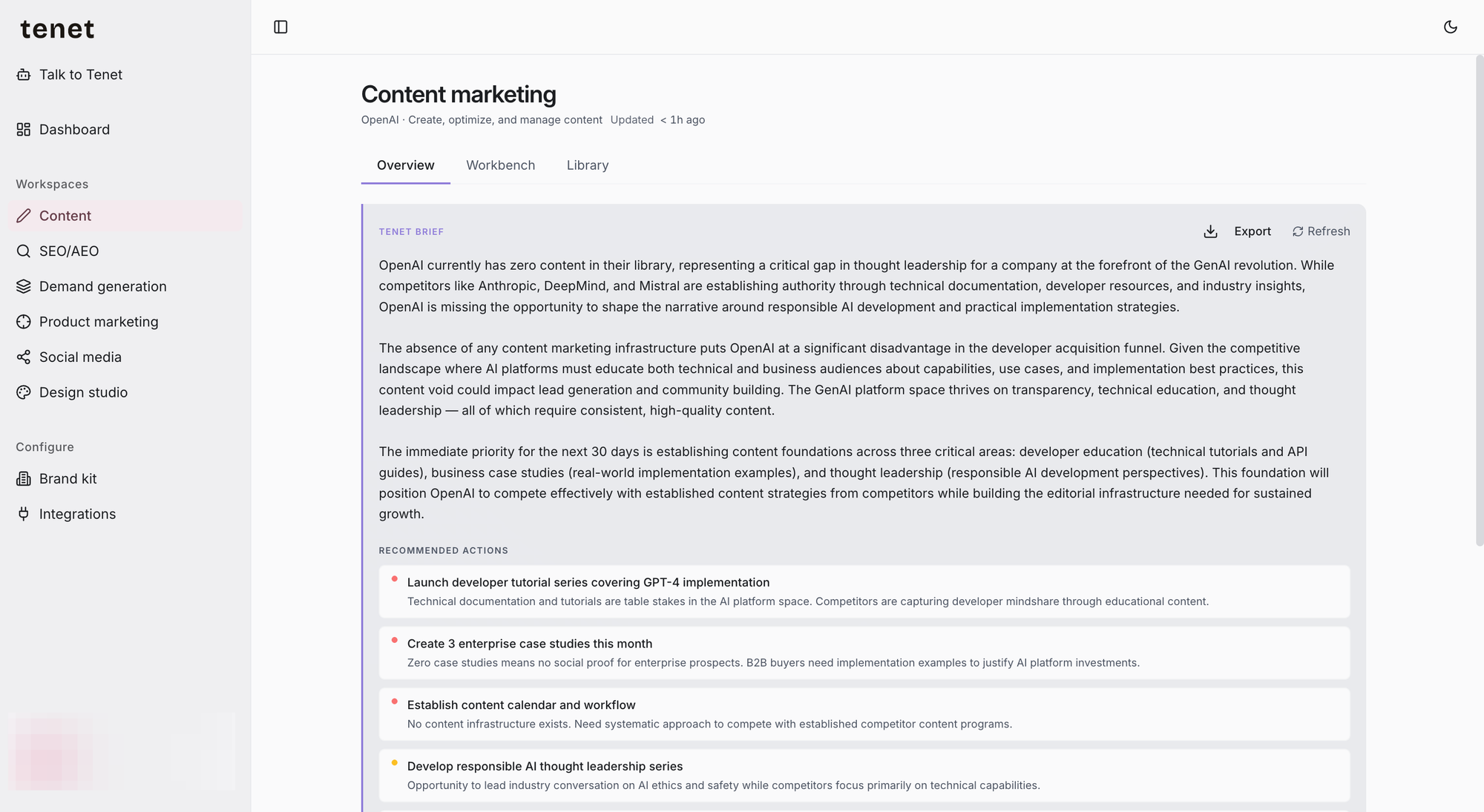
How Tenet can help you navigate this decision
If you've read this far, you probably recognize that the real challenge isn't choosing between a human marketer and an AI agent. It's building a marketing system that uses both correctly — and that requires knowing what strategy, creative direction, and performance infrastructure you need in place first.
Tenet is the AI marketing agent for lean SMB marketing teams: solo marketers, founders still owning marketing, and 1–5 person teams doing the work of departments three times their size. We built Tenet for the teams that can't afford to hire wrong, can't afford to wait, and don't have a head of marketing to design the system for them.
 Anjana Vasan
That system is what we call Tenet Operator, a done-with-you engagement where we deploy AI across your marketing stack, execute campaigns end to end, and hand you back a function that runs without you having to manage every moving part. It's not a software subscription you figure out on your own. It's an AI marketing agent that works with your team to close the gap between strategy and execution, so neither gets dropped.
Whether you're a founder deciding where your first marketing dollar goes, a lean team figuring out which execution layers to hand to AI, or a growing company trying to build a marketing system that doesn't break when someone leaves, Tenet can help you design the right setup — rather than guess at it.