

TL; DR
- AI marketing exists because modern customer data has grown too complex for humans to process manually — it uses machine learning to find patterns, make predictions, and act on them at scale.
- There are four core capability buckets: predictive AI (who will do what), generative AI (what to say), conversational AI (real-time responses), and analytical AI (what happened and why).
- The key distinction from traditional automation is that AI learns and improves from outcomes, while rule-based automation just scales decisions you've already made.
- Start narrow: pick one problem, audit your data first, run a small pilot, and only scale what's proven to work — most expensive failures come from skipping those steps.
- Humans still own strategy, brand voice, ethical decisions, and anything requiring real context — AI works best clearing away the mechanical 80% so the strategic 20% gets proper attention.
There's a concept in statistics called the curse of dimensionality. As you add more variables to a dataset, the data becomes exponentially sparse, and human intuition breaks down completely. A marketer trying to manually segment customers across a dozen behavioral signals doesn't just find it difficult — the math makes it impossible to do well.
This is the real reason AI marketing exists. Not because machines are smarter than people. Not because automation is inherently better than judgment. But because modern customer data has grown far beyond what any human team can process, interpret, and act on quickly enough to matter.
A mid-size e-commerce brand now generates millions of behavioral signals per day: page views, scroll depth, add-to-cart events, email opens, ad clicks, support tickets, purchase sequences, return patterns. A marketer sitting down to build a campaign from that data is like trying to read a novel that's been shredded into confetti. The information is all there. The signal is real. But the format makes it inaccessible without help.
AI marketing is that help. Not magic, not science fiction, not "algorithms that think." It's software that learns patterns from past data to make better predictions about what customers will do next, then acts on those predictions faster and more consistently than any human team working manually. Strip away the vendor language and that's the core of it.
The rest of this guide explains exactly how that works, where it applies across real marketing tasks, how to start using it without making expensive mistakes, and what humans still need to handle themselves.
What AI marketing is (and what it isn't)
Start with the definition that matters for practitioners: AI marketing is the use of machine learning, predictive analytics, generative AI, and automation to improve how marketing decisions are made and how campaigns are executed.
That definition has three parts worth unpacking.
- Machine learning means software that improves from examples rather than following fixed rules. A traditional email automation tool sends emails based on rules you write: "if someone downloads this guide, wait two days, then send this email." A machine learning system looks at thousands of past email sequences, figures out which timing and content combinations led to purchases, and adjusts what it sends for each subscriber based on those patterns.
- Predictive analytics means using historical data to make forward-looking estimates. Which customers are likely to cancel in the next 30 days? Which leads are most likely to become paying customers? Which ad creative is most likely to drive conversions with this audience segment? These are prediction problems, and machine learning handles them well.
- Generative AI is what most people picture when they talk about AI marketing right now: tools that produce text, images, and other content by predicting what comes next based on massive training datasets. Think of it as sophisticated autocomplete that can draft an email subject line, write an ad variation, or outline a blog post in seconds.
How AI marketing differs from traditional automation
Rule-based automation is not AI. If you've built a welcome sequence in your email platform that fires a series of messages over 10 days whenever someone signs up, that's automation. The sequence follows rules you wrote. It doesn't learn. It doesn't adapt.
AI marketing does something different: it observes outcomes and adjusts behavior to improve them. An AI-powered email system might notice that subscribers who work in finance open emails at 7am on weekdays and respond better to data-heavy subject lines, while subscribers in creative industries open emails mid-morning and engage more with narrative-driven content — and it makes those adjustments without you explicitly programming them.
The practical difference is significant. Rule-based automation scales your existing decisions. AI marketing improves on them over time.
The AI marketing stack: four capability buckets
Most AI marketing tools fall into one of four categories, and understanding them prevents a lot of confusion:
Most AI marketing tools fall into one of four buckets — knowing which one clears up a lot of vendor confusion.
a complete AI marketing approach eventually touches all four — you don't have to start there.
- Predictive AI answers "Who will do what next?" It scores leads, predicts churn, estimates customer lifetime value, and identifies the next best offer for each customer.
- Generative AI answers "What should we say or show?" It drafts copy, generates creative concepts, writes subject lines, and produces content variations.
- Conversational AI answers "How do we respond in real time?" It powers chatbots, virtual assistants, and AI-driven customer support.
- Analytical AI answers "What happened and why?" It runs attribution modeling, detects anomalies, analyzes campaign performance, and surfaces actionable patterns.
A complete AI marketing approach eventually touches all four. But you don't have to start there.
How AI marketing works under the hood
The mechanical explanation is simpler than most people expect. Strip away the technical vocabulary and you're left with a four-step loop that repeats continuously.
Strip away the vendor language and the mechanism underneath is a four-step loop that repeats continuously.
this loop is the whole mechanism. everything else is vocabulary.
Step 1: Data goes in
Every AI marketing system starts with inputs. Customer behavior data: page views, clicks, time on site, purchases, email opens, support interactions. Attribute data: location, device type, industry, company size, subscription tier. Campaign performance data: which ads ran, which content went out, what the results were.
The quality of what goes in determines the quality of what comes out. Statista’s overview puts it directly: AI "excels at analyzing large amounts of data about customers to uncover trends, behaviors and preferences." But if the data is incomplete, inconsistent, or biased, the AI's output will reflect those same problems. Poor inputs don't just limit performance — they actively mislead.
This is why data quality is the unglamorous prerequisite that most AI marketing conversations skip past. Before you invest in sophisticated tools, ask whether you have clean, connected, permission-based customer data to feed them.
Step 2: The model learns patterns
Once you have data, an algorithm processes it to find relationships. Which customer characteristics predict repeat purchase? Which combination of email subject line, content, and send time produces the highest click-through rate for which segment? Which sequence of behaviors predicts cancellation?
The model isn't reasoning about these questions the way a strategist would. It's finding statistical correlations across thousands or millions of examples and building a mathematical function that predicts outcomes. The "intelligence" is pattern recognition applied at enormous scale, not judgment or intuition.
Step 3: Predictions drive actions
The patterns the model has learned get applied to new situations. A new visitor arrives on your site: the system predicts their likelihood to convert and adjusts which product is featured, which offer appears, which message shows in the chat widget. A lead enters your CRM: the system scores them based on firmographic and behavioral signals and routes them accordingly. An ad campaign launches: the system allocates budget toward the audiences and creatives showing the strongest early performance signals.
Step 4: The feedback loop
Every outcome gets recorded and fed back into the model. The email that got a 40% open rate and the one that got a 12% open rate. The product marketing that led to a purchase and the one that was ignored. The ad that drove cost-per-acquisition down versus the one that burned budget.
Where AI marketing shows up in practice
Theory is useful. Examples are more useful. Here's where AI is doing real work in marketing right now.
Customer segmentation and targeting
Traditional segmentation creates a handful of buckets: new customers, returning customers, high-value customers. AI-driven segmentation goes further. It discovers segments you wouldn't have thought to define: customers who bought within 48 hours of seeing a specific content type, subscribers who engage heavily but have never made a purchase, customers in a specific industry whose renewal rate is double the average.
These aren't segments you define. They're segments the algorithm finds by identifying which clusters of customers behave similarly. And they update automatically as behavior changes.
Personalization and recommendations
When you visit an e-commerce site and the homepage shows products that feel oddly relevant to you, that's a recommendation engine at work. It's looking at your browsing history, purchase history, and the patterns of customers who behave similarly, then predicting what you're most likely to want to see.
According to Gartner, effective personalization uses AI to tailor content, offers, and experiences for individual consumers at scale. A human merchandiser could personalize a recommendation for 10 customers. An AI system personalizes it for 10 million simultaneously, without proportional cost.
Content creation and optimization
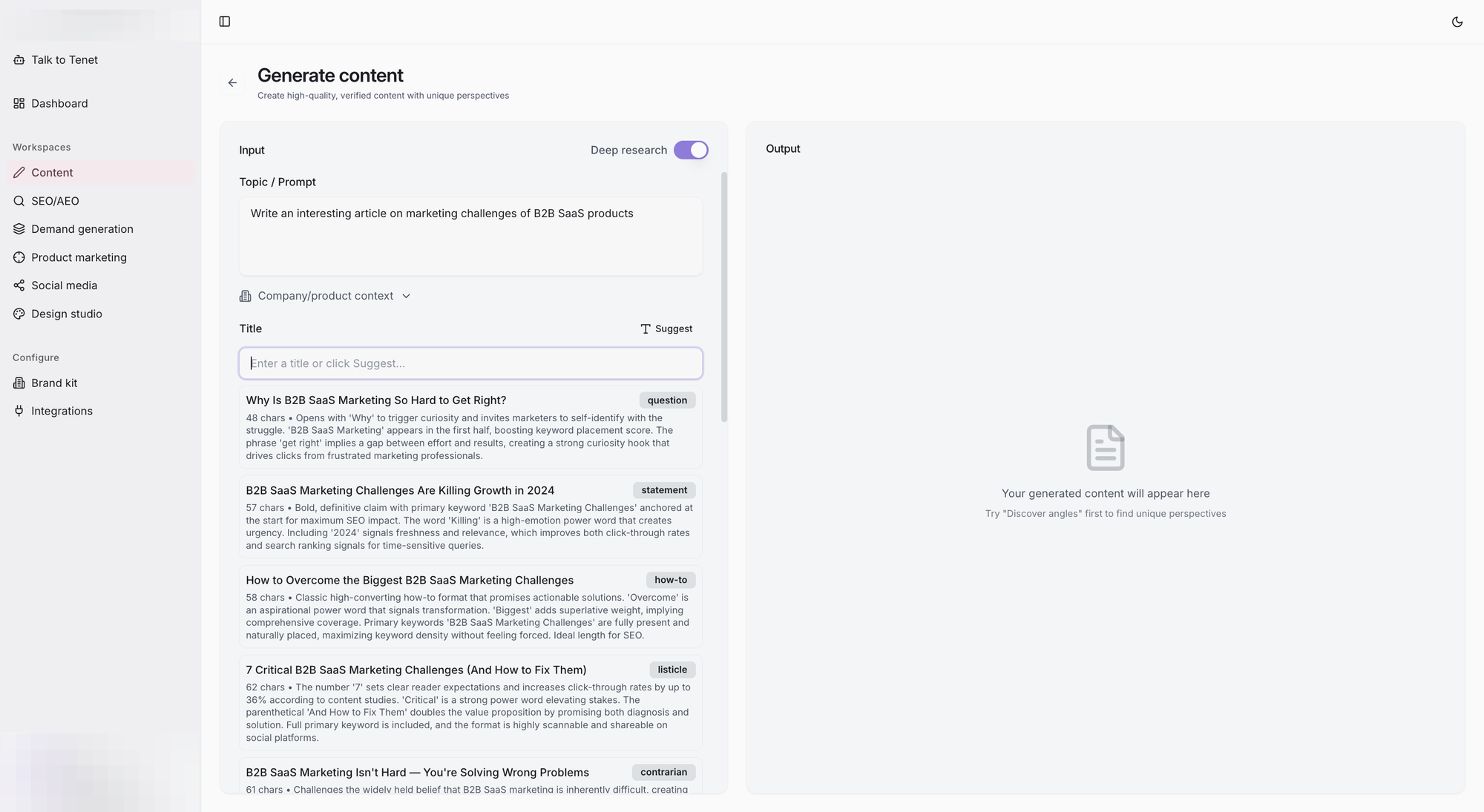
Generative AI has made the biggest practical difference here. Marketing teams now use AI to produce first drafts of email copy, generate multiple ad headline variations, write product descriptions, suggest blog structures, and test which versions of a subject line perform best.
The mistake is treating AI-generated content as finished content. Paul Roetzer of the Marketing AI Institute frames it well: AI in marketing is about "augmenting what marketers are capable of doing." That means AI drafts and humans refine. The brand voice, strategic insight, cultural sensitivity, and final judgment still need human eyes.
Predictive analytics
This is where AI marketing often delivers its clearest ROI. Predicting which leads are most likely to convert so sales prioritizes them. Identifying which customers show early signs of churn so retention campaigns reach them before they leave. Estimating customer lifetime value so acquisition budgets go toward customers most likely to be profitable long-term.
These predictions aren't perfect. But a model that correctly identifies 70% of at-risk customers is dramatically better than guessing, and it runs across your entire customer base without proportional increases in headcount.
Ad targeting and bid optimization
Programmatic advertising already runs almost entirely on machine learning. Bids adjust in real time based on predicted conversion probability. Audiences expand to lookalike segments that resemble your best customers. Creative variations rotate based on which combinations are performing.
Most marketers using Google or Meta ads are already using AI — they just don't always think of it that way. The platforms handle bid optimization and audience modeling automatically. The human job is setting strategy, defining the right objectives, and watching for cases where the automation makes bad decisions.
Chatbots and customer service
Conversational AI handles high volumes of customer inquiries that would otherwise require human support time: FAQ responses, order status checks, basic troubleshooting, and routing to the right resource. The Gartner’s guide describes this as AI enabling more responsive customer interactions while freeing human agents for complex problems.
A well-built bot creates a better customer experience and reduces support cost. A poorly built one — giving irrelevant responses, failing to escalate, frustrating people who just want a straight answer — damages the relationship faster than a slow human response would.
An end-to-end example: what AI marketing looks like in practice
Abstract explanations only go so far. Here's how this plays out for a real marketing scenario.
Imagine a SaaS company selling project management software to small businesses. They have a CRM, a basic email platform, website analytics, and a record of every trial signup and subscription event.
The goal: Convert more free trial users into paying customers within 14 days.
Step 1: Data foundation. They connect trial signup data, email engagement, in-app usage events (which features were used, how often, how quickly), and subscription outcomes. Clean data: deduplication, consistent field names, clear definition of "conversion."
Step 2: Pattern learning. A predictive model analyzes past trials and finds that trial users who invite a team member within 72 hours and use the reporting feature at least once convert at 4x the rate of those who don't. Users who open fewer than two emails during the trial have a 78% non-conversion rate.
Step 3: Targeted action. Email sequences now trigger differently based on in-app behavior. A trial user who hasn't invited a team member by day 3 gets a specific email about collaboration features. One who hasn't used reporting by day 7 gets a use-case story about reporting. The sequences adapt to each user's actual behavior rather than following a single linear flow.
Step 4: Content generation. AI drafts multiple variations of each email, including subject lines.
The marketing team reviews, edits for brand voice, and selects the best options. A/B testing runs automatically.
Step 5: Feedback and iteration. Which email sequences led to feature adoption? Which led to conversion? The model updates. The sequences improve. Next month, the team has better data, sharper predictions, and more refined messaging.
This is not a futuristic scenario. It's standard practice for B2B SaaS teams using tools like HubSpot, Salesforce Marketing Cloud, or Intercom today.
The human + AI framework: what to automate, what to assist, what to keep
Most AI marketing guidance goes vague right here. "Humans and AI work together" is true but not useful. Here's a more concrete breakdown.
Not every task deserves the same amount of human hand-holding — hover each for where the article draws the line.
automate where the stakes of a single error are low. keep humans where context and accountability matter.
The pattern is consistent. Automate decisions where the feedback signal is clear, the volume is high, and the stakes of any individual error are low. Use AI to assist where creativity and brand judgment still matter. Keep humans in charge where the decision requires context, values, and accountability that an algorithm can't provide.
How to start with AI marketing: a practical roadmap
The most common mistake is starting with the tool instead of starting with the problem. Someone reads about AI marketing, signs up for six platforms, and three months later has a pile of subscriptions and nothing materially better than before.
Start with a specific problem
Pick one. The clearest starting points:
- Email campaigns underperforming → start with AI-assisted subject line testing or send-time optimization
- Too much time spent writing content → start with AI drafting tools for first drafts
- Not knowing which leads to prioritize → start with lead scoring
- High trial-to-paid drop-off → start with behavioral email sequences
One problem. One use case. Measurable baseline before you start.
Audit your data before choosing tools
AI tools that require clean, centralized customer data will underperform if your CRM is a mess. Before evaluating platforms, answer these questions:
- What customer data do you have?
- Is it in one place, or spread across disconnected systems?
- Is it permission-based and privacy-compliant?
- Can you define your key events cleanly — signup, purchase, cancellation, upgrade?
Evaluate tools with a short checklist
When selecting an AI marketing tool, the questions that matter:
- Does it solve the specific problem you identified?
- What data does it need, and do you have it?
- Does it integrate with the systems you already use?
- Can marketers use it without constant IT support?
- What are the data handling, privacy, and compliance policies?
- What's the actual pricing model — per seat, per usage, flat fee?
Run a pilot before scaling
A good pilot is narrow: one channel, one use case, a clear comparison to your baseline, and a defined time window. Run the AI-assisted version against the control, measure the difference, and document what worked and what didn't. Only then consider expanding.
McKinsey’s framework for AI marketing implementation consistently emphasizes this sequence: establish goals, build a data foundation, choose tools carefully, and test before scaling. Most teams skip steps two and three. That's usually where expensive disappointments start.
The risks nobody talks about enough
Benefits are easy to discuss. The less-examined problems deserve equal attention.
Data bias compounds at scale
If your historical data reflects biased decisions — certain customer segments were never targeted, certain channels were always prioritized — AI will learn and perpetuate those biases. A lookalike audience model built on your current customer base will replicate the characteristics of that base, including any demographic skew. Biased inputs don't just limit what AI can do; they actively encode past mistakes into future decisions, and they do it at a scale no human team could match.
Over-personalization becomes creepy
There's a line between "this feels relevant" and "this feels like surveillance." Hyper-personalization based on behavioral tracking can cross that line, and when it does, it damages trust faster than any generic campaign would. The Forbes Tech Council has flagged this explicitly: marketers need to balance personalization with consumer comfort.
Generative ai hallucinates
AI-generated text sometimes contains invented statistics, wrong product details, or factual claims that sound plausible but are incorrect. Any AI-written content that goes out under your brand marketing needs real human review — not as a formality, but as an actual accuracy check.
Model drift is real
AI models are trained on past data. When customer behavior shifts , due to economic changes, platform changes, or competitive moves ; a model trained on older data can give increasingly wrong recommendations. Models need periodic review and retraining. Treating any model as permanently set is a recipe for quiet degradation that doesn't announce itself until the numbers are already off.
The brand voice problem
Generic AI content sounds generic. If every company in your industry is using the same AI writing tools with similar prompts, the output starts to converge on the same bland middle. The solution isn't to avoid AI — it's to train tools on your own voice, review outputs against real brand standards, and ensure the content sounds like your company, not a template with your logo on it.
AI search is changing how customers find you
One thing the AI marketing conversation rarely addresses: AI is also changing how customers discover information and brands in the first place. Harvard Business Review's analysis describes how conversational interfaces are creating new discovery paths that bypass traditional search results entirely.
When someone asks ChatGPT or Perplexity "what's the best project management tool for small teams," they're not seeing 10 blue links. They're getting a synthesized answer. The brands that appear in that answer are the ones whose content is clearly structured, factually accurate, directly answers specific questions, and has established topical authority across multiple relevant pages.
This shifts the job of content marketing. The goal isn't just ranking for keywords anymore — it's producing content that AI systems can extract clear, accurate, attributable answers from. Concretely: lead with direct response near the top of each section, use structured headings that mirror real questions, define terms explicitly, and back claims with credible sources. These aren't SEO tricks; they're what makes content useful to both AI systems and the humans reading the answers those systems generate.
AI marketing by team size: different starting points
Most AI marketing content assumes enterprise scale. That most teams are small.
Solo marketers and small businesses
Start with tools you already have. Most email platforms , include AI features for send-time optimization and segmentation. Most ad platforms already run AI-powered bidding. Start by using those features deliberately rather than letting them run on default settings.
Add generative AI for content production: draft first versions of emails and social posts, test subject line variations, generate multiple ad copy options. The productivity gain is real and immediate. The investment is low.
One use case, well-executed, beats five use cases done poorly.
Mid-size and larger teams
The priority shifts to infrastructure. Data centralization, CRM hygiene, cross-channel tracking, and governance become the prerequisites for anything sophisticated. Teams at this scale also need clear ownership: who decides which AI tools the team uses, who reviews outputs for quality and compliance, and how AI-generated content gets approved before it goes live.
More advanced use cases — predictive analytics, multi-channel personalization, sophisticated segmentation — require data infrastructure that small teams don't yet have. Build the foundation before the tooling.
What to take away
AI marketing isn't magic — and it's not just dumb pattern matching either. The real value shows up when you combine serious computational speed with human judgment at the moments that actually matter. Data goes in, content gets researched and drafted, campaigns get planned and launched, results feed back in, and the whole thing gets a little sharper every cycle. When it's working, it doesn't feel like automation. It feels like having a capable team that never drops the ball.
The honest catch is this: AI doesn't know your customers the way you do. It doesn't carry the instinct you've built from years in your market. And it won't push back on a strategy that's technically sound but quietly misses something human. That's why the best AI marketing setups don't try to remove people from the loop — they free people from the mechanical 80% so the strategic 20% actually gets the attention it deserves.
Introducing Tenet Operator
 Anjana Vasan
That's exactly the model behind Tenet Operator.
Tenet handles the heavy lifting — the research, the drafts, the campaigns, the optimization — end to end. A dedicated Tenet Operator then runs it for you every week. One person, inside your account, accountable for shipping your marketing and reporting back on what's actually moving the needle. Not a rotating agency team working in tools you can't see. Not a freelancer stretched across five other clients. One person who owns the plan, does the work, and tells you what's working in plain English.
You approve the direction. You keep full visibility. And if you ever decide to leave, your entire marketing setup — the strategy, the assets, the data — comes with you. Not a folder of PDFs.
If you're just getting started, start narrow. Pick one problem. Get your messaging right before you try to scale anything. And keep a human accountable for what goes out under your name — not because AI can't write it, but because someone should own it.
The judgment, the relationships, the strategy: those stay with you. With Tenet and Tenet Operator, everything else can run.