The ultimate AI marketing checklist for founders: Launch, scale, and automate in 2026
A practical AI marketing checklist for founders covering ICP research, content, email, ads, automation, and analytics. Built for solo founders and small teams in 2026.


TL; DR
- This is a stage-based AI marketing checklist for founders — not a tool list, but a framework that starts with positioning (ICP, brand voice, analytics) before any AI tool gets touched.
- Founders who get AI marketing right build the foundation first: a defined ICP, a brand voice document, and conversion tracking configured before a single piece of content goes out — skipping this step just makes AI generate polished-sounding noise faster.
- AI's real value is compressing execution time on repetitive work — first drafts, subject line testing, ad creative variants, SEO clustering — freeing founders to focus on the things AI can't do: positioning, customer relationships, and judgment calls.
- Every function (content, email, ads, analytics) gets a quality-control checkpoint, because AI hallucinates statistics and citations by default; human fact-checking and brand-voice review stay non-negotiable at every stage.
- The plan closes with a concrete 30-day launch sequence and a recurring quarterly audit (strategy alignment, content ROI, tool stack rationalization, capability upgrades) so AI marketing stays tied to actual business outcomes instead of vanity activity.
There's a concept in project management called "scope creep by optimism." You start with a clear plan, but because each individual addition seems small and reasonable, the whole thing balloons into something unmanageable before you realize what happened. Nobody decided to build a monster. They just kept saying yes to things that seemed sensible in isolation.
AI marketing for founders works exactly the same way. You add a content tool here, an email automation there, a chatbot because someone on Twitter swore by it. Six months later, you're paying for eleven subscriptions, your brand voice sounds like it was written by a committee of robots, and you still can't tell which channel is actually generating customers.
The founders who get AI marketing right don't start with tools. They start with a framework, then fill it in deliberately. According to Gartner’s research, 84% of businesses use AI to save time and 78% use it to generate ideas, but the ones translating that activity into revenue have something the others don't: a structured process that connects AI output to business outcomes.
This checklist is that process. It covers every major function of founder-led marketing, from pre-launch brand building through quarterly audits, and it's organized so you can work through it at your actual growth stage rather than drowning in tactics meant for companies ten times your size.
What is an AI marketing checklist?
Pre-Launch Foundation
- Define your ICP — brain-dump for 20–30 minutes, then use AI to structure it into two profiles (title, goal, top three pains, decision triggers)
- Run competitor and market research with AI — positioning summaries, common objections, emerging trends
- Write a brand voice document — tone, non-negotiables, phrases you never use, two to three "at your best" examples
- Set up analytics first — configure GA4, set conversion tracking for every goal, connect ad platforms into one view
Content
- Build a content strategy before a calendar — map content to each funnel stage (discover → evaluate → decide)
- Do AI keyword research — cluster by intent, find gaps, prioritize 20–30 topics by volume, competition, and fit
- Run the draft workflow — AI for research, outline, and first draft; human edit for your examples, verified data, and point of view
- Apply a QC checkpoint on every piece — fact-check stats and citations, confirm brand voice, confirm it says something specific
- Build three core sequences — welcome (3–5 emails), lead-magnet follow-up, demo/trial nurture
- Test subject lines and copy with AI — keep a "winning examples" library of what your audience responds to
- Personalize beyond first name — tag leads by signup page and behavior, then build conditional sequences
Paid Ads
- Launch with 5–10 creative variants, not one perfect ad — let performance data decide
- Enable automated bidding only after conversion tracking is solid and you hit ~30–50 conversions/campaign/month
Analytics
- Set up a unified dashboard pulling ads, email, CRM, and site data into one view
- Define KPIs before you start — write down what success looks like at 30, 60, and 90 days, and the number that means "stop"
Ethics and Risk
- Check each tool's data policy before feeding it customer or proprietary data — confirm your plan blocks model training on inputs
- Verify every statistic, name, and claim before publishing — assign one person to own fact-checking
- Audit audience targeting quarterly for bias so you reach the full intended market
Quarterly Audit
- Q1 — recheck that AI activities still map to current business goals
- Q2 — review content performance and channel CAC:LTV; cut losers, double down on winners
- Q3 — list every AI subscription, kill overlaps and unused tools
- Q4 — review new AI capabilities and team skill gaps; invest in learning
30-Day Launch Plan
- Week 1 — ICP doc, brand voice guide, analytics/conversion tracking, core stack chosen
- Week 2 — keyword priority list, three pillar pieces drafted, SEO baseline set
- Week 3 — welcome sequence, lead-magnet funnel, landing page with two headline variants
- Week 4 — small paid test ($10–20/day, five variants), review week-one data, document learnings
Why founders need a different kind of marketing checklist
Most marketing playbooks are written for teams. They assume you have a content manager, a paid media specialist, an email marketer, and someone to proofread everything before it goes out. They assume budget, headcount, and time.
Founders have none of that. You're the strategist, the copywriter, the analyst, and the customer success rep, often in the same afternoon.
The compounding problem of doing everything manually
The math is brutal. If content creation, email sequences, ad copy, social posting, and performance reporting each take ten hours a month for a dedicated specialist, you're looking at fifty-plus hours of marketing work that has to somehow happen alongside product development, fundraising, sales calls, and everything else that keeps a startup alive.
BCG’s insider once cited one found that three out of four knowledge workers are now using AI at work, and 93% of power users report meaningfully higher productivity. The gap between founders who've built AI into their workflow and those who haven't is widening quickly, and it's not closing on its own.
What AI actually levels
AI doesn't replace judgment. What it does is compress execution time for repetitive but necessary work: first drafts, SEO research, subject line variations, audience segmentation, performance summaries. That compression is what levels the playing field, not because AI makes founders smarter than larger competitors, but because it gives you the bandwidth to focus on the things only you can do: your story, your positioning, your customer relationships.
McKinsey data reported by Yotpo shows that 62% of organizations are now regularly using generative AI, but scaling it to genuine enterprise value remains difficult. Founders, ironically, have an advantage here: you're small enough to move fast, iterate without bureaucracy, and get signal quickly from the market.
How to use this checklist
Don't try to implement everything at once. The checklist is organized by function. Work through the Pre-Launch Foundation section first regardless of where you are, then prioritize the channels most relevant to your current stage. If you're pre-revenue, content and email matter more than paid advertising optimization. If you're at $1M ARR trying to scale, the automation and analytics sections become your leverage points.
Each section includes the action, the reasoning behind it, and the common mistake founders make. Read the reasoning. Understanding why something matters is what turns a checklist into a skill.
Pre-launch AI marketing foundation checklist
The biggest mistake founders make before launch is skipping to tactics. They start writing blog posts before they've defined who they're writing for. They run ads before they've articulated why their offer is meaningfully different from what already exists. AI tools make this worse, not better, because they can generate polished-sounding content very quickly, which creates the illusion of progress while the underlying positioning remains undefined.
Define your ICP before touching any tool
Your Ideal Customer Profile is the foundation of product marketing, everything else rests on. Without it, AI-generated content is just noise that happens to be formatted well.
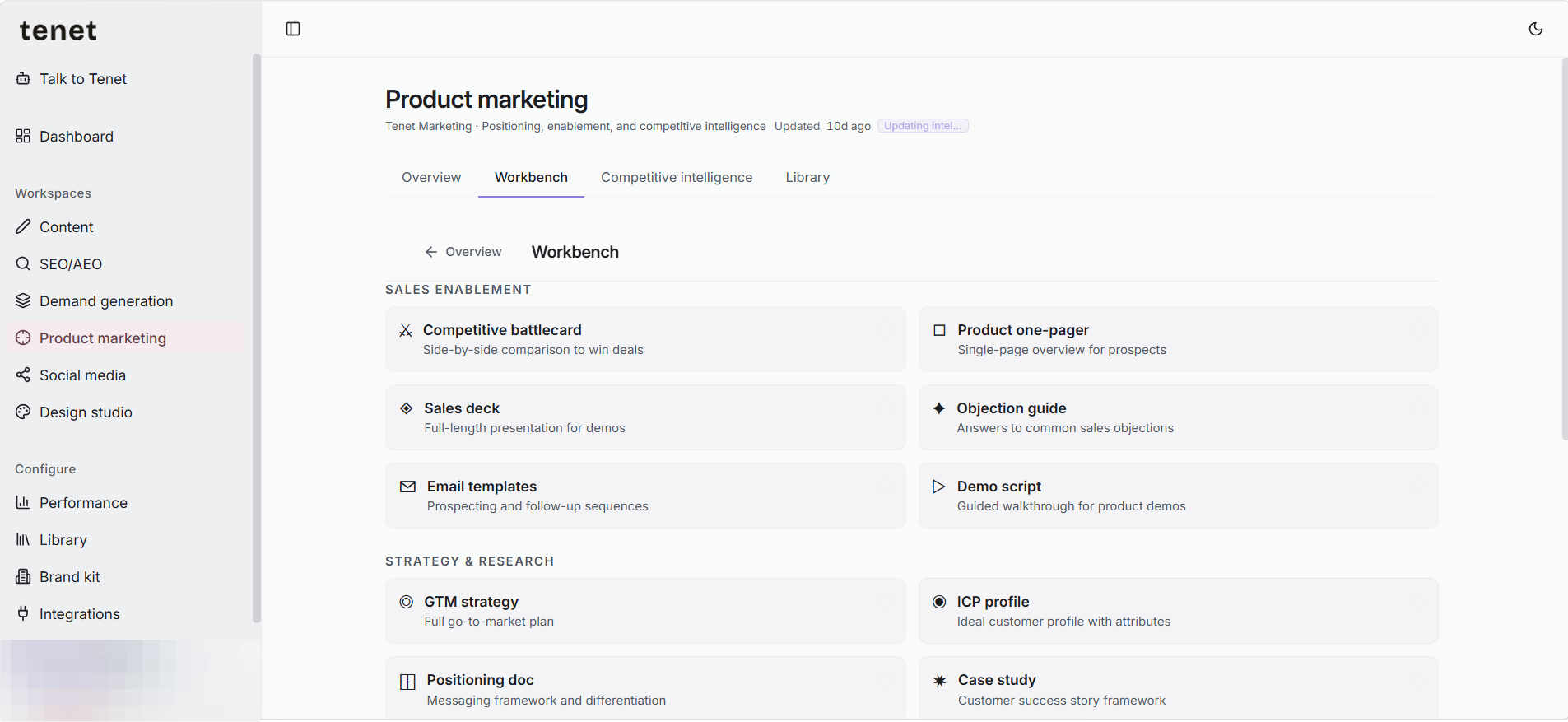
Start with a brain dump. Write for 20-30 minutes about who your best potential customers are: their job, their goals, the thing that keeps them up at night, the solutions they've already tried, and why those didn't fully work. Be specific. "Startup founders" is not an ICP. "SaaS founders at pre-Series A companies trying to build repeatable acquisitions without hiring a full marketing team" is getting closer.
Once you have that raw material, use an AI tool to structure it. A prompt like: "You are a B2B growth strategist. Take these notes and create two ICP definitions with job title, primary goal, top three pain points, and decision-making triggers" will produce something far more useful than starting from scratch with AI and hoping it guesses correctly.
Conduct market and competitor research with AI
Before you finalize messaging, you need to know what your competitors are saying and where the gaps are. AI tools can significantly accelerate this research. Ask for competitor positioning summaries, common customer objections in your category and emerging trends in your space.
Yotpo's research found that structured content work including verifiable statistics and clear positioning can increase visibility in AI search engines by up to 73%. That advantage starts here, at the research stage, before a single piece of content is written.
Build your brand voice document
This is not optional. Before you use AI for any content, you need a brand voice document that codifies your tone, your non-negotiables, what you never say, and two or three examples of writing that sounds like you at your best.
The Brand Whisperers recommend that every AI-generated asset prove a single, important benefit with concrete proof and plain language.
Ogilvy's observation that "the more facts you tell, the more you sell" applies doubly to AI-assisted content, where the temptation toward vague generalities is significant.
Set up your analytics infrastructure first
Most founders set up analytics after they've started marketing. This guarantees you'll spend weeks without reliable data. Before you publish anything, configure Google Analytics 4 (or your analytics platform of choice), set up conversion tracking for every goal that matters (signups, demo bookings, purchases), and connect your ad platforms so you can see cross-channel performance marketing in one place.
Analytics is the feedback loop that makes AI marketing work. Without it, you're optimizing in the dark.
AI content marketing checklist for founders
Content is where most founders first turn to AI, and where they most often go wrong. The failure mode isn't bad writing. It's good writing about the wrong things, distributed on the wrong channels, with no measurement attached.
Build a content strategy before creating a calendar
A content calendar is an operations tool. A content strategy is the answer to "why would the right person read this and what should they do next?" Many founders have the first without the second.
Your content strategy should map directly to your sales funnel. What content helps someone who just discovered you understand that their problem is real and solvable? What content helps someone already aware of your category understand why your approach is different? What content helps someone actively evaluating you decide to buy?
AI can help you build this map quickly. Feed it your ICP, your offer, and your main differentiators, and ask it to generate a content framework for each funnel stage. Then validate it against what your actual customers say they needed before they bought.
AI-powered SEO and keyword research
The basics of keyword research haven't changed: find what your target customers are searching for, understand the intent behind those searches, and create content that genuinely answers those questions better than what's already ranking.
AI accelerates the clustering and prioritization steps significantly. Tools now have AI features that group keywords by semantic intent, identify content gaps against competitors, and surface questions your audience is actually asking. Use them to build a priority list of 20-30 topics, then organize them by search volume, competition level, and how directly they connect to your offer.
Blog and long-form content creation workflow
The workflow that works: use AI for research and structure, write the first draft with AI assistance, then edit heavily as a human. The goal is to end up with content that has your actual opinions in it, not just a well-organized summary of what everyone else already says.
Specifically: generate an outline with AI, expand each section with AI assistance, then go through and add specific examples from your own experience, data points you've verified, and positions you actually hold. The posts that rank and get shared have a point of view. AI doesn't naturally produce those without significant human direction.
Quality control standards
Every piece of AI-generated content needs a human review checkpoint before publishing. Check for factual accuracy (AI tools hallucinate statistics and citations regularly), brand voice alignment, and whether the piece actually says something specific or just sounds like it does.
Create a simple review checklist: Does this prove a specific benefit? Does it include at least one concrete proof point? Would a smart reader learn something they didn't know before? If the answer to any of those is no, it's not ready.
AI-powered email marketing checklist
Email is still the highest-ROI channel for most early-stage companies, and AI has made it significantly faster to build and optimize. The key is building sequences that are actually personal rather than just personalized in the "Hi {first_name}" sense.
Set up your core automation sequences first
Before doing anything else, build three sequences: a welcome sequence for new signups (3-5 emails), a lead magnet follow-up sequence, and a demo or trial nurture sequence. These run in the background indefinitely, which means the time you invest in making them good compounds over the life of your company.
Use AI to generate initial drafts for each email, then rewrite them heavily with specific examples, real customer quotes (even from early conversations), and a clear next step in each one. Generic nurture emails get ignored; specific, useful ones get replied to.
AI subject line and copy testing
Virgin Holidays' work with Phrasee demonstrated that AI-generated subject lines consistently outperformed human-written ones when tested at scale, driving measurable increases in open rates and downstream bookings. The mechanism is straightforward: AI can generate and test hundreds of variations much faster than a human writer can, and email performance data provides clear signals on what works.
Most email platforms now have built-in AI subject line tools. Use them, but always maintain a "winning examples" library so you understand what patterns your audience responds to, not just what won last week.
Personalization beyond first name
Real personalization means sending different content based on what someone actually did or expressed interest in, not just what list segment they're on. AI can help you build this logic even without an enterprise marketing automation platform.
Start by tagging your leads based on the page they signed up on, the content they've engaged with, and any explicit preferences they've expressed. Then build conditional sequences: if someone downloaded your pricing guide, they get a different follow-up than someone who read a thought leadership post. The more specific your triggers, the more relevant your emails, and the more relevant your emails, the better every metric gets.
AI paid advertising checklist for founders
Paid advertising is the fastest way to generate data about what messaging works. AI has made it substantially more efficient, particularly for audience building and creative testing.
Start with creative variety, not perfect creative
The biggest mistake founders make with paid ads is spending too long perfecting one creative before testing it. With AI tools for copy generation and design, you should be launching with five to ten creative variants from day one, letting performance data tell you what resonates rather than guessing.
Persado's research found that AI-optimized copy achieved a 4x higher click-through rate compared to human-written headlines in controlled tests. The advantage wasn't that AI is inherently more creative; it was that AI could generate and test enough variations to find what actually worked with that specific audience.
AI bidding and budget optimization
AI-powered bidding optimizes your target conversion in real time. For founders without a dedicated paid media specialist, these automated bidding strategies generally outperform manual bidding once you have sufficient conversion data (roughly 30-50 conversions per campaign per month).
Before enabling automated bidding, ensure your conversion tracking is correctly configured. Automated bidding is only as good as the signal you're feeding it, and if you're optimizing for form fills that don't correspond to qualified leads, the algorithm will optimize for the wrong thing efficiently.
AI analytics and performance reporting checklist
Set up a unified dashboard
Tracking performance across multiple channels in separate platforms is a setup for bad decisions. You'll consistently over-attribute results to whatever platform you happened to look at last.
Use tools that pull data from your ad platforms, email tool, CRM, and website analytics into one view. Once configured, you can run your weekly review in 20-30 minutes rather than an hour of tab-switching.
Define KPIS before you start, not after
A KPI you define after seeing the data is just a rationalization. Before any campaign or channel investment, write down: what would success look like at 30, 60, and 90 days? What number would tell you this isn't working and you should stop?
MMA Global's AI implementation checklist covers 13 areas of AI marketing governance, and measurement discipline appears consistently as a prerequisite for meaningful AI investment. You can't optimize what you haven't defined.
AI marketing ethics and risk management checklist
This section gets skipped more than any other, usually until something goes wrong. Don't make that mistake.
Data privacy and tool usage compliance
Every AI tool you use has a data policy. Some use your inputs to train their models; others explicitly don't. Before feeding customer data, internal strategy documents, or proprietary business information into any AI tool, check whether you're on a plan that prevents model training on your inputs.
Traverse Legal's checklist for AI startups recommends ensuring all contributors sign invention assignment agreements, conducting trademark clearance searches before brand rollouts, and including usage limits and ownership terms in customer agreements, particularly for AI-generated outputs. These aren't bureaucratic niceties; they're the difference between owning your work and not.
Accuracy and hallucination prevention
AI tools generate plausible-sounding content. They don't generate accurate content by default. Every statistic, company name, product claim, and factual assertion in AI-generated content needs human verification before publication.
Build this into your review workflow, not as an afterthought. Assign one person (even if that person is you) the job of checking facts before anything goes live. The reputational cost of publishing a hallucinated statistic is significantly higher than the ten minutes it takes to verify one.
Bias in targeting and personalization
AI-powered audience targeting can reproduce and amplify biases present in historical data. If your past customers skewed toward a particular demographic, your lookalike audiences will too, not because of intentional discrimination but because the algorithm is doing its job. Audit your audience targeting quarterly to ensure you're reaching the full market you intend to serve.
Quarterly AI marketing audit checklist
Most founders review their marketing when something breaks. Quarterly audits catch problems before they become expensive.
Q1: Strategy and goal alignment
Are your AI marketing activities still connected to your current business goals? As companies evolve, the marketing metrics that mattered six months ago sometimes stop mattering. Validate your KPIs against current priorities, not inherited ones.
Q2: Content performance and channel roi
Which pieces of content are actually driving qualified traffic and conversions? Which channels have a positive CAC:LTV ratio and which are burning money? Cut ruthlessly; double down on what works.
Q3: Tool stack rationalization
List every AI marketing subscription you're paying for. For each one, answer: what specific outcome is this producing and how much is it worth? Most founders discover two or three tools doing overlapping jobs and three or four tools barely being used. Consolidate.
Q4: Annual planning and capability upgrades
What AI capabilities have become available in the past year that you haven't explored? What skills does your team need to develop? Q4 is the time to invest in learning, not just execution.
Your 30-day AI marketing launch plan
Week 1: Foundation. Write your ICP document, complete your brand voice guide, configure analytics and conversion tracking, and choose your core AI marketing stack (one content tool, your email platform, your CRM).
Week 2: Content Engine. Build your keyword priority list, write your first three pillar content pieces with AI assistance, and set up your SEO tracking baseline.
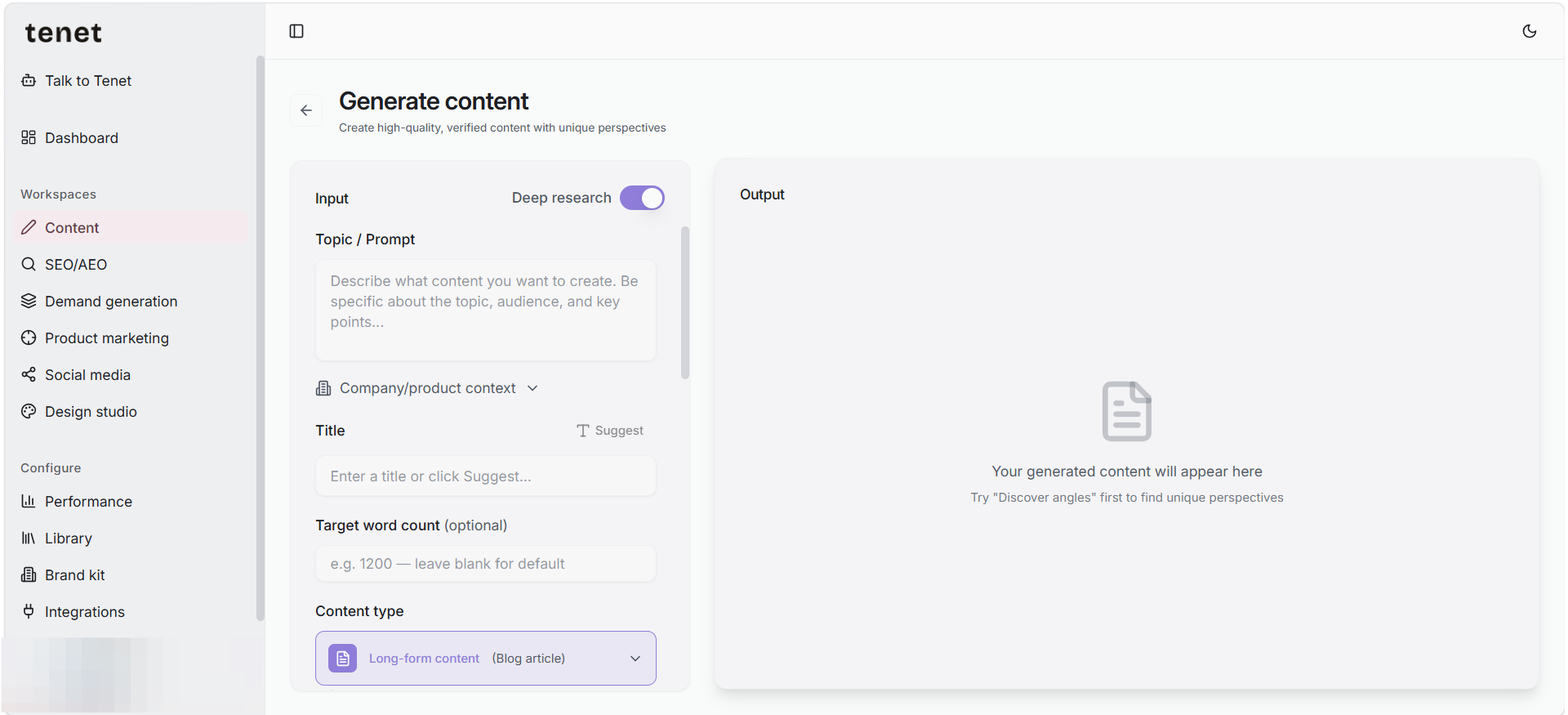
Week 3: Email and Lead Capture. Build your welcome sequence, configure your lead magnet funnel, and set up your landing page with at least two headline variants to test.
Week 4: Paid Channels and First Review. Launch a small paid test (even $10-20/day) with five creative variants, review your first week of data, and document what you learned.
Month 2 and Beyond: The goal is iteration speed. How quickly can you generate a hypothesis, test it with AI assistance, measure the result, and apply the learning to the next experiment? That speed, compounded over time, is the real competitive advantage.
How Tenet can help
If this checklist surfaced more gaps than you have time to close on your own, that's exactly the problem Tenet is built to solve.
Tenet is an AI marketing platform built for founders and lean teams — it handles the research, writing, SEO, campaigns, and content strategy end-to-end, so you're not stitching together five different tools or starting from a blank page every week.
 Anjana Vasan
And if you want someone to actually run it for you, that's what Tenet Operator is for. You get the platform plus one dedicated person who owns your marketing — the plan, the execution, and the weekly reporting. They work inside your Tenet account, so you see everything, keep everything, and spend your time approving direction rather than managing work. No rotating agency team, no freelancer juggling five other clients. Just one person, accountable for shipping your marketing every week.
Conclusion
The founders who win with AI marketing aren't the ones with the most tools or the highest content volume. They're the ones who got clear on their message first, tied everything back to real business outcomes, and kept enough human judgment in the loop to catch what the AI misses.
Work through this checklist section by section. Build the foundation before you scale the tactics. Measure from day one. And when something isn't working, trust the data over the urge to add another tool.
The compounding effect works in your favor here: small improvements in message clarity, audience targeting, and conversion add up fast. Start with the fundamentals — and let the math do its work.
Frequently asked questions
How much should a founder realistically budget for AI marketing tools?
For early-stage companies, a functional AI marketing stack costs between $100-400/month. This covers an AI writing assistant, a basic email platform, and either a CRM with AI features or a lightweight analytics tool. You don't need enterprise-grade tools to get enterprise-level results from the basics.
Should AI generate my content entirely or just assist with it?
Assist, not replace. The content that performs best consistently combines AI's speed and structure with human judgment, specific examples, and real positions. Use AI to get to a workable draft faster; then invest the time you saved into making the content actually say something worth reading.
How do I keep my brand voice consistent across AI-generated content?
Create a brand voice document with tone descriptors, examples of on-brand writing, and explicit no-fly zones (phrases, formats, or topics you never use). Feed this document to your AI tools as context at the start of every content session. Some teams maintain a "system prompt" with brand guidelines that gets appended to every prompt automatically.
What's the biggest AI marketing mistake founders make?
Automating before validating. If your positioning isn't working manually, AI will just help you scale messaging that doesn't convert. Get three to five customers through a mostly manual process first, understand what actually convinced them, then use AI to systematize and scale that proven message.
How do I measure whether AI is actually improving my marketing?
Run controlled comparisons where possible. For email, test AI-generated subject lines against human-written ones and track open rates. For ads, track ROAS on AI-generated creative versus your baseline. For content, track organic traffic and conversion rate on AI-assisted pieces versus fully manual ones. Forbes framework recommends tracking ROI impact explicitly as a standing agenda item, not a quarterly afterthought.
Can AI help with investor-facing marketing materials?
Yes, with heavy human oversight. AI can accelerate the drafting of pitch decks, one-pagers, and case studies. But investor materials require a level of specificity, honesty about risk, and narrative coherence that AI doesn't naturally produce. Use AI to get to a first draft; then rewrite from scratch if necessary. Investors read hundreds of decks; generic AI-polished language is recognizable and not in your favor.
When should I hire a marketing person versus continuing with AI tools?
AI tools start to hit limits when your marketing requires deep customer relationships, nuanced positioning decisions, or channel expertise you don't have (complex paid media, PR, partnership development). A useful heuristic from founder-focused guidance ensure you have six-plus months of runway after the hire before committing, and make sure your analytics are solid enough that a new hire has clear signal on what to optimize.