

TL; DR
- AI won't replace marketing managers, but it's already replacing the work junior marketers used to do — automation risk for the role sits at just 21–24% ("low risk"), and job openings are projected to grow 8.2% by 2033.
- AI is already excellent at execution: content drafts, performance reporting, campaign automation, and SEO/CRO tasks. Marketers using it recover 6–10 hours a week on average.
- What AI can't do is judgment: strategic vision, brand "taste," stakeholder trust, and creative approval calls remain firmly human — and companies that cut strategic roles assuming AI covers the gap tend to end up with a lot of activity and little impact.
- The real disruption is to the career ladder: entry-level execution roles (junior copywriters, social coordinators) are shrinking fast, which threatens the traditional path into marketing management even as the top of the role stays secure.
- The future belongs to "AI conductors" — marketers who direct AI tools to multiply their output while doubling down on strategy, relationships, and creative judgment, not marketers who compete with AI on execution speed.
Can AI replace a marketing manager? No — but it is already replacing the work junior marketers used to do. Automation risk for the marketing manager role sits at just 21–24%, and openings are projected to grow 8.2% by 2033. What AI takes over is execution — drafts, reporting, campaign automation — while judgment, strategy, brand taste, and stakeholder trust stay human. Here is the honest breakdown of what changes, for whom, and how to stay on the right side of it.
 Tenet
TenetThere's a thought experiment economists use called the "lump of labour fallacy." The idea is that people assume there's a fixed amount of work available, so every job a machine takes is a job a human loses. History keeps disproving this. The printing press didn't eliminate writers.
Spreadsheets didn't eliminate accountants. ATMs didn't reduce the number of bank tellers; they actually increased them by making branches cheaper to run.
The question of whether AI will replace marketing managers is running headlong into this same fallacy. The fear is understandable. Analysis show that 95% of marketing work done by agencies, strategists, and creative professionals will be handled by AI "at almost no cost." That's not a fringe prediction from a random tech blogger. That's the person running the most influential AI company in the world.
But the data tells a more complicated story. Current automation risk models put marketing managers at roughly 21–24% automation risk, which sits firmly in the "low risk" category. Job openings for marketing managers are projected to grow 8.2% by 2033. The median U.S. salary for the role sits at $157,620 a year.
So, which is it? Mass displacement, or a job that's growing?
The honest answer is both narratives are partially right, and both are missing the point.
What AI can already do in marketing today
The starting point for any honest assessment is acknowledging what AI is genuinely good at. And right now, it's remarkably good at quite a lot of what fills a marketing manager's week.
AI is already handling a surprising share of a marketing manager's week — here's where it's strongest right now.
the common thread: pattern-based, data-intensive, well-defined tasks — exactly what AI is built for.
Content creation and copywriting at scale
AI tools can now produce first-draft blog posts, email sequences, ad copy, product descriptions, and social captions in seconds. Virgin Holidays demonstrated this practically when they adopted Phrasee, an AI copywriting platform, to generate email subject line variants at scale. Before AI, their team produced 2–3 subject line options per campaign.
After implementation, Phrase generated hundreds of data-tested variants automatically, continuously learning from performance data. The human copywriters didn't disappear; their role shifted from writing every line to setting brand parameters and approving outputs.
The broader productivity data backs this up. The average marketer using AI tools recovers 6.1 hours per week, with senior practitioners saving 8–10 hours. McKinsey estimates generative AI can lift marketing productivity by 5–15%, with the clearest gains specifically in content creation and audience research.
Data analysis, reporting, and performance insights
Performance reporting is one of the most time-consuming parts of a marketing manager's week, and it's one of the tasks AI handles best. IBM Watson, for example, analyzes customer data to deliver personalized experiences while predicting customer intent with up to 80% accuracy before users even express their needs. Work that previously required teams of analysts handling manual segmentation and intent modeling is now largely automated.
Campaign automation and audience targeting
Most platforms now automate email workflows, CRM triggers, audience segmentation, and bid adjustments. A/B test setups that once required dedicated resources can be configured and optimized algorithmically.
According to IDC research, by 2028 around 60% of marketing functions will be managed by AI systems.
SEO, social scheduling, and CRO
Over 50% of marketing managers are already using AI tools for content optimization, competitive research, keyword mapping, and social scheduling. These aren't peripheral tasks; they're the bread-and-butter activities that used to justify full work weeks. AI is compressing them into hours.
What AI cannot do: the marketing manager's irreplaceable edge
Here's where the "AI will replace everyone" narrative breaks down. The tasks AI excels at share a common characteristic: they're pattern-based, data-intensive, and relatively well-defined. The tasks that define excellent marketing managers share a different characteristic: they require judgment under ambiguity.
AI executes well. Where it runs out of road is judgment — here's the line, in three concrete cases from the article.
AI executes. judgment about what's worth executing stays human.
Strategic thinking and long-term brand vision
AI can optimize a campaign. It can identify which headlines perform best this week. What it cannot do is decide whether you should even be running that campaign, whether it serves the three-year brand positioning you're trying to build, or whether the short-term conversion lift is worth the long-term equity erosion. These are judgment calls that require understanding business context, competitive dynamics, leadership priorities, and the kind of nuanced market intuition that comes from years of experience.
As one expert analysis puts it directly: "AI can execute, but it struggles with strategy." Companies that have cut strategic marketers assuming AI can cover the gap tend to end up with a lot of activity and very little impact, campaigns that don't ladder up to coherent positioning, and budget optimization chasing short-term metrics at the expense of brand equity.
Emotional intelligence and human relationship management
Marketing doesn't happen in a vacuum. It happens through relationships: with customers, agency partners, media contacts, internal stakeholders, and sales teams.
Jon-Stephen Stansel, a recognized social media strategist, put it clearly when asked if AI would replace social media managers:
That word "taste" is worth sitting with. Taste is the accumulated ability to recognize what's right even when you can't fully articulate why. It's the thing that prevents your brand from publishing a culturally tone-deaf campaign, from responding to a PR crisis with the wrong register, or from approving technically correct copy that somehow feels off. AI has no taste. A strong marketing manager is largely defined by theirs.
Cross-functional leadership and stakeholder alignment
Marketing managers don't just manage marketing. They negotiate with finance over budget, align with product teams on launch messaging, brief sales on competitive positioning, and convince skeptical executives to approve initiatives. None of this is about data. All of it is about persuasion, trust, organizational credibility, and the ability to read a room. These capabilities are further from automation than any content or analytics task.
Creative direction and brand safety
Heinz ran a campaign using DALL-E 2 to generate AI images for creative assets, inviting the public to submit their own prompts. It worked brilliantly, partly because the marketing team made shrewd strategic decisions: which prompts to use, which outputs to approve, which to reject, and how to frame the campaign as participatory. The AI generated the images. Humans decided what was safe, on-brand, interesting, and worth shipping. That approval layer wasn't optional. It was the whole point.
The real threat: AI replacing junior roles, not senior managers
The honest version of the AI-and-marketing story isn't about senior marketing managers losing their jobs. It's about the traditional career ladder being disrupted from the bottom.
Which marketing roles face highest risk
Christopher Penn at Trust Insights has talked openly about AI enabling headcount reductions at scale. For larger companies with 50 people in roles like social media management, he suggests 80% headcount reduction is feasible. A Forbes analysis estimated AI agents could cut 60% of marketing jobs by 2028, largely in execution and operational roles.
This is already showing up in agency economics. One agency owner reported clients demanding 80% fee reductions because AI produced better results than the agency for certain tasks. Another revealed they were reducing their team by 60% in 2026 because AI had fundamentally changed client cost expectations. These aren't predictions; they're 2025 events already in motion.
How the career ladder is changing
The traditional path into marketing management ran through execution roles: junior copywriter, campaign coordinator, social media specialist, then gradually up toward strategy and leadership. AI is compressing exactly those entry-level roles. The work that used to take a junior team of five to produce is now manageable for one person with the right tools.
This creates a genuine problem for people entering the field. Not because marketing management itself is disappearing, but because the traditional apprenticeship model for reaching it is being disrupted. The marketers who will reach senior roles in five years are the ones building strategic and analytical skills now, not the ones assuming their copywriting output will be irreplaceable.
 Tenet
TenetAI as a force multiplier: what augmentation actually looks like
The most useful mental model here isn't "AI vs. humans." It's closer to asking what a skilled surgeon can accomplish with better instruments. The instruments don't replace the surgeon's judgment; they extend what that judgment can accomplish.
Real-world examples of AI-augmented teams
Christopher Penn runs a newsletter with 300,000 subscribers with a team of four people. AI tools handle data analysis, content segmentation, and repurposing, enabling scale that would have required a large dedicated team five years ago. Trust Insights has four people performing the work that organizations with much larger headcounts used to struggle to match.
This is the augmentation model in practice: not fewer marketing managers, but marketing managers who can do significantly more with less overhead.
Productivity numbers that matter
Multiple research sources converge on consistent productivity figures. Teams using AI strategically report 44% productivity gains. 83% of AI-using marketers report increased productivity. Senior practitioners are recovering 8–10 hours per week. These aren't marginal improvements; they're the difference between one person doing the work of 1.4 and one person doing the work of two.
The implication for marketing managers is straightforward: the ones who adopt AI tools and build the workflows to use them effectively become significantly more valuable, not less. The ones who don't risk being out-produced by a smaller team that does.
The 2026 reality: what the near future actually looks like
Rather than speculating abstractly, it's worth looking at what the data and emerging evidence point to for the next 12–24 months.
What industry analysts are actually forecasting
IDC projects 60% of marketing functions managed by AI by 2028. A 2024 industry survey found 78% of marketers expect at least 25% of their tasks automated within three years, with over a third expecting more than 50% automation. Companies are on track to spend three times more on AI optimization than traditional search engines by 2029.
These numbers sound dramatic, but they're largely about task automation within roles, not elimination of roles themselves. The job is getting restructured, not deleted.
Skills that will define the marketing manager of 2026 and beyond
The skills that automation risk models consistently flag as resistant to AI replacement are worth cataloguing specifically:
- Strategic business acumen: understanding how marketing connects to revenue, competitive position, and company-level priorities
- Emotional intelligence: reading audiences, managing relationships, navigating organizational politics
- Creative judgment: knowing what's good, what's on-brand, and what will land in culture
- Cross-functional leadership: aligning sales, product, finance, and operations around marketing strategy
- Ethical and brand oversight: making decisions about what a company should and shouldn't do in public
The marketing managers who thrive in 2026 won't be the ones who fought AI adoption. They'll be the ones who become skilled at directing AI tools while deepening exactly these human capabilities.
How marketing managers can future-proof their careers against AI
Here's a practical framework, not a theoretical one.
Future-proofing the role comes down to a four-step framework the article lays out plainly.
the risk signal the article flags: if your role is 60% repetitive execution, the work is migrating toward AI.
Step 1: Audit your current role for AI vulnerability
Map your weekly tasks into three categories: repetitive (reporting, first drafts, scheduling), judgment-based (strategy, approvals, prioritization), and relationship-based (stakeholder meetings, agency management, client conversations). The first category is where AI will increasingly replace you. The second and third are where your value concentrates.
If your role is 60% repetitive execution, that's a genuine risk signal. Not because you'll be fired tomorrow, but because the work is migrating toward AI and away from headcount.
Step 2: Build AI literacy without becoming an engineer
You don't need to understand how large language models work at a technical level. You need to know how to brief them effectively, what they're good and bad at, how to evaluate their outputs critically, and which tools are worth building into your workflows. This is operational fluency, not engineering.
Step 3: Double down on high-value human skills
Strategic thinking, stakeholder communication, creative direction, and cultural judgment aren't soft skills; they're the skills that are genuinely hard to automate. Investing in them now is investing in the part of your role that AI will expand, not replace.
Step 4: Reposition as an AI-enabled strategic leader
The framework that's gaining traction in the field is "AI conductor": someone who knows which tools to deploy, when, and how to synthesize their outputs with human insight to drive better decisions. This framing is more accurate and more valuable than "marketer who also uses AI tools."
A note on choosing the right partner
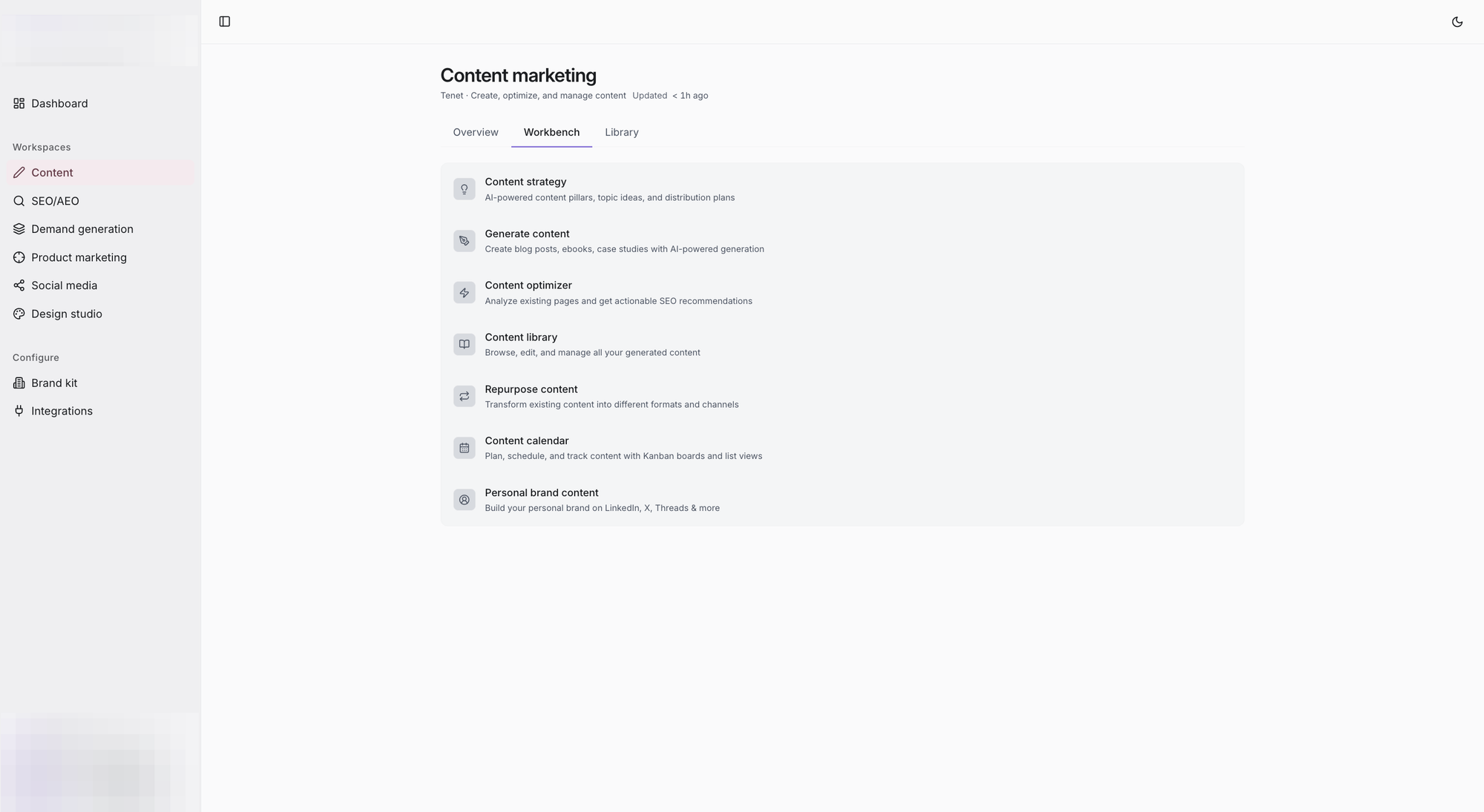
One factor that's easy to underestimate is whether your marketing setup — tool, platform, or partner — is genuinely built around the way marketing works now, or just dressed up with AI language to sound current. Tenet is worth understanding here, because it's a different kind of answer to the same problem.
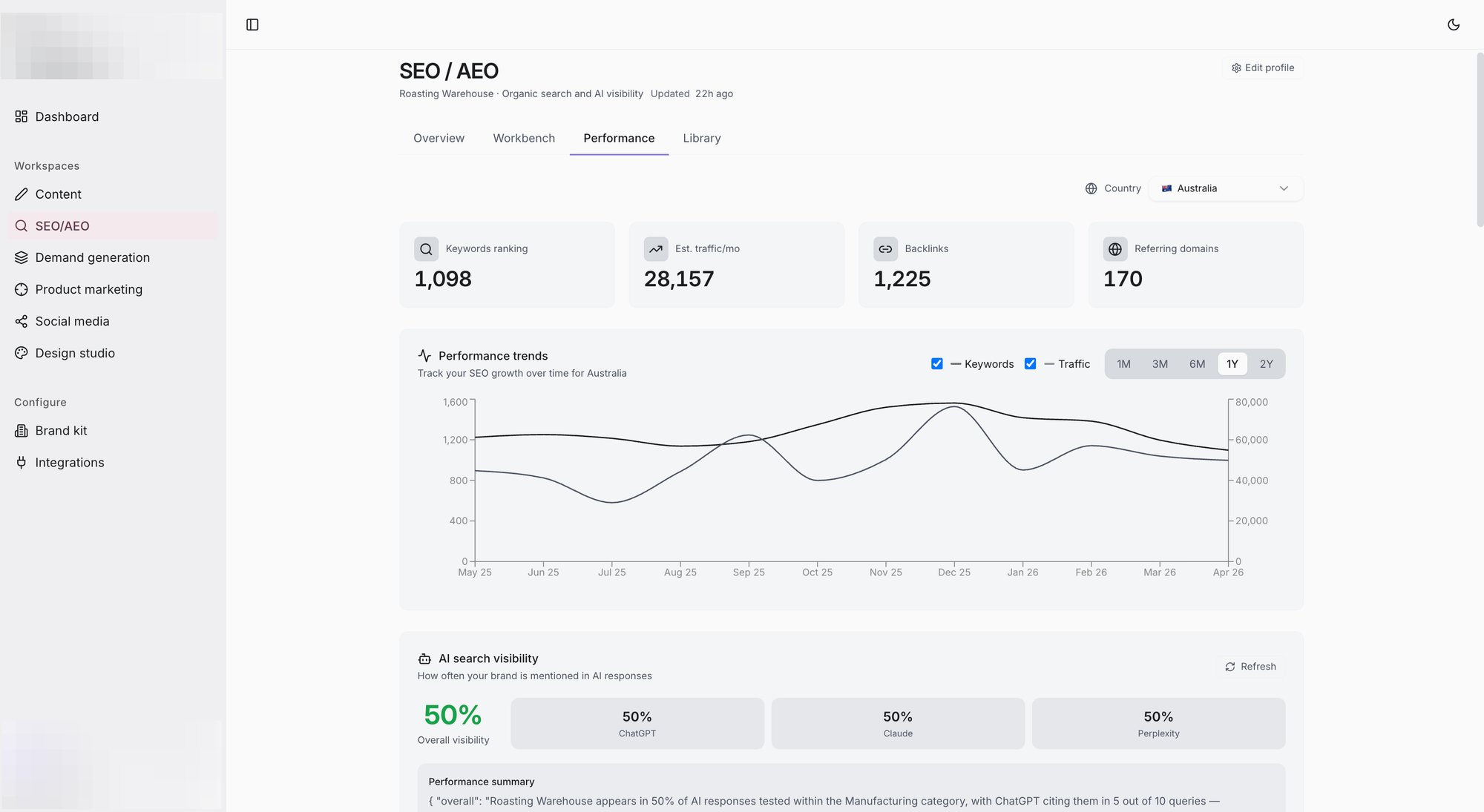
Tenet is an AI marketing agent built specifically for lean teams: solo marketers, founders, and small B2B SaaS companies that need the output of a full marketing department without the headcount. It handles strategy, positioning, content, SEO, demand gen, social, and product marketing in one connected system — not as a writing assistant, but as an agent that researches, writes, scores, and optimizes work before you ever see it.
For marketing managers who are already stretched, the more relevant offering is Tenet Operator. It pairs the AI agent with one dedicated person who owns your marketing week to week — running the plan, shipping campaigns, and reporting back on what's actually moving the needle. There are no account rotations, no opaque agency workflows, and no tool fees layered on top. The work lives in your account, and if you ever leave, you keep a fully working setup. One person, powered by the AI doing the heavy lifting underneath, can handle what normally takes a whole team.
 Anjana Vasan
 Tenet
Tenet