


TL;DR
 Tenet
Tenet- "We should do marketing" is a statement of intent, not a plan and most marketing efforts fail not from lack of ideas, but because intent never becomes a governed system.
- An AI-led marketing sprint structures your decisions in the right order: goals → ICP → money pages → topic clusters → content briefs → channels → KPIs.
- AI speeds up the messy middle – clustering ideas, drafting briefs, analyzing SERPs but the judgment and final decisions still belong to your team.
- A realistic 90-day plan built around 70% of your team's capacity will always outperform an ambitious one that collapses by week four.
- Done right, the sprint produces a repeatable marketing operating system, not a one-time strategy doc; so marketing keeps running even when attention moves elsewhere.
An AI marketing plan becomes real when a 7-day sprint turns "we should do marketing" into a governed sequence: goals, ICP, money pages, topic clusters, content briefs, channels, and KPIs. AI speeds up the messy middle — clustering keywords, drafting briefs, summarizing SERPs — while the team keeps the judgment calls. Built around 70% of team capacity, the plan becomes a repeatable operating system instead of a strategy doc nobody reopens.
There’s a specific kind of business sentence that sounds productive but changes nothing:
“We should do marketing.”
Everyone agrees. Nobody argues. A few ideas get thrown around. Someone mentions SEO. Someone else suggests LinkedIn. A founder says they want more leads. A sales leader asks for better content. For a moment, the company feels aligned.
Then the week moves on.
The person who raised the idea gets pulled into customer calls. The founder goes back to product and hiring. The one marketer, if there is one, opens a blank planning doc and tries to convert vague momentum into something executable. By the next week, the energy has faded. The idea still exists, but the plan does not.
This is where most marketing efforts fail. Not because the team lacks creativity. Not because the company has nothing useful to say. Not because AI tools are bad.
They fail because nobody turns intent into infrastructure.
AI can help, but only if it is used correctly. The point of an AI-led marketing sprint is not to create a dramatic 90-day strategy deck that looks impressive in a meeting. The point is to build a boring, repeatable system: goals, customer retention profiles, money pages, topic clusters, content briefs, channels, KPIs, owners, and a review cadence.
That is what this guide is about.
What is an AI-led marketing sprint?
An AI-led marketing sprint is a structured planning process that uses AI to turn business goals into a usable marketing operating system. Instead of asking AI to “create a marketing strategy,” you use it to organize decisions, expose gaps, draft briefs, map priorities, and pressure-test the plan before your team starts executing.
The difference matters.
A generic AI-generated strategy usually gives you a long list of plausible tactics: publish more blogs, run paid ads, start an email newsletter, improve SEO, post on LinkedIn, build lead magnets. None of that is wrong. But it is not a plan.
A real plan answers harder questions:
- Who exactly are we trying to reach?
- What business outcome are we trying to influence?
- Which pages on our site actually create pipeline?
- Which topics support those pages?
- Which channels can we realistically sustain?
- Who owns the work?
- How will we know if it is working?
AI is useful because it speeds up the messy middle. It can help structure scattered inputs, cluster ideas, create first drafts, summarize competitive patterns, and generate repeatable templates. But the judgment still comes from the team.
Core components of an AI-led marketing plan
A strong AI-led marketing plan has seven pieces:
- Defined business goals tied to revenue, retention, or pipeline
- Clear ideal customer profiles with pain points, buying triggers, and objections
- Money pages that convert visitors into leads, demos, trials, or revenue
- Topic clusters that support those money pages
- Channel priorities based on customer behavior and team capacity
- A 90-day execution calendar with owners and deadlines
- KPIs and a review cadence so the plan can self-correct
- Notice what is not on that list: “go viral,” “build thought leadership,” or “post more often.”
Those might happen later. But they are not the foundation.
The foundation is a system your team can follow even when nobody feels excited anymore.
Why “we should do marketing” usually goes nowhere
Most companies do not fail at marketing because they lack ideas. They fail because the ideas never become governed work.
“We should do marketing” is a statement of intent. It is not a strategy. It does not define the customer, the goal, the channel, the message, the owner, the deadline, or the metric. It creates energy, but not accountability.
That is why marketing often becomes reactive. Someone asks for a blog post. Someone wants a landing page. Someone suggests a campaign. A competitor launches something and the team rushes to respond. The work feels active, but it is not connected.
AI can make this worse if the team uses it only for output. It becomes easier to produce more content without fixing the underlying problem: nobody knows what the content is supposed to do.
The governance problem
Marketing needs governance before it needs more ideas.
Governance sounds heavy, but in this context it simply means:
- Who decides priorities?
- Who approves messaging?
- What gets created first?
- What does “good” look like?
- What should AI be allowed to draft?
- What needs human review?
- What happens every month when the numbers come in?
Without those answers, AI gives teams speed without direction. That creates more drafts, more scattered assets, and more work to manage.
A 7-day sprint solves this by forcing decisions in the right order. First goals. Then ICP. Then money pages. Then topics. Then channels. Then calendar. Then governance.
The infrastructure mindset vs. the campaign mindset
A campaign mindset asks, “What should we launch?”
An infrastructure mindset asks, “What system should we build so marketing keeps working even when attention moves elsewhere?”
That shift changes everything. A campaign might be a one-time email push, a webinar, a LinkedIn series, or a product launch sequence. It can be useful. But if every marketing effort starts from zero, the team never builds compounding value.
Infrastructure looks less exciting:
- A documented SEO cluster that gets updated quarterly
- A set of product pages tied to specific buyer pain points
- A monthly review of keyword rankings and demo requests
- A reusable content brief template
- A nurture sequence that follows up after a demo request
- A competitive intelligence doc that has one owner
None of this feels flashy. That is the point.
Durable marketing is usually boring before it becomes effective.
AI marketing planning examples that create real structure
The best way to use AI in marketing planning is not to ask it for one big answer. It is to give AI a specific role at each step.
The order matters more than the tools — here's the seven-day sequence the sprint forces.
seven days, in order — skip a step and the rest wobbles.
Here is how the 7-day sprint works.
Day 1: Define goals, ICP, and money pages
Day 1 is about turning vague business goals into measurable marketing priorities.
Most teams start with something broad:
“We need more leads.”
“We need better content.”
“We need to grow organic traffic.”
“We need to explain the product better.”
Those are useful signals, but they are not usable goals. Your first job is to convert them into specific outcomes.
Use AI to create a goal tree from the business objective.
Prompt:
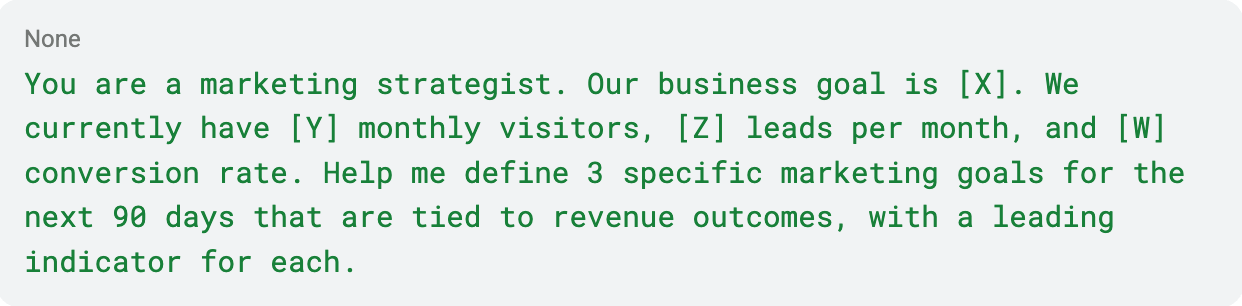
The output will not be perfect. That is fine. You are not asking AI to make the decision. You are asking it to structure the decision.
Once the goals are clear, identify the pages that actually do the revenue work.
These are your money pages.
They may include:
- Product pages
- Use case pages
- Pricing pages
- Demo pages
- Comparison pages
- Industry landing pages
- High-intent service pages
- Conversion-focused landing pages
A common mistake is building the blog before fixing the pages the blog is supposed to support. If your product page is weak, your go-to-market strategy has nowhere useful to send people.
Day 1 deliverables
- 3 signed-off marketing goals
- A clear ICP summary
- A list of 5–15 money pages
- A note on which money pages exist, which are weak, and which are missing
Day 2: Build keyword research around intent
Keyword research becomes messy when it starts too early.
If you begin with a keyword tool, you will find hundreds of possible topics. Some will look interesting. Some will have high search volume. Some will be easy to rank for. But without a business goal, you will not know what matters.
That is why Day 2 starts after Day 1.
Now you can ask a sharper question:
Which searches support our money pages and business goals?
- Use Semrush, Ahrefs, Google Search Console, or another SEO tool to pull keyword data around each money page. Then use AI to organize the list by intent.
- The goal is not just to find keywords. It is to map them to the buyer journey.
- Informational keywords help buyers understand the problem
- Commercial keywords help buyers compare options
- Transactional keywords help buyers make a decision
- Each cluster should support a specific page.
For example, if your money page is a product page for an AI marketing agent, your supporting topics might include:
- What is an AI marketing agent?
- AI marketing agent vs AI marketing tool
- How to build a marketing function with AI
- Best AI marketing software for small teams
- AI marketing strategy examples
Each topic should have a job. If it does not support a money page, a buyer question, or a revenue goal, it is probably a distraction.
Day 2 deliverables
- A prioritized keyword list
- Keywords grouped by intent
- 3–7 topic clusters
- Each cluster mapped to a money page
Day 3: Analyze the SERP and competitors
Before writing anything, study what already ranks.
This does not mean copying competitors. It means understanding what Google is already rewarding and where the gaps are.
For each priority keyword, look at the top-ranking results and ask:
What format is ranking?
Is it a guide, listicle, comparison, template, calculator, or product page?
- What questions does every result answer?
- What sections appear repeatedly?
- What examples do they use?
- What is missing?
- Where is the content too generic?
Where could your company provide a more specific answer?
AI can help summarize SERP patterns, but you should still review the actual pages yourself. AI is useful for organizing observations. It should not replace judgment.
Prompt:
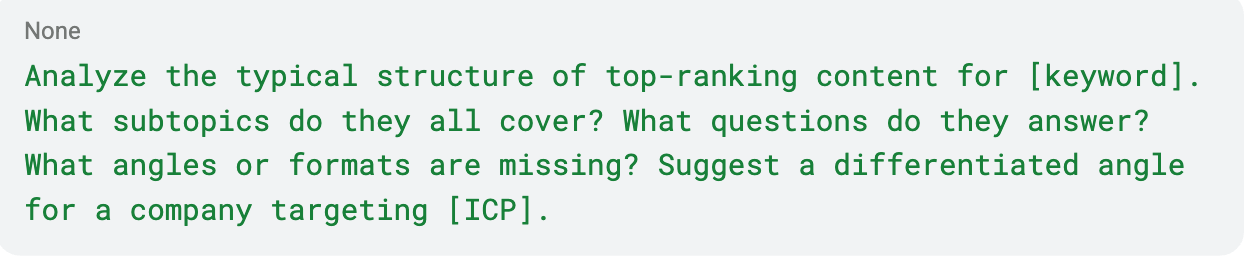
The most useful output from Day 3 is not a list of competitors. It is a point of view.
You need to know how your content will be different.
Maybe it is more practical. Maybe it is built for small teams. Maybe it is focused on revenue instead of traffic. Maybe it includes templates. Maybe it explains what most articles skip.
Without that angle, you are just adding another article to the internet.
Day 3 deliverables
- A SERP analysis document
- Common ranking patterns
- Content gaps
- A one-paragraph differentiation statement
 Tenet
TenetDay 4: Build topic clusters and content architecture
Day 4 is where the plan starts to become visible.
- You have goals, money pages, keywords, and SERP insights. Now you need to arrange them into a content architecture.
- A topic cluster connects related content around a central theme. Usually, it includes:
- A pillar page that covers the broad topic
- Supporting articles that answer more specific questions
- Internal links from supporting articles to the pillar page
- Internal links from the pillar page to supporting articles
- Links from relevant articles to money pages
This structure helps both users and search engines understand your authority around a topic.
It also helps your team stop making random content decisions.
Instead of asking, “What should we write this week?” you ask, “Which piece in this cluster is next?”
Designing for AI search
This is also where you make the plan LLM-ready.
- AI search rewards content that is easy to retrieve, summarize, and cite. That means your content should be structured clearly.
- Use direct, question-shaped headings
- Open sections with a clear answer
- Define important terms plainly
- Use specific examples
- Attribute statistics clearly
- Add FAQ sections with concise answers
- Make internal links obvious and relevant
This is not about stuffing articles with keywords. It is about making the page easier for both humans and AI systems to understand.
Day 4 deliverables
- Cluster map for each money page
- Pillar page recommendations
- Supporting article list
- Internal linking blueprint
- First 10 pages to create or optimize
Day 5: Create content briefs, not full drafts
Day 5 is where many teams move too fast.
They ask AI to write the article.
That is usually the wrong first move.
Before creating content, you need instructions. A content brief turns strategy into execution. It tells the writer, editor, or AI assistant what the piece needs to accomplish.
A good content brief includes:
- Target keyword
- Audience
- Funnel stage
- Search intent
- Recommended title
- H2 and H3 structure
- Questions to answer
- Internal links
- External source needs
- Word count range
- Differentiation angle
- CTA
This removes guesswork. It also keeps AI-generated drafts from becoming generic.
Prompt:
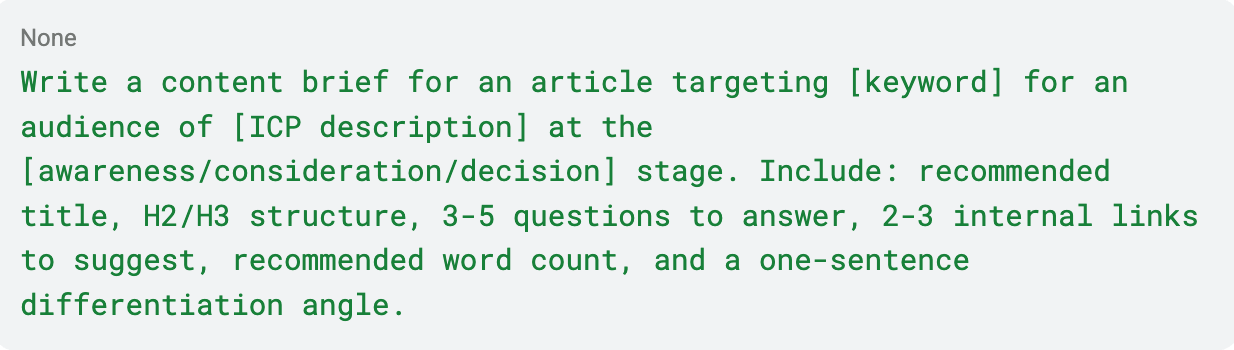
The content brief becomes the control layer. It gives AI boundaries. It gives writers direction. It gives editors a way to judge whether the draft did its job.
Day 5 deliverables
- 8–20 content briefs
- A reusable brief template
- Internal link recommendations
- CTA guidance for each asset
Day 6: Choose channels your team can actually sustain
Most marketing plans collapse because they overcommit.
A small team decides to publish weekly blogs, post daily on LinkedIn, run paid search, start a newsletter, launch webinars, build lead magnets, and update the website.
The plan looks impressive. Then real life happens.
The team misses one week. Then two. The calendar becomes unrealistic. Eventually, everyone stops looking at it.
Day 6 is about choosing fewer channels and making them work.
Your channel plan should be based on two things:
- Where your ICP actually spends time
- What your team can execute consistently
Here is a simple way to think about it:
For most lean teams, two or three channels are enough. A realistic plan beats an ambitious one that dies in six weeks.
Campaign architecture
Once channels are selected, create campaign maps for your top two money pages.
Each campaign should include:
- Traffic driver
- Landing page
- Follow-up sequence
- Conversion goal
- Owner
- Metric
For example, if the money page is an AI marketing agent product page, the campaign might include:
- SEO article cluster as the traffic driver
- Product page as the landing destination
- Email nurture sequence for demo requests
- Demo booked as the conversion goal
- Organic demo requests as the KPI
This makes marketing feel less scattered. Every asset has a role.
Day 6 deliverables
- 2–3 channel priorities
- Rationale for each channel
- Campaign maps for top money pages
- Distribution checklist for each content type
Day 7: Turn the plan into an operating system
Day 7 is where the sprint becomes real.
You are not creating more ideas. You are building the system that governs what happens next.
Start with a 90-day calendar. Assign the first pieces of work to specific owners with deadlines. Be conservative. Build the plan around 70% of your team’s capacity, not 100%.
That buffer matters.
People get sick. Product priorities change. Customer calls run long. Launches move. If your plan only works in a perfect week, it is not a good plan.
Next, define your KPIs.
- Keep them operational:
- Organic traffic to money pages
- Keyword rankings for priority terms
- Demo requests from organic
- Email open rates
- Email click-to-demo rate
- Cost per qualified lead
- Landing page conversion rate
- Content production velocity
Every KPI needs an owner and a review cadence. A metric nobody reviews is decoration.
Finally, use AI as a critic before finalizing the plan.
Prompt:
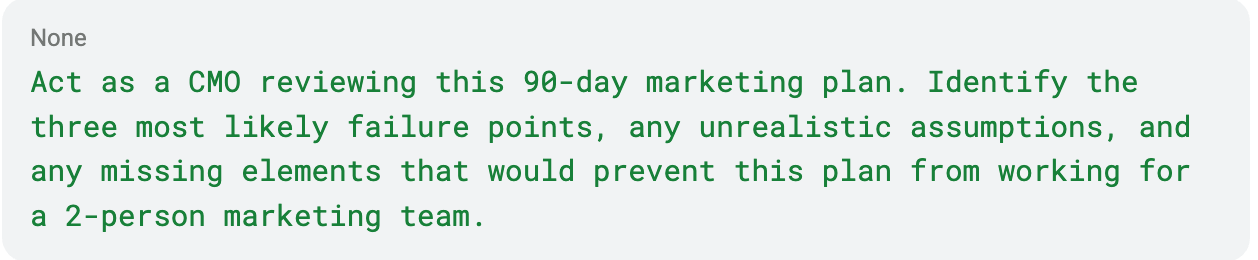
This prompt is useful because it forces the plan to face reality before execution begins.
Day 7 deliverables
- 90-day execution calendar
- KPI dashboard structure
- Owners for each workstream
- Monthly review cadence
- One-page stakeholder summary
How to make the plan LLM-ready, not just Google-ready
Search behavior is changing. People still use Google, but they also ask AI tools for recommendations, explanations, comparisons, and vendor shortlists.
That means your content needs to work for both traditional search and AI retrieval.
The practical differences are simple.
Use answer-first sections
- Start each section by answering the question directly. Then add explanation, examples, and nuance.
- For example:
- What is a money page?A money page is a website page designed to convert visitors into pipeline, revenue, or another business outcome.
- That structure is easier for users to understand and easier for AI systems to summarize.
Define your terms clearly
- Do not assume the reader knows your internal language.
- If you use terms like money page, ICP, topic cluster, conversion path, or AI marketing agent, define them plainly.
- Definitions make content more useful and more quotable.
Use specific data with attribution
- AI tools are more likely to surface content that includes clear, well-supported claims. Avoid vague statements like “many companies are using AI.”
- Use concrete claims only when you can support them with credible sources.
Add FAQs
- FAQ sections map naturally to how people search and how AI tools answer questions.
- Keep answers short, complete, and direct.
Build internal links intentionally
Every article should point somewhere useful.
- Cluster articles should link to pillar pages. Pillar pages should link to supporting articles. Relevant articles should link to money pages.
- Internal linking is not just an SEO tactic. It is how you guide the reader toward the next logical step.
Governance rules for AI-led marketing
AI makes it easier to produce more work. That is useful only if the work stays accurate, on-brand, and aligned with the business. The governance layer does not need to be complicated.
You need three rules.
1. Create a brand brief for every AI workflow
Your brand brief should include:
- ICP
- Product positioning
- Voice guidelines
- Approved phrases
- Banned phrases
- Claims you can make
- Claims you cannot make
- Competitors to avoid naming
- Internal links to prioritize
This brief should be included in every content workflow.
2. Add a human review checkpoint
AI can draft, organize, summarize, and suggest. But a human should review anything that gets published.
The review does not need to be slow. A 10-minute check can catch the most important issues:
- Is the claim accurate?
- Does the tone sound like the brand?
- Are the links working?
- Is the CTA correct?
- Does the content match the brief?
- Are any unsupported statistics included?
3. Set a data privacy rule
Teams need a clear rule for what should never be pasted into external AI tools.
That may include:
- Customer data
- Financial data
- Private sales notes
- Internal strategy
- Unreleased product information
- Confidential customer examples
The goal is not to slow the team down. It is to make AI safe enough to use consistently.
Common mistakes that kill AI marketing plans
The most common failure is not bad keyword research. It is overbuilding. Teams try to create too much too quickly. They plan 40 briefs, six campaigns, daily social posts, weekly newsletters, and a full website refresh.
A realistic plan built at 70% capacity outruns an ambitious one — watch both play out over the 90-day plan.
The ambition is real. The capacity is not.
By week four, the plan feels impossible. People stop following it. The calendar gets ignored. Marketing goes back to scattered execution.
The fix is simple:
- Cut the plan in half.
- If you are a solo marketer, your realistic 90-day plan might be:
- Two blog posts per month
- One money page optimization per month
- One email nurture improvement per month
- One monthly KPI review
That might not look impressive in a strategy deck. But it can actually run.
A plan that runs is better than a plan that inspires people for three days and disappears.
Comparison: AI-led sprint vs. traditional marketing planning
The AI-led sprint wins on speed and cost. But it only works if the team treats it as an operating system, not a one-time planning exercise.
Compare the four approaches to see how the article's own numbers stack up.
the sprint wins on speed and cost — durability still depends on running it as a system instead of a one-time exercise.
The goal is not to finish a document but to create a repeatable way to decide what marketing should do next.
TenetHow Tenet helps small teams turn planning into execution
Building a marketing plan is one thing. Keeping it alive is the harder part.
That work often gets spread across too many tools and too few people.
Tenet is built for teams that need marketing infrastructure without building a full marketing department. It helps turn scattered ideas into strategy-backed content, SEO-ready briefs, campaign assets, and repeatable workflows.
That is the real value of a 7-day AI-led marketing sprint. It turns “we should do marketing” into a system: goals, ICP, money pages, topic clusters, content briefs, channels, KPIs, owners, and review cycles.
Instead of starting from a blank page every week, your team can work from a structured plan: goals, ICP, pages, topics, briefs, campaigns, and KPIs.
Marketing gets simpler when the system is clear.
Small teams do not need more random content. They need a marketing function that runs.