


There's a paradox hidden in plain sight across social media feeds. Scroll through Instagram, and you'll see perfectly curated posts from creators with millions of followers—polished product shots, professional lighting, captions that read like advertising copy. These posts might get thousands of likes, but they often generate fewer actual sales than a simple, unfiltered video from someone with 50,000 followers showing how they actually use the product.
And the true differentiator? It isn't reach; it's trust.
This disconnect reveals something fundamental about how influence actually works. Real influence isn't about broadcasting to the largest possible audience—it's about creating genuine connections that drive action. When 92% of consumers trust recommendations from influencers more than traditional advertisements, they're not responding to polish or production value. They're responding to authenticity.
Yet most brands still approach influencer marketing like it's traditional advertising with a social media wrapper. They chase follower counts, create rigid content briefs, and measure success through vanity metrics. The result? A $32 billion industry where many campaigns fail to deliver meaningful ROI despite massive investment.
The brands that succeed understand that influencer marketing isn't about renting someone else's audience; it's about building partnerships that create value for everyone involved: the brand, the creator, and most importantly, the audience. This guide breaks down exactly how to build that kind of strategy.
What is an influencer marketing strategy?
Influencer marketing strategy is the systematic approach to partnering with content creators who have established trust and authority with specific audiences. Unlike traditional advertising, which interrupts consumers with messages, influencer marketing integrates brand messages into content that audiences actively choose to consume.
The core components work together like a three-legged stool. First, there's audience alignment—ensuring the influencer's followers match your target customer profile. Second is authentic integration—the brand message fits naturally within the creator's typical content style and voice. Third is measurable value exchange—both the brand and influencer receive clear benefits that justify the partnership.
What makes this approach powerful is specificity. When Warby Parker partnered with seven micro-influencers who had organically posted about the brand, they weren't just buying access to audiences. They were amplifying existing authentic conversations, creating content that felt genuine because it was genuine.
Why influencer marketing strategy matters in 2026
The numbers tell a clear story about why this matters now more than ever. The global influencer marketing market reached $24 billion in 2024, tripling since 2019. But growth isn't the most important metric—effectiveness is.
Brands report an average ROI of $5.78 for every dollar spent on influencer marketing, significantly outperforming many traditional channels. More telling, 57% of consumers have made purchases based on influencer recommendations, proving that these partnerships drive actual buying behavior, not just awareness.
The shift reflects broader changes in how people consume media and make purchasing decisions. Traditional advertising relies on repetition and interruption—the idea that enough exposure will eventually drive action. Influencer marketing works through recommendation and relationship—leveraging the trust creators have built with their audiences over time.
The 4 m's of influencer marketing framework
The article's 4 M's framework for running a campaign — flip each to see what it covers.
83.8% of brands say influencer-acquired customers outperform other channels on quality.
Make (content creation)
Content creation in influencer marketing isn't just about producing posts—it's about creating assets that serve multiple purposes across your marketing ecosystem. The most successful brands treat influencer partnerships as content studios, generating materials that work across paid advertising, email campaigns, and owned media channels.
 Dhanishta Raman
Kettle & Fire demonstrates this approach effectively. When they partnered with targeted influencers to create Instagram posts for their bone broth products, they didn't just use the content once. Those posts became the foundation for Facebook ad campaigns, solving two problems simultaneously: creating authentic content and improving ad performance.
The key is thinking beyond the initial post. When you brief influencers, consider how the content might be repurposed. A single collaboration can generate Instagram posts, Instagram Stories, TikTok videos, and even longer-form content for YouTube or blogs. This multiplies the value of each partnership while giving influencers more opportunities to showcase their creativity.
Smart content planning also considers the full customer journey. Different types of content serve different purposes: awareness-stage content introduces your brand to new audiences, consideration-stage content helps potential customers understand your value proposition, and conversion-stage content provides the final push toward purchase.
Dhanishta Raman
Manage (campaign management)
Effective campaign management balances structure with flexibility. You need enough process to ensure campaigns deliver on their objectives, but not so much that you constrain the creativity that makes influencer content effective.
The foundation is clear communication about expectations, deliverables, and timelines. Successful brands typically reach out to influencers at least three months before campaign launch, allowing time for strategy development, content planning, and review cycles. This timeline prevents rushed content that feels forced or inauthentic.
Campaign management also involves orchestrating multiple moving pieces. If you're working with several influencers, content should be staggered to create sustained visibility rather than a single burst. If you're running paid amplification alongside organic posts, timing becomes even more critical. Lean teams in particular benefit from systematizing this.
Anjana Vasan
Documentation matters enormously here. Successful campaigns track not just what content was created and when it was published, but also what worked and why. This knowledge becomes invaluable for future campaigns, helping you identify which types of content, influencers, and messaging drive the best results.
Monitor (performance tracking)
Real-time monitoring allows you to identify opportunities and problems while you can still act on them. If an influencer's post is performing exceptionally well, you might increase paid amplification. If engagement is lower than expected, you can analyze why and adjust future content accordingly.
The most important metrics during active campaigns are engagement rates, reach, and early conversion signals. Engagement rates tell you how well content is resonating with audiences. Reach shows you how many people are seeing your message. Early conversion signals—like clicks, website visits, or promo code usage—indicate whether content is driving action, not just awareness.
Monitoring also involves qualitative assessment. Read comments on posts to understand audience sentiment. Are people asking questions about your product? Expressing skepticism? Sharing their own experiences? This feedback provides insights that quantitative metrics miss.
Advanced monitoring includes competitive intelligence. Track how competitors' influencer campaigns are performing, what types of content they're creating, and which influencers they're working with. This information helps you identify opportunities they might be missing or tactics you should consider adopting.
Measure (ROI analysis)
ROI measurement in influencer marketing requires both direct attribution and broader impact assessment. Direct attribution tracks immediate actions: sales from promo codes, traffic from bio links, conversions from specific campaigns. Broader impact assessment looks at how influencer marketing affects overall brand metrics: awareness, consideration, customer acquisition costs, and lifetime value.
The most sophisticated measurement approaches use multi-touch attribution, recognizing that customers typically interact with multiple touchpoints before purchasing. An influencer post might introduce someone to your brand, but they might not purchase until they see a retargeting ad or receive an email campaign. Proper attribution ensures influencer marketing gets credit for its role in that conversion journey.
Dhanishta Raman
Customer lifetime value (CLV) often reveals influencer marketing's true impact. While the immediate ROI might be positive, customers acquired through influencer recommendations often have higher retention rates and spend more over time. 83.8% of brands believe the quality of customers from influencer marketing campaigns exceeds other channels.
Dhanishta Raman
The 3 R's of influencer marketing
The article's 3 R's framework — reach, relevance, resonance — in the order it argues they matter.
69% of marketers call long-term relationships the most effective strategy — resonance is what compounds when a partnership runs long enough to build trust.
Reach: Expanding your audience
Reach in influencer marketing isn't just about raw numbers—it's about reaching the right people with the right message at the right time. The most effective reach strategies focus on quality over quantity, prioritizing audiences that align closely with your target customer profile.
Micro-influencers often provide superior reach efficiency compared to mega-influencers. While a celebrity might have millions of followers, their audience is typically broad and diverse. A micro-influencer with 50,000 followers in a specific niche often delivers better reach for your actual target market. Micro-influencers deliver higher engagement rates than macro-influencers, with some platforms like TikTok averaging 17.9% engagement compared to Instagram's 3.5%.
Platform selection dramatically impacts reach effectiveness. Instagram remains dominant, with 89% of marketers using it for campaigns, but platform preferences vary by industry. YouTube is preferred for technology influencer marketing, with 90% of marketers using it, while TikTok shows the highest growth, with 32% of brands increasing investment.
The most sophisticated reach strategies use multiple influencers across different audience segments, creating a network effect. Daniel Wellington exemplified this approach, generating over 20,000 mentions from 7,200 influencers—more mentions than Nike or Sephora achieved, despite being a much smaller brand.
Relevance: Targeting the right audience
Relevance requires deep understanding of both your target customer and the influencer's audience. Surface-level demographic matching isn't enough—you need alignment on interests, values, and behaviors. An influencer might have the right age and income demographics, but if their content focuses on topics unrelated to your product category, the partnership won't drive results.
Dhanishta Raman
Audience analysis goes beyond follower counts to examine engagement patterns. Look at who comments on posts, what types of content generate the most interaction, and whether the audience asks questions that suggest genuine interest in the influencer's recommendations. High engagement with promotional content indicates an audience that trusts the creator's endorsements.
Geographic relevance matters more than many brands realize. An influencer with a global following might seem attractive, but if your product is only available in certain markets, much of that reach becomes irrelevant. Successful brands often prioritize influencers whose audiences cluster in their target markets.
Industry experts emphasize that "the most successful influencer partnerships are based on shared values and audiences rather than follower count." This shared-value alignment creates natural content opportunities where your brand message integrates seamlessly with the influencer's typical content themes.
Resonance: Creating meaningful connections
Resonance happens when influencer content doesn't just reach your target audience—it moves them. This requires content that feels authentic, provides value, and connects emotionally with viewers. Resonance is why some influencer posts with modest reach generate significant sales while others with massive reach produce minimal results.
Authentic integration is crucial for resonance. The most effective influencer content doesn't feel like advertising—it feels like a friend sharing a genuine recommendation. This authenticity requires giving influencers creative freedom while ensuring they understand your brand's core value proposition. If you haven't nailed that value proposition yet, start with how to create a powerful unique selling proposition.
Storytelling drives resonance more than product features. When influencers share how your product fits into their daily routine, solves a real problem, or connects to their personal experience, audiences connect emotionally. These emotional connections translate into trust, and trust drives purchasing decisions.
Long-term partnerships amplify resonance over time. When audiences see an influencer consistently using and recommending a brand, trust deepens. Single posts might generate awareness, but sustained partnerships build the kind of trust that drives significant business results. 69% of marketers consider long-term relationships the most effective strategy. Customer advocacy turns your relationships into a growth engine.
10 Steps to creating your influencer marketing strategy
Step 1-3: Goal setting and audience research
Step 1: Define clear, measurable objectives
Start by identifying what you want influencer marketing to achieve for your business. Vague goals like "increase awareness" lead to vague results. Instead, set specific targets: increase website traffic by 25%, generate 500 qualified leads, or boost sales of a specific product line by 15%.
Your objectives should align with broader business goals and current marketing priorities. If you're launching a new product, awareness and trial might be primary objectives. If you're an established brand, customer acquisition cost optimization or market share growth might take priority.
Timeline matters for goal setting. Different objectives require different time horizons. Brand awareness campaigns might show results within weeks, while customer lifetime value improvements could take months to materialize fully.
Dhanishta Raman
Step 2: Understand your target customer profile
Successful influencer marketing requires intimate knowledge of your ideal customer: their demographics, interests, pain points, and media consumption habits. This understanding helps you identify influencers whose audiences align with your target market.
Go beyond basic demographics to understand psychographics—values, attitudes, and lifestyle preferences. A 25-year-old urban professional interested in sustainable living represents a very different market segment than a 25-year-old suburban parent focused on convenience, even though they share the same age and income level.
Map the customer journey to understand where influencer marketing fits best. An effective demand gen strategy starts with knowing different touchpoints serve different purposes: discovery, education, consideration, and conversion. Influencer content might introduce new audiences to your brand, or it might provide the final endorsement that converts existing prospects.
Step 3: Research platform and content preferences
Your target audience's platform preferences determine where you should focus influencer marketing efforts. Different platforms serve different purposes and attract different audience behaviors. Instagram works well for lifestyle and beauty brands, LinkedIn excels for B2B software, and TikTok drives results for younger consumer demographics.
Content format preferences vary significantly across platforms and audiences. Some audiences prefer polished, professional content, while others respond better to raw, authentic posts. Understanding these preferences helps you brief influencers appropriately and set realistic expectations for content style.
Research your competitors' influencer marketing activities to identify opportunities and avoid oversaturated spaces. Look for gaps where your target audience might be underserved or influencer partnerships that competitors haven't explored.
Step 4-6: Influencer discovery and vetting
Step 4: Identify potential influencer partners
Start with influencers who already mention your brand, industry, or related topics organically. These creators demonstrate genuine interest in your space, making partnerships more authentic and effective. Tools like social listening platforms can help identify these natural brand advocates.
Evaluate influencer reach within your specific target market rather than total follower count. An influencer with 100,000 followers in your target demographic provides better reach than one with 500,000 followers where only 20% match your customer profile.
Consider influence beyond social media metrics. Some creators have significant impact through newsletters, podcasts, or blog content that might not be reflected in their social media following. Multi-platform creators often provide more comprehensive reach and engagement opportunities.
Step 5: Assess authenticity and audience quality
Audit potential partners' content history to ensure brand safety and message alignment. Review recent posts for controversial content, competitor partnerships, or messaging that conflicts with your brand values. This due diligence prevents partnerships that could damage your reputation.
Evaluate audience authenticity using engagement rate analysis and comment quality assessment. Genuine audiences engage meaningfully with content—asking questions, sharing experiences, and having conversations. Fake audiences generate generic comments or unusual engagement patterns.
Analyze the influencer's promotional content performance specifically. High engagement on organic posts doesn't guarantee success with sponsored content. Look for examples of previous brand partnerships and how audiences responded to promotional posts.
Step 6: Evaluate content quality and brand fit
Assess content quality through both creative and strategic lenses. Strong creative content captures attention and generates engagement. Strategic content communicates value propositions clearly and includes effective calls-to-action that drive desired behaviors.
Evaluate the influencer's content consistency and posting frequency. Irregular posting schedules or significant content quality variations suggest potential reliability issues. Consistent creators provide more predictable results and better long-term partnership potential.
Consider the influencer's audience engagement patterns and community building skills. The best influencer partners don't just create content—they foster communities. Active community engagement indicates an audience that trusts the creator's recommendations and is likely to act on them.
Step 7-10: Campaign execution and optimization
Step 7: Develop campaign strategy and content brief
Create detailed campaign briefs that communicate objectives clearly while preserving creative freedom. Include key messaging points, content requirements, and success metrics, but avoid overly prescriptive instructions that constrain authenticity.
Plan content timing strategically, considering both the influencer's posting schedule and your marketing calendar. Coordinate with other marketing activities—product launches, sales promotions, or seasonal campaigns—to maximize impact through integrated messaging.
Dhanishta Raman
Establish clear approval processes that balance quality control with creative flexibility. Many successful brands provide feedback on content concepts rather than requiring approval of finished posts, allowing for authentic creation while ensuring brand alignment.
Step 8: Execute campaign launch and management
Monitor campaign performance actively from launch, tracking both quantitative metrics and qualitative feedback. Early performance indicators help identify successful content that might benefit from paid amplification or additional influencer partnerships.
Maintain regular communication with influencer partners throughout the campaign. Successful partnerships feel collaborative rather than transactional. Regular check-ins help address questions quickly and ensure content stays on track.
Be prepared to make real-time adjustments based on performance data and market feedback. If certain content types or messaging approaches perform better than expected, consider expanding successful elements within the current campaign or planning similar content for future campaigns.
Step 9: Measure performance against objectives
Track both direct attribution metrics and broader brand impact indicators. Direct metrics include click-through rates, promo code usage, and attributed sales. Broader impact metrics encompass brand awareness changes, website traffic increases, and social media following growth.
Analyze performance data to identify patterns and insights for future campaigns. Which types of content generated the highest engagement? Which influencers drove the most conversions? What messaging resonated most strongly with audiences?
Calculate return on investment using both immediate returns and projected long-term value. Influencer marketing often generates benefits beyond immediate sales, including content assets, audience growth, and brand credibility improvements.
Step 10: Optimize and scale successful elements
Document successful campaign elements for replication in future efforts. This includes effective influencer partnership models, content formats that drive results, and messaging approaches that resonate with your target audience.
Identify opportunities to expand successful partnerships into long-term relationships. Consistent partnerships with effective influencers often generate better results over time as audiences become more familiar with your brand through trusted creator recommendations.
Plan systematic testing of new approaches while scaling proven successful elements. This balance between optimization and innovation ensures continued improvement while maintaining reliable performance from influencer marketing investments.
Types of influencer marketing strategies
Product collaborations and sponsorships
Product collaborations represent the most straightforward influencer marketing approach, but execution complexity varies significantly based on campaign objectives and creative strategy. Simple product seeding involves sending products to influencers with minimal requirements, hoping for organic mentions. More structured sponsorships include specific deliverables, timelines, and performance expectations.
BURGA's approach to product collaborations demonstrates scale and systematization. They send products to 500+ creators monthly, generating 800-1,000 posts quarterly from 3,500 influencers across 17 countries. Their success comes from careful influencer selection—filtering for 1%+ engagement rates and relevant demographics—rather than complex campaign requirements.
The most effective product collaborations provide clear value to influencers beyond monetary compensation. This might include early access to new products, exclusive discounts for their audiences, or co-creation opportunities where influencer feedback influences product development.
Seasonal and event-based collaborations often generate higher engagement because they connect with timely audience interests. H&M's holiday line promotion used celebrity fashion influencers for video ads that reached 12 million consumers, leveraging seasonal shopping intent to maximize campaign impact.
Long-term brand partnerships
Long-term partnerships solve several problems that plague one-off campaigns: they build authentic relationships between brands and creators, generate sustained visibility over time, and allow for strategic content planning that supports broader marketing objectives.
Industry data supports the long-term approach: 69% of marketers consider sustained relationships the most effective lead nurturing strategy. The reasoning is practical—audiences need multiple touchpoints with a brand before developing trust and making purchase decisions. Single posts rarely drive significant conversion rates.
Midi Health exemplifies effective long-term partnerships by working repeatedly with midlife female creators who authentically represent their target demographic. These ongoing relationships feel natural to audiences because they develop organically over time rather than appearing as sudden commercial arrangements.
Successful long-term partnerships often include performance incentives that align influencer interests with brand objectives. This might include tiered compensation based on engagement rates, sales commissions, or exclusive partnership benefits that increase over time. For example, affiliate marketing techniques.
User-generated content campaigns
User-generated content (UGC) campaigns extend influencer marketing beyond individual creator partnerships to broader audience participation. These campaigns leverage influencers as catalysts who demonstrate desired behaviors and encourage audience participation. UGC is closely tied to organic advocacy as it turns word-of-mouth into a scalable growth engine.
Chipotle's TikTok guacamole challenge demonstrates UGC campaign potential. By partnering with influencers like Brent Rivera to launch the challenge, they created a viral trend that generated massive organic participation. The campaign became the top branded challenge in the U.S. for 2019, boosting avocado usage by 68%.
UGC campaigns require careful design to ensure participation feels rewarding rather than exploitative. Successful campaigns offer clear incentives—whether recognition, prizes, or exclusive access—that motivate audience participation while generating valuable content for the brand.
Dhanishta Raman
The content generated through UGC campaigns often provides long-term value beyond the initial campaign period. Brands can repurpose user-generated content across multiple marketing channels, creating a content library that demonstrates authentic customer enthusiasm.
Influencer takeovers and events
Influencer takeovers involve creators temporarily controlling brand social media accounts or participating in exclusive events that generate content and audience engagement. These strategies work particularly well for product launches, brand announcements, or special promotions.
Event-based influencer marketing creates unique content opportunities while building stronger relationships between brands and creators. Exclusive events provide influencers with distinctive content that stands out from typical sponsored posts, often generating higher engagement rates.
Virtual events and digital takeovers have expanded possibilities for brands with limited event budgets or global audience reach requirements. These approaches can include Instagram Live sessions, Twitter chats, or collaborative content creation that doesn't require physical presence.
The most successful takeover strategies provide influencers with genuine behind-the-scenes access or exclusive information that their audiences can't find elsewhere. This exclusivity creates value for both the influencer's content and the brand's marketing objectives.
Social media platform strategies
Instagram influencer marketing
Instagram remains the dominant platform for influencer marketing, with 89% of marketers using it for campaigns. The platform's visual focus and diverse content formats—posts, Stories, Reels, IGTV—provide multiple touchpoint opportunities within single partnerships.
Instagram's algorithm favors engagement over reach, making authentic content crucial for campaign success. Posts that generate genuine conversations through comments and shares receive broader distribution than those with passive engagement like likes alone.
The platform's shopping integration allows for seamless transitions from content consumption to purchase consideration. Influencer posts can include direct product tags that lead to purchase pages, reducing friction in the conversion funnel.
Instagram Stories provide additional opportunities for authentic, behind-the-scenes content that feels less polished and more genuine. Many successful campaigns combine polished feed posts with casual Stories content to appeal to different audience preferences.
TikTok and YouTube strategies
TikTok represents the fastest-growing platform for influencer marketing, with 32% of brands increasing investment and 31% testing new strategies on the platform. The platform's algorithm prioritizes engaging content over follower counts, creating opportunities for smaller creators to achieve significant reach.
TikTok's short-form video format requires different content strategies than image-focused platforms. Successful TikTok campaigns often leverage trending sounds, challenges, or formats that feel native to the platform rather than promotional.
YouTube provides opportunities for longer-form content that allows for detailed product demonstrations, reviews, and educational content. The platform's search functionality also provides long-term visibility for evergreen content.
YouTube partnerships often generate better attribution data because viewers actively search for product information, indicating higher purchase intent. Additionally, YouTube content often has longer lifespans than content on other platforms, providing extended value from individual partnerships.
LinkedIn and Twitter for B2B
LinkedIn's professional focus makes it essential for B2B influencer marketing, where thought leadership and industry expertise drive purchasing decisions. Successful LinkedIn campaigns often focus on educational content, industry insights, and problem-solving approaches rather than direct product promotion.
Dhanishta Raman
LinkedIn's native publishing platform allows influencers to create long-form content that demonstrates expertise while naturally incorporating brand messaging. These posts often generate higher engagement rates than traditional social media posts because they provide substantial value to professional audiences, and they are powerful inbound marketing examples.
Twitter's real-time conversation format works well for thought leadership content, industry commentary, and customer service integration. B2B brands often succeed on Twitter by engaging in existing industry conversations rather than creating isolated promotional content.
Thread-style posts on Twitter allow for detailed explanation of complex topics while maintaining the platform's conversational tone. This format works particularly well for explaining technical products or industry trends.
The 5-5-5 rule for social media engagement
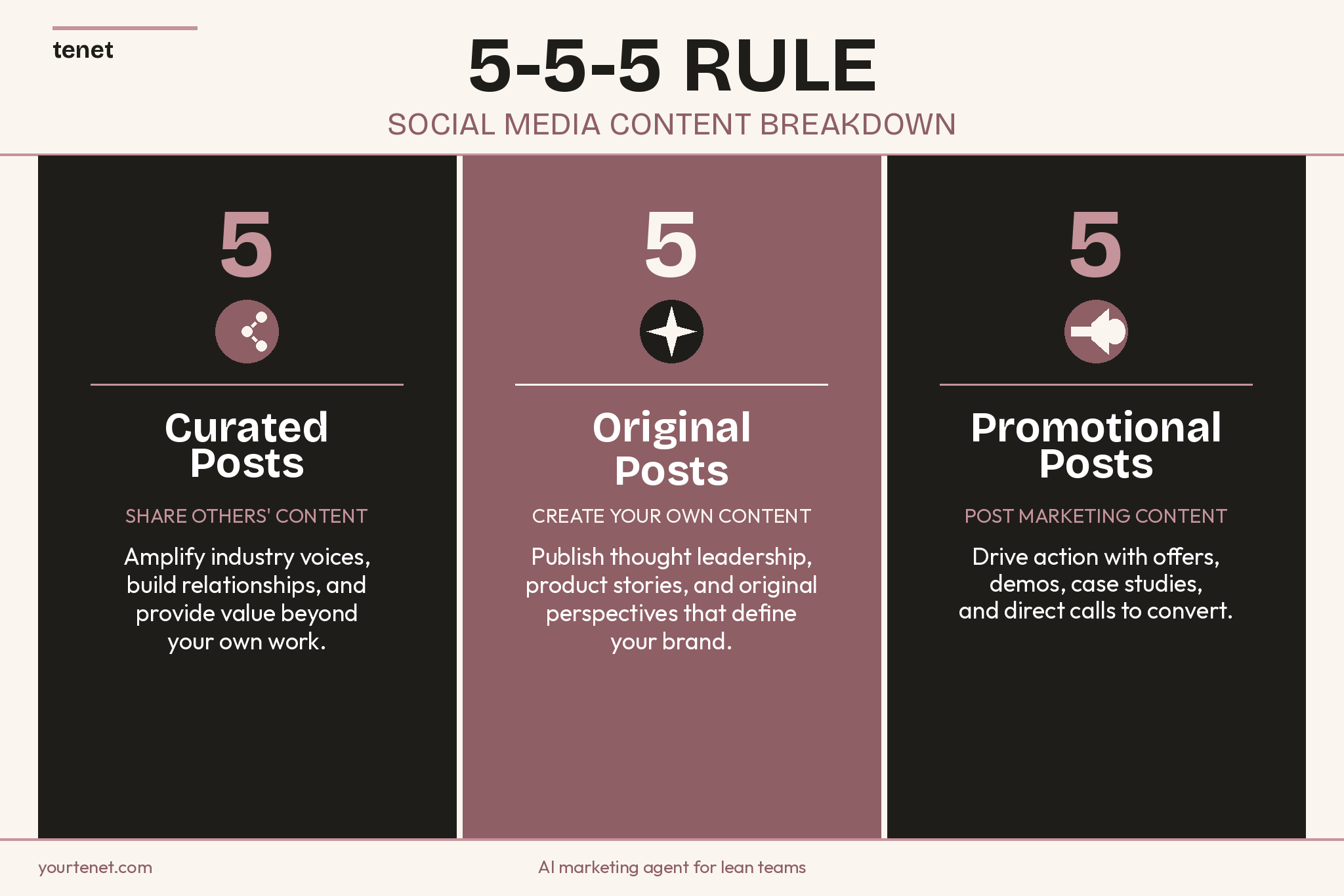
The 5-5-5 rule provides a framework for authentic social media engagement that supports influencer marketing campaigns: spend 5 minutes engaging with your audience, 5 minutes engaging with your community, and 5 minutes engaging with your industry daily.
This engagement framework builds the relationships and community presence that make influencer partnerships more effective. Brands that actively participate in social media conversations create contexts where influencer endorsements feel natural rather than forced.
The rule emphasizes quality engagement over volume—meaningful responses and conversations rather than generic likes or comments. This approach builds genuine relationships that often lead to organic influencer partnerships and advocacy.
Consistent application of the 5-5-5 rule also provides market intelligence that informs influencer strategy. Regular engagement reveals audience interests, competitor activities, and emerging trends that can guide partnership decisions and content planning.
Budget planning and ROI measurement
Setting your influencer marketing budget
Budget planning for influencer marketing requires balancing cost considerations with strategic objectives and expected returns. 63% of marketers plan to increase their influencer marketing budgets, indicating growing confidence in the channel's effectiveness.
Start by determining what percentage of your total marketing budget should go to influencer marketing. Industry benchmarks suggest 10-20% for brands already using the channel effectively, with newer brands often starting at 5-10% while they develop expertise and measurement capabilities.
Consider the full cost of influencer marketing beyond creator compensation. Additional expenses include content production, paid amplification, management time, platform fees, and measurement tools. These costs can add 30-50% to the base influencer compensation budget.
Budget allocation should reflect campaign objectives and timeline. Brand awareness campaigns might distribute budget across many micro-influencers for broad reach, while conversion-focused campaigns might concentrate budget on fewer, high-performing partnerships with detailed tracking.
Pricing models and negotiation
Influencer pricing varies significantly based on platform, audience size, engagement rates, and content complexity. Common pricing models include flat fees per post, cost-per-thousand impressions (CPM), cost-per-click (CPC), and performance-based commission structures.
Micro-influencers typically charge $100-500 per post on Instagram, while macro-influencers command $1,000-10,000+ depending on their reach and engagement rates. However, engagement quality often matters more than follower count for campaign success.
Performance-based pricing aligns influencer incentives with brand objectives but requires sophisticated tracking and attribution systems. Hybrid models that combine base compensation with performance bonuses often work well for building long-term partnerships.
Negotiation should focus on value exchange rather than just price reduction. Additional value might include multiple content formats, extended usage rights, exclusivity periods, or cross-platform promotion that provides more comprehensive campaign value.
KPIs and performance metrics
Effective measurement requires tracking metrics at multiple levels: content performance, audience engagement, traffic generation, and business impact. Content performance includes reach, impressions, and engagement rates that indicate how well content resonates with audiences.
Engagement quality matters more than quantity. Comments that ask questions, share experiences, or express purchase intent indicate more valuable engagement than generic positive responses. Analyzing comment content provides insights into audience sentiment and campaign effectiveness.
Traffic metrics bridge content engagement and business results by tracking how influencer content drives website visits, page views, and user behavior. UTM parameters and unique landing pages help attribute traffic to specific influencer partnerships.
Business impact metrics include lead generation, sales attribution, customer acquisition cost, and customer lifetime value. These metrics demonstrate influencer marketing's contribution to revenue growth and business objectives rather than just marketing metrics.
Calculating return on investment
ROI calculation requires accurate attribution of both costs and benefits over appropriate time periods. Direct costs include influencer compensation, content production, platform fees, and management time. Indirect costs might include opportunity costs of alternative marketing approaches.
Benefits include immediate sales, long-term customer value, content assets, brand awareness improvements, and audience growth. Many benefits extend beyond the immediate campaign period, requiring measurement frameworks that capture long-term value creation.
Customer lifetime value (CLV) often reveals influencer marketing's true impact. While immediate conversion rates might be modest, customers acquired through trusted influencer recommendations often demonstrate higher retention rates and spend more over time. Our customer loyalty guide goes deeper on the levers that drive CLV.
Multi-touch attribution helps account for influencer marketing's role in complex customer journeys where multiple touchpoints contribute to eventual conversion. This approach provides more accurate ROI calculations than simple last-click attribution models.
Common mistakes and how to avoid them
Influencer selection pitfalls
The most expensive mistake in influencer marketing is choosing partners based on follower count alone rather than audience quality and alignment. Large followings don't guarantee effective reach if the audience doesn't match your target customer profile or lacks genuine engagement.
- Fake followers and engagement represent significant risks that careful vetting can prevent. Look for engagement patterns that seem natural—varied comment types, authentic conversations, and engagement rates that align with follower count and content quality.
- Failing to research an influencer's content history and brand partnerships can lead to associations that damage your brand reputation. Review recent posts for controversial content, competitor partnerships, or messaging that conflicts with your brand values.
- Geographic misalignment often gets overlooked but significantly impacts campaign effectiveness. An influencer with global reach might seem attractive, but if their audience concentrates in markets where your product isn't available, much of that reach becomes worthless.
Campaign management errors
- Overly restrictive content briefs constrain the authenticity that makes influencer marketing effective. While brand guidelines are important, excessive control over messaging, visuals, or posting schedules often produces content that feels forced rather than natural.
- Inadequate timeline planning creates rushed campaigns that produce mediocre results. Successful influencer campaigns typically require 3+ months from initial outreach to content publication, allowing time for relationship building, content development, and review cycles.
- Poor communication throughout campaigns leads to misaligned expectations, missed deadlines, and suboptimal content. Regular check-ins and clear feedback processes help ensure campaigns stay on track while maintaining positive working relationships.
- Neglecting paid amplification often limits organic content's reach due to platform algorithm limitations. Strategic paid promotion of high-performing influencer content can significantly expand reach and improve campaign ROI.
Legal and compliance issues
FTC disclosure requirements mandate clear identification of sponsored content, but many campaigns fail to meet legal standards. Influencers must use disclosure language that's prominent, clear, and unambiguous—buried hashtags or unclear language can result in regulatory penalties.
Intellectual property issues arise when brands use influencer content beyond agreed-upon scope or timeframe. Clear usage rights agreements prevent legal disputes and ensure brands can leverage content assets effectively across marketing channels.
Data privacy regulations like GDPR affect how brands collect and use audience data from influencer campaigns. Ensure compliance with relevant privacy laws when tracking campaign performance or building audience lists from influencer partnerships.
Contract clarity prevents disputes about deliverables, timelines, compensation, and performance expectations. Well-written agreements protect both brands and influencers while establishing frameworks for successful collaboration.
Future trends and strategy evolution
Micro and nano-influencer rise
The trend toward smaller, more specialized influencers reflects growing emphasis on authenticity and community over broad reach. Nano-influencers (1K-10K followers) often deliver the highest engagement rates because their audiences consist primarily of genuine personal connections.
Micro-influencers deliver higher engagement rates than macro-influencers across most platforms, with TikTok averaging 17.9% engagement compared to Instagram's 3.5%. This engagement advantage often translates into better conversion rates and ROI.
Brands are discovering that multiple micro-influencer partnerships can provide better reach and engagement than single macro-influencer campaigns while offering more diverse content perspectives and reduced risk from individual partnership failures.
The economics favor micro-influencer strategies for many brands. Lower individual partnership costs allow for broader testing, more diverse content creation, and budget flexibility that supports optimization and scaling of successful approaches.
AI and data-driven influencer marketing
63% of marketers plan to incorporate AI tools and machine learning into their influencer marketing strategies, indicating significant technology adoption ahead.
Dhanishta Raman
AI applications include influencer discovery and vetting, audience analysis, content performance prediction, and campaign optimization. These tools can process vast amounts of data to identify partnership opportunities and performance patterns that manual analysis might miss.
Predictive analytics help brands identify which influencers, content types, and timing strategies are most likely to succeed based on historical performance data and audience behavior patterns.
However, AI tools must complement rather than replace human judgment in influencer marketing. Authenticity and relationship building remain fundamentally human activities that technology can support but not fully automate.
Virtual influencers and emerging technologies
Virtual influencers—computer-generated characters with social media presence—represent an emerging category that offers complete creative control while raising questions about authenticity and audience acceptance.
Dhanishta Raman
Augmented reality (AR) and virtual reality (VR) technologies create new possibilities for immersive brand experiences that influencers can share with their audiences. These technologies might become particularly relevant for product demonstrations and virtual events.
Blockchain technology could enable new models for creator compensation, content ownership verification, and performance tracking that provide more transparency and efficiency in influencer partnerships.
Voice-activated devices and audio content platforms like Clubhouse or podcast sponsorships represent growing opportunities for influencer marketing beyond traditional visual social media platforms.
Partner with tenet for strategic influencer marketing success
Building an effective influencer marketing strategy requires more than just finding creators and sending products. It demands systematic planning, authentic relationship building, and sophisticated measurement—capabilities that many growing companies struggle to develop internally while managing their core business operations.
Tenet specializes in helping B2B SaaS and technology companies develop comprehensive influencer marketing strategies that integrate seamlessly with their broader marketing ecosystems. Rather than treating influencer marketing as an isolated tactic, we build programs that support your entire customer acquisition and brand building objectives.
Our approach combines strategic planning with hands-on execution, handling everything from influencer discovery and vetting to campaign management and ROI measurement. We understand the unique challenges facing growing technology companies: limited marketing resources, need for measurable results, and the complexity of building authentic partnerships that drive real business outcomes.
Whether you're launching your first influencer marketing campaign or scaling existing efforts, Tenet provides the strategic expertise and execution capabilities that turn influencer partnerships into sustainable growth drivers. Contact us to learn how we can help you build an influencer marketing strategy that delivers measurable results for your business.
Frequently asked questions
What are the 3 R's of influencer marketing?
The 3 R's of influencer marketing are Reach, Relevance, and Resonance.
Reach refers to expanding your audience through influencers' followers, but it's about quality reach to your target customers rather than just total numbers.
Relevance means ensuring the influencer's audience aligns with your target market in demographics, interests, and values.
Resonance involves creating content that meaningfully connects with audiences, driving emotional engagement that leads to trust and action. Successful campaigns balance all three elements rather than optimizing for just one.
What are the 4 M's of influencer marketing?
The 4 M's framework covers Make, Manage, Monitor, and Measure.
Make focuses on content creation that serves multiple purposes across your marketing ecosystem, not just single posts.
Manage involves campaign coordination, timeline planning, and relationship building with influencers.
Monitor means real-time tracking of performance metrics, engagement patterns, and audience feedback during active campaigns.
Measure encompasses comprehensive ROI analysis, including direct attribution and broader brand impact assessment. This framework ensures systematic approach to campaign execution and optimization.
What is the 5-5-5 rule on social media?
The 5-5-5 rule involves spending 5 minutes daily engaging with your audience, 5 minutes engaging with your community, and 5 minutes engaging with your industry.
This framework builds authentic relationships that support influencer marketing success by creating contexts where partnerships feel natural.
Quality engagement includes meaningful responses and conversations rather than generic interactions. Regular application provides market intelligence about audience interests, competitor activities, and emerging trends that inform influencer strategy decisions.
How do you measure influencer marketing ROI effectively?
Effective ROI measurement requires tracking multiple levels: immediate metrics like engagement and clicks, traffic generation through UTM parameters, and business impact including sales attribution and customer lifetime value.
Use multi-touch attribution to account for influencer marketing's role in complex customer journeys where multiple touchpoints contribute to conversion. Calculate both immediate returns and long-term value, as customers acquired through influencer recommendations often have higher retention rates and lifetime value than those from other channels.
What's the difference between micro and macro-influencer strategies?
Micro-influencers (10K-100K followers) typically deliver higher engagement rates and more targeted audiences, often providing better ROI for niche markets.
They charge less individually, allowing brands to work with multiple creators for diverse content and reduced risk. Macro-influencers (100K+ followers) offer broader reach but may have more diverse audiences with lower engagement rates. Micro-influencer strategies work well for authentic content and community building, while macro-influencer approaches suit awareness campaigns requiring significant reach.
How far in advance should you plan influencer campaigns?
Plan influencer campaigns at least three months in advance for optimal results. This timeline allows for proper influencer research and vetting, relationship building, content strategy development, and review cycles.
Rushed campaigns often produce forced, inauthentic content that performs poorly. The timeline should include influencer outreach (month 1), content planning and creation (month 2), and campaign execution with real-time optimization (month 3). More complex campaigns or those involving multiple influencers may require longer planning periods.
What are the biggest mistakes brands make in influencer marketing?
Common mistakes include choosing influencers based solely on follower count rather than audience alignment and engagement quality, setting overly restrictive content briefs that constrain authenticity, focusing on one-off posts instead of building long-term relationships, and measuring success through vanity metrics like likes rather than business impact. Brands also frequently skip proper audience research, fail to establish clear objectives and KPIs, and neglect legal compliance including FTC disclosure requirements. Avoiding these mistakes requires strategic planning and authentic relationship building.
Which social media platforms work best for influencer marketing?
Platform effectiveness depends on your target audience and campaign objectives. Instagram dominates with 89% of marketers using it, working well for lifestyle, beauty, and fashion brands. TikTok shows highest growth with 32% of brands increasing investment, particularly effective for younger demographics.
YouTube excels for technology brands with 90% usage for detailed product demonstrations and reviews. LinkedIn serves B2B markets where thought leadership and professional credibility drive purchasing decisions. Choose platforms where your target audience actively engages rather than just following largest audiences.