

TL; DR
- A first marketing hire costs $65K–$90K/year. A thoughtfully assembled AI stack covers most of the same ground for $50–700/month — about 10–12% of the annual salary cost.
- The right comparison isn't AI vs. a senior marketer — it's AI vs. a junior generalist in year one. On content, email, social, design, and basic analytics, the stack keeps up.
- Build one tool per core function and use it deeply: one LLM, one CRM/email platform, one design tool. A bloated stack is its own tax — you become the project manager of tools instead of a marketer.
- Keep three things human regardless of your stack: positioning decisions, real customer conversations, and editorial judgment. AI drafts; a human decides what it means and whether it's true.
- The stack you build now is infrastructure, not a stopgap. Content published today drives organic traffic for years. When you eventually hire, bring in someone who can run and extend what you've built — not someone who'll start from scratch.
AI tools can cover most of what a first marketing hire does in year one — content, email, social, design, and basic analytics — for $50 to $700 a month, versus $65,000 to $90,000 a year for a junior generalist. What they can't replace: positioning decisions, real customer conversations, and editorial judgment, which still need a human in the loop.
There's a hiring decision that trips up almost every early-stage founder. The business is growing, marketing needs to happen, but a full-time hire feels premature, expensive, and risky. The typical salary for a generalist marketing manager sits somewhere between $65,000 and $90,000 a year — before benefits, before onboarding time, before the three-month ramp before they're producing anything useful.
So, founders do what seems logical. They either neglect marketing entirely ("we'll hire when we have more revenue") or they splurge on an agency that delivers polished slide decks and underwhelming results.
There's a third option most founders don't pursue deliberately: build an AI-first marketing function. Not a random pile of tools, but a considered stack that covers the actual responsibilities a first marketing hire would own.
The AI in marketing market is forecast to reach $82 billion by 2030, and the growth isn't driven by enterprise experimentation — it's driven by smaller organizations discovering that AI tools, assembled thoughtfully, can cover the majority of what a generalist marketer does at a fraction of the salary cost.
This guide is not a "30 best AI marketing tools" list. Those exist already. This is a first-hire replacement framework: what a first marketer does, which tools cover each responsibility, what a starter stack looks like at different stages, and what you should keep human regardless.
What a first marketing hire does (and why that matters)
Before you can replace something, you need to know what it does.
A first marketing hire at an early-stage startup is almost never a specialist. You're not hiring a paid media expert or a content strategist in a silo. You're hiring someone who can do a reasonable job across four or five functions simultaneously: produce content, manage SEO, run email campaigns, handle social, and tell you what's working.
World Economic Forum guidance on first marketing hires puts it plainly: you need someone who is "eager and willing to use AI and other tech tools to do more, go faster, and deliver high-quality results." That framing is useful. The job isn't about depth in one channel. It's about coverage and speed.
The core scope usually looks like this:
- Strategy and planning: channel prioritization, campaign ideas, basic competitor review
- Content and SEO: keyword research, blog production, on-page optimization
- Email and lifecycle: lead nurture sequences, newsletters, basic segmentation
- Social and distribution: scheduling, post creation, repurposing content
- Design and creative: social graphics, landing page assets, ad images
- Analytics and reporting: dashboards, campaign performance, what-to-do-next judgment
That's a lot of ground for one person. It's also a reasonably close map to what AI tools now handle well.
The "good enough" standard for early marketing
One trap founders fall into is evaluating AI tools against a senior marketer benchmark. That's the wrong comparison. The right comparison is against a junior to mid-level generalist in their first year. At that stage, "good enough" means:
- Enough output to test channels and see what generates response
- Enough consistency that you're present across the channels that matter
- Enough quality that you're not damaging the brand or embarrassing the company
AI tools clear that bar across most of these functions. The question is how to assemble them deliberately.
The first marketing hire scorecard: responsibilities mapped to AI tools
Think of this as a job description you're filling with software instead of headcount.
Strategy and planning
Every marketer starts the week with some version of "what should we focus on?" That involves scanning competitors, reviewing what worked last week, identifying content gaps, and generating ideas for campaigns or experiments.
General-purpose LLMs handle this surprisingly well. ChatGPT and Claude are strong for brainstorming campaign angles, drafting messaging variations, and stress-testing positioning. Semrush adds a research layer: you can run competitor content audits, find keyword gaps, and pull traffic data that gives strategic decisions some grounding in evidence.
The human still owns the actual prioritization call. AI can surface five content angles; you decide which one aligns with what you're trying to build. That division of labor works.
Content strategy and SEO
SEO-focused AI tools have matured significantly. What used to take a dedicated SEO specialist and a content writer two to three days, a founder or solo operator can compress into a few hours using this workflow. The research is faster. The brief writes itself. The draft needs editing, not a full rewrite.
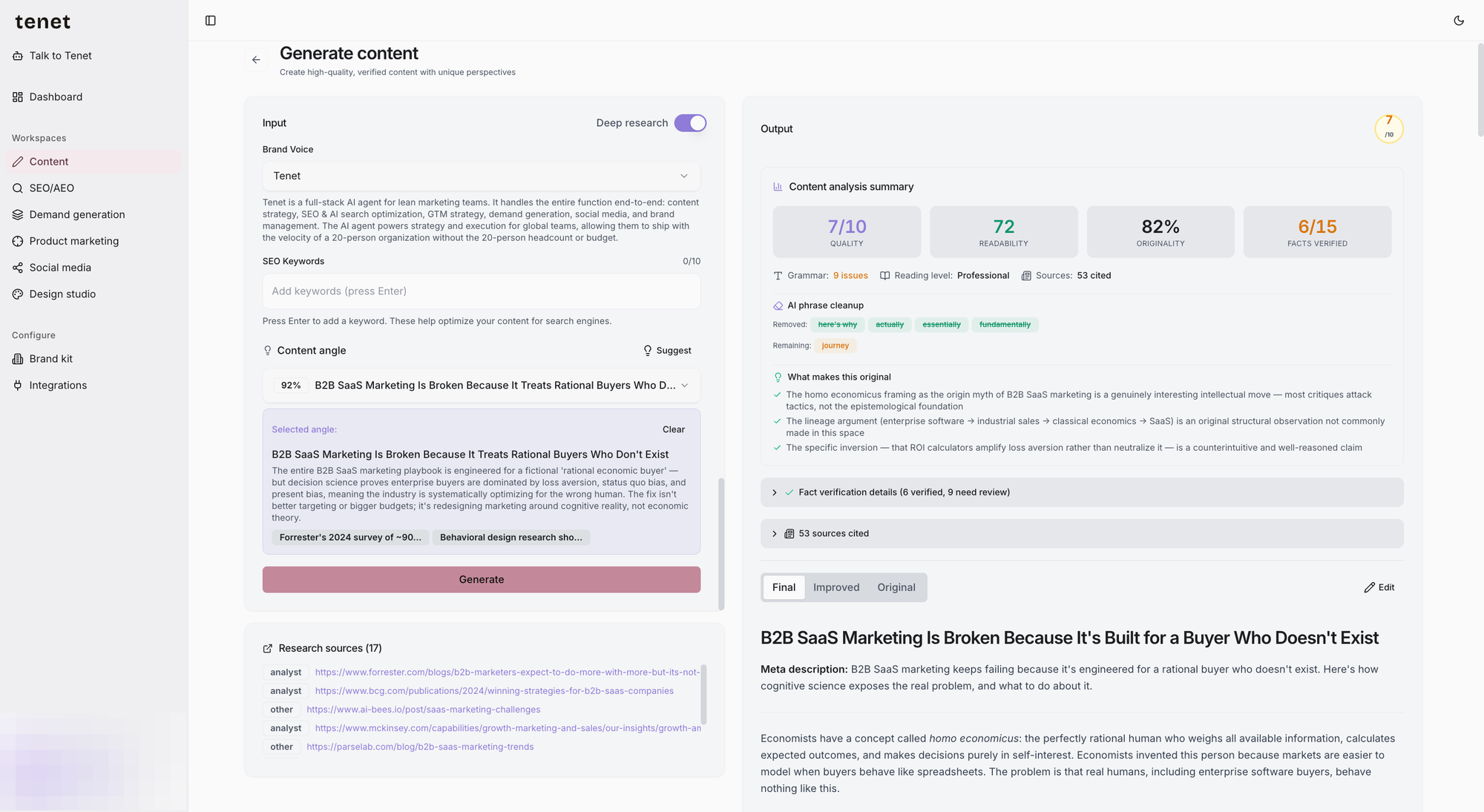
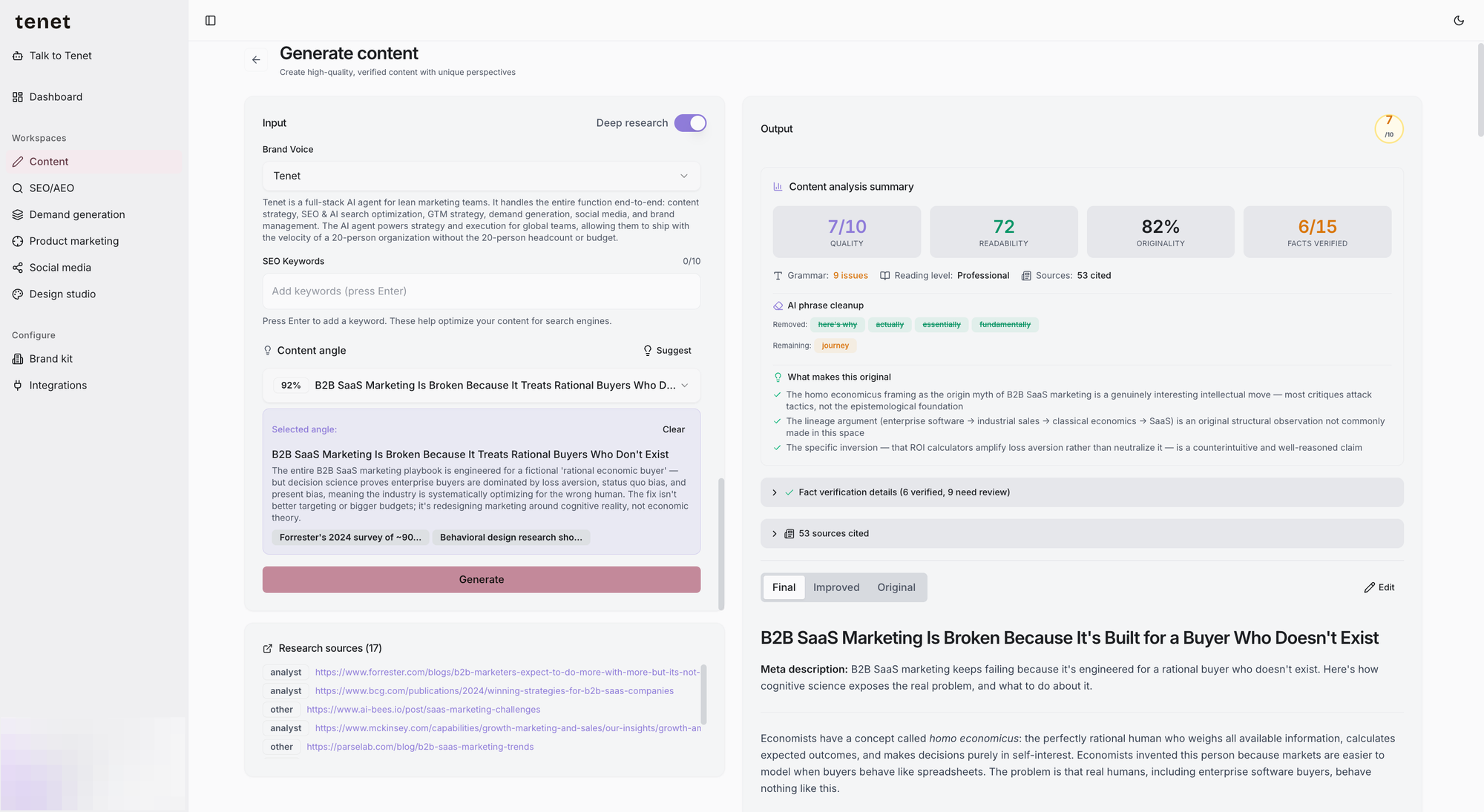
The gap is in judgment: which keywords are worth ranking for given your business model, and what content format will convert visitors rather than just attract them. That still requires a human with business context.
Content and copy creation
This is where AI tools have the most obvious impact. Blog posts, landing pages, ad copy, email subject lines, product descriptions — most LLMs handle all of these adequately and some handle them well.
The distinction worth making is between generic LLMs and marketing-specific tools. Generic tools give you flexibility and broad capability. Specialized tools give you templates, brand memory, and workflows built around marketing outputs. For a solo founder, Tenet with a well-constructed prompt library often does the job without the added cost. For a team that needs consistency across multiple people producing content, Writer's brand voice enforcement becomes more valuable.
One caution worth flagging: AI-generated copy tends toward the average. It's grammatically correct and structurally sound, but it rarely has a strong point of view. Someone needs to inject that. A practical workflow is AI for structure and first draft, human for opinion and specificity.
Email and lifecycle marketing
According to SurveyMonkey's data on AI in marketing, 88% of marketers already use AI to optimize content, including email campaigns, and 43% use it to automate repetitive processes. Email is one of the clearest wins for AI because the volume of decisions , segment this audience, test this subject line, send at this time ; quickly exceeds what a single person can manage manually.
AI handles the full stack here for most early-stage companies: list management, sequence building, send-time optimization, and basic analytics, with AI-assisted content suggestions built in. Some are stronger for e-commerce with its predictive send features. For outbound-heavy GTM motions automate sequencing while keeping personalization in the loop.
The setup investment is real. But once email workflows are built, they run without manual intervention — the functional equivalent of having someone in marketing operations.
Social media and distribution
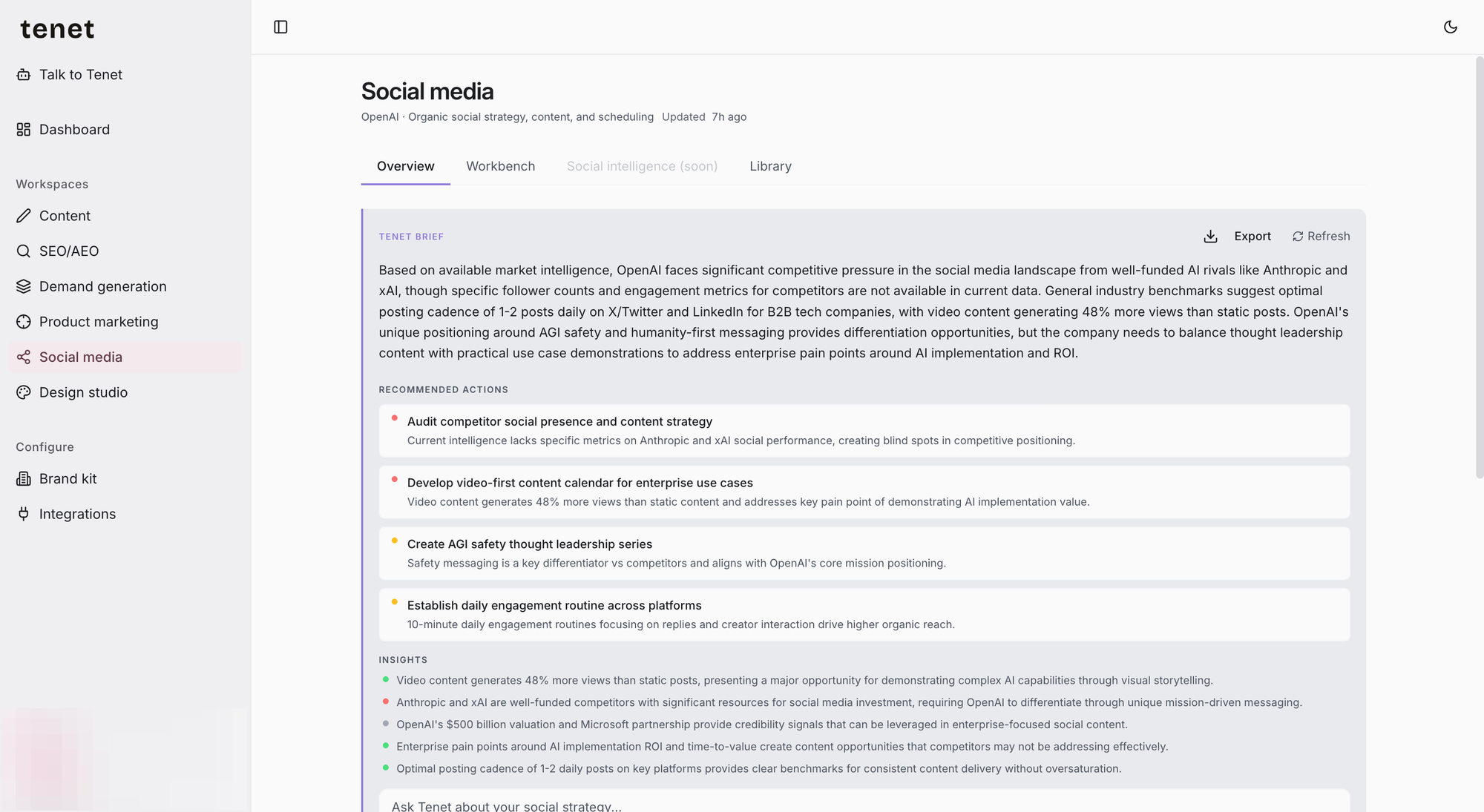
Social is where AI tools are most useful for removing the bottleneck between "we have something to say" and "we said it publicly." The production and scheduling of social content is genuinely time-consuming, and much of it is repetitive: write a caption, resize an image, pick a posting time, repeat.
Buffer and Hootsuite handle scheduling with AI-assisted suggestions on timing and format. Canva's AI features handle image production for non-designers at a speed that would otherwise require a freelance designer on retainer. For turning long-form content , a blog post, a podcast episode ; into social variants, an LLM reduces that work from 45 minutes to about 5.
Design and creative production
This is the area where early-stage companies used to rely on expensive freelancers or let things slip entirely. Canva AI has largely solved the problem for social graphics and basic landing page assets. Midjourney and tools like PhotoRoom handle product imagery and more custom visual work. For short-form video, Opus Clip trims long recordings into social-ready clips, while Crayo handles template-based video creation for founders who want to ship quickly without editing skills.
A non-designer founder can produce assets that look professional inside an AI-assisted design tool. Not agency-quality, but not embarrassing either — which is the right bar for early-stage.
Automation and workflow management
Tools like Tenet are what make a small AI stack behave like a small team. They connect tools that don't natively talk to each other: a lead submits a form, Tenet creates a CRM record, triggers an email sequence, and sends a Slack notification. What used to require a marketing ops person to set up and maintain can now be configured by a non-technical founder in an afternoon.
Tenet sits in the more advanced agentic space, handling multi-step automations , pulling data from one source, processing it, and pushing outputs to another ; without requiring code. Worth adding once you have workflows complex enough to justify it.
Analytics and attribution
AI tools are strong at dashboards and summaries, less reliable on causal attribution. Its reporting gives you the descriptive layer cleanly. Some tools attempt multi-touch attribution, which helps, though the underlying data quality matters as much as the tool itself.
Where AI earns its keep in analytics is weekly synthesis: here's what performed, here's what didn't, here's what to test next. That used to require a marketing analyst. A well-configured dashboard combined with an LLM prompt asking it to summarize performance and suggest experiments covers most of it.
The starter stack: 3 to 5 tools that cover most of it
A bloated stack is a real risk. The most common mistake lean teams make is subscribing to 15 tools, using three of them consistently, and wasting money on the rest.
Here's what the stack costs at each stage, next to a salary.
a junior marketing hire runs $70,000/year, roughly $5,800/month in salary alone.
The better approach: pick one tool per core function and use it deeply before adding more. Here's a practical starter stack at three stages:
Compare that to a junior marketing hire at $70,000/year — roughly $5,800/month in salary alone, before benefits, tools, and onboarding time. Even a fully equipped seed-stage AI stack runs at about 10 to 12 percent of that annual cost.
The output difference is real, but narrower than most founders expect. A junior marketer brings relationship intelligence, strategic judgment, and creative instinct that AI tools don't replicate. But in terms of raw output volume across content, email, social, and reporting? The stack keeps up.
What to keep human (regardless of your stack)
AI tools have clear ceilings. Acknowledging them makes the rest of the framework more credible, not less.
The stack covers more than you'd expect — but not everything, and not by accident.
the stack covers more than you'd expect. that's not an accident.
Positioning and messaging
Positioning is the decision about what your company means and to whom. AI can help you pressure-test messaging, generate alternatives, and analyze competitor product positioning. But the final call , what makes you different and why that matters to a specific type of customer ; requires business judgment that AI doesn't have. Feed your positioning into AI tools; don't expect AI tools to generate it.
Customer insight
Real customer conversations are irreplaceable. What customers say to a sales rep or a founder in a 30-minute call contains nuance, language, and context that no AI tool synthesizes on its own. The best AI-assisted marketing stacks are fed by regular human conversations with real customers.
Editorial judgment and quality control
AI content requires a human editor, not just a proofreader. Facts need checking. Tone needs calibrating against your brand voice. Claims that could attract legal risk need review. The workflow should be AI draft, human edit — not AI draft, publish. That editorial step is where brand voice lives.
Relationship-driven work
Partnerships, press, community building, high-value customer relationships: none of this scales through automation. These require human judgment, credibility, and actual presence. AI can prepare you for these interactions. It can't replace them.
Overhyped vs. worth it: where to spend budget
Not every AI marketing tool deserves subscription money. A few practical distinctions:
Worth the budget:
- LLMs (Claude or ChatGPT) for content drafting, research, and brainstorming. High return per dollar, flexible across functions.
- Surfer SEO for content optimization. The difference between AI content that ranks and AI content that doesn't often comes down to whether it was optimized against real SERP data.
- Canva Pro for design. The alternative is freelancer spend that's 5x the cost for the same output.
Overhyped or redundant:
- Dedicated AI writing tools when you already have Claude or ChatGPT. Jasper and similar tools add brand memory and templates, but for a solo founder, a good prompt library achieves most of the same result at lower cost.
- AI analytics platforms that promise "insights" without strong underlying data hygiene. Attribution tools are only as good as the event tracking feeding them.
- Social AI tools that promise viral growth. Scheduling and repurposing tools save real time. No tool reliably predicts or manufactures audience growth.
As Mckinsey & Company’s analysis of startup marketing tools) points out, marketing-specific AI tools can outperform generic AI when they're built around a specific workflow. But that only matters if the workflow is one you run consistently.
A week in the life of an AI-first marketing function
The practical question isn't whether AI tools can do marketing work. It's whether you can build a repeatable weekly cadence around them. Here's what that looks like:
Here's what a repeatable week looks like once the stack is actually running.
repeat weekly.
Monday: Review last week's performance in HubSpot and GA4. Use an LLM to summarize what worked, identify one experiment to run this week, and generate campaign ideas based on upcoming dates or product activity.
Tuesday: Content production. Keyword research in Surfer or Semrush, outline in Claude, first draft in Claude, optimization pass in Surfer, editorial review by you. One piece of long-form content per week is a realistic cadence for a solo founder.
Wednesday: Creative and distribution. Repurpose the blog content into three to five social posts using an LLM, create social assets in Canva, schedule in Buffer. Write this week's email in HubSpot using the blog content as the base.
Thursday: Lead follow-up. Review new leads in HubSpot, confirm that automation sequences are running correctly, manually review any high-intent leads that need a personal touch.
Friday: Light analytics review, notes on what to adjust next week, and any competitor or market research to feed into Monday's planning.
That's a marketing function. Not perfect, not comprehensive, but consistent. Consistency is what most early-stage companies lack, and AI tools make it achievable without a full-time hire. Content published this month can drive organic traffic for years. Email sequences built today nurture leads without ongoing maintenance.
When to stop using AI as your first hire and hire someone
The AI-first marketing stack works well until it doesn't. The triggers are recognizable:
Complexity exceeds the founder's time. You're managing the stack, editing content, reviewing email performance, and doing everything else that running a company requires. At some point, AI tools don't reduce workload enough — they just change what the work is.
The strategy conversation needs a dedicated owner. AI tools execute within a strategic framework. When your strategy needs constant refinement — channel mix decisions, positioning evolution, cross-functional coordination between marketing, sales, and product — that work requires a human who can own it full-time.
Brand quality requirements rise. Investor attention, press coverage, competitive positioning in a crowded market: these raise the bar on what "good enough" means. A dedicated marketer with strong editorial judgment produces outputs that are qualitatively different from AI-first production.
When you reach that point, the best first hire is someone who will inherit and extend the AI stack rather than ignore it. Greg Kogan, a product marketing advisor, frames this well: what you need is an AI-native generalist marketer who "can use AI to write compelling copy, generate visual assets, build landing pages, and create competitor analysis, and ship it all in days, not weeks." When you interview candidates, ask them to walk you through how AI tools have changed their output — someone who genuinely uses them should be able to describe 5 to 10x productivity improvements with specific examples.
The AI stack you build now becomes their starting point, not something they replace.
Build the stack before you hire
The old model was: hit a certain revenue milestone, then hire a marketer. The better model is: build a marketing function with AI tools first, then hire someone to run and extend that function when the strategy load justifies it.
The AI marketing stack you build now becomes infrastructure. Content published this month drives organic traffic for years. Email sequences built today nurture leads without ongoing maintenance. Analytics set up now give you the data to make better decisions faster.
Start with coverage, not comprehensiveness. Pick tools that map to real responsibilities. Edit AI output before publishing. Keep strategy and customer relationships human. And when you eventually hire, hire someone who knows how to run what you've built.
The AI tools in this article are real. They cover real ground. But here's what nobody tells you when you start assembling them: the coordination cost is also real. You become the project manager of your own marketing stack — context-switching between tools, re-explaining your brand voice, catching errors, and chasing consistency.
That's not a marketing function. That's a part-time job you didn't sign up for.
Tenet is built specifically to close that gap. It's an AI marketing agent — not another point tool — that runs content, SEO, product marketing, demand gen, social, and design as one connected system. You set up your brand once: who you are, what you sell, how you talk. Tenet holds that context across everything it produces. And before you see any output, it's already been verified, cleaned of filler, and scored for quality. You review and ship. You don't draft and fix.
One system doing the work of the stack, at a fraction of the hiring cost.
 Anjana Vasan
If you want someone to run it for you entirely, Tenet Operator pairs the platform with a dedicated person who owns your marketing week to week — no hiring process, no payroll, no six-month ramp.