


TL;DR
- Outbound marketing has evolved from a volume game to a precision game in 2026.
- Success now depends on surgical targeting, personalized messaging, and systematic optimization rather than mass outreach.
- The most effective strategies combine account-based marketing, AI-powered personalization, and omnichannel sequences (email, LinkedIn, calls, direct mail) over 6-8 touchpoints.
- Key metrics include response quality over quantity, with modern campaigns requiring deep prospect research, value-first messaging, and compliance with privacy regulations. Companies like PayPal succeed by targeting specific pain points rather than generic product features, while emerging AI technologies enable hyper-personalization and predictive campaign optimization.
The law of large numbers suggests that with enough attempts, random events will converge toward predictable outcomes. Most marketers apply this thinking to outbound campaigns—send enough emails, make enough calls, run enough ads, and eventually you'll hit your targets.
But here's where they get it wrong: outbound marketing isn't a numbers game anymore. It's a precision game.
The companies winning with outbound today aren't the ones sending more emails. They're the ones sending better emails to better prospects at better times. When Rootly optimized their sales sequences, they didn't increase volume—they increased intelligence. The result? LinkedIn’s B2B Marketing Benchmark research shows that trust, video, and influence are key drivers of B2B pipeline performance on the platform, with outcomes varying significantly by targeting and offer quality.
The shift from volume to precision represents the evolution of outbound marketing strategy. While 80% of high-performing sales teams still rely on outbound as a key revenue strategy, the tactics that worked five years ago are now table stakes. What separates effective outbound programs from spam folders is sophisticated targeting, compelling value propositions, and relentless optimization.
This isn't about abandoning outbound marketing—it's about doing it right. The companies that master this precision approach aren't just hitting their numbers. They're redefining what's possible with proactive customer acquisition.
What is an outbound marketing strategy?
Outbound marketing strategy is the systematic approach to proactively reaching potential customers who haven't yet expressed interest in your product or service. Unlike passive marketing that waits for customers to find you, outbound pushes your message directly to prospects through channels like email, cold calls, advertisements, and direct mail.
The core principle separating effective outbound from spam is value-first communication. Instead of immediately pitching products, successful outbound campaigns lead with insights, solutions to problems, or relevant opportunities. When PayPal targeted young, connected users with their bill-sharing feature, they focused on the specific pain point of splitting expenses among friends rather than generic payment processing benefits.
Modern outbound strategy operates on three foundational elements: precision targeting, personalized messaging, and systematic optimization. Precision targeting means identifying prospects who match your ideal customer profile with surgical accuracy. Personalized messaging adapts your value proposition to each prospect's specific situation and challenges. Systematic optimization involves continuous testing and refinement based on real performance data.
When to use outbound marketing in your strategy
Outbound marketing becomes essential in three specific scenarios: when you need rapid market entry, when targeting specific high-value accounts, or when your ideal customers aren't actively searching for your solution.
Rapid market entry situations include launching new products, entering new geographic markets, or competing against established players. Waiting for organic awareness through inbound channels can take months or years. Nike's targeted Instagram campaigns for new running shoes reached sports enthusiasts immediately rather than waiting for them to search for footwear options.
High-value account targeting requires outbound precision because these prospects receive dozens of vendor approaches monthly. Generic inbound content rarely breaks through to C-suite decision-makers. Account-based outbound campaigns with personalized research and relevant business insights create the executive-level conversations that drive enterprise deals.
The third scenario involves products or services that customers don't know they need. Security software, productivity tools, and specialized business services often fall into this category. Prospects aren't searching for solutions because they haven't identified the problem yet. Outbound campaigns can surface these hidden needs and create market demand.
Essential components of an effective outbound marketing strategy
Target audience identification and segmentation
Effective outbound marketing starts with ruthless audience precision. The difference between successful campaigns and spam folders often comes down to how accurately you've identified your ideal customer profile (ICP). This isn't just demographics—it's combining firmographic data with behavioral signals and timing indicators.
Start by analyzing your best existing customers. What company sizes generate the highest lifetime value? Which industries close fastest? What technologies do they use? Research shows that companies using high-definition ICPs that include tech stack and buying signals achieve significantly higher response rates than those relying on basic demographic targeting.
Segmentation becomes powerful when you layer multiple data points. A software company might segment by company size and current tech stack and recent funding events. This creates micro-segments small enough for highly personalized messaging. The key is building segments that predict buying behavior, not just shared characteristics. A segment of "HR directors at 100-500 person companies" might seem logical, but adding "who recently posted about employee retention challenges" creates a segment primed for your workforce management solution.
Message development and positioning
Message development for outbound campaigns requires balancing relevance with scalability. You need messages personalized enough to feel one-to-one while structured enough to scale across hundreds or thousands of prospects.
The most effective outbound messages follow a problem-agitation-solution framework, but with a crucial twist: they lead with insights rather than products. Instead of "Our CRM helps sales teams," try "Sales teams using spreadsheets lose 27% of leads in handoffs between marketing and sales. Here's how three companies fixed that problem." The insight creates credibility before the pitch begins.
Product positioning becomes critical when prospects receive multiple competing messages. Your value proposition must immediately differentiate you from alternatives. Salesforce research indicates that outbound messaging increasingly relies on data-driven insights and customized content designed for specific audience segments.
The most common mistake is feature-focused messaging. Prospects don't care about your features—they care about outcomes. Transform "We offer automated email sequences" into "Companies using our platform reduce follow-up time by 73% while increasing response rates." The outcome creates urgency that features never will.
Channel selection and budget allocation
Channel selection determines campaign success before you write a single message. Different audiences respond to different channels, and your budget allocation should reflect where your prospects actually pay attention.
Enter the number of touchpoints in your sequence to see where it lands against the article's ranges.
For B2B audiences, LinkedIn and email typically generate the highest response rates, while phone calls create the deepest engagement for qualified prospects. Cold outreach can still work in B2B, but results vary widely by industry and seniority; benchmark data shows C-level reply rates around 5%, while some studies report 57% of executives prefer being contacted by phone and 69% of buyers accepted a cold call in the prior year.
The 70-20-10 framework is a planning heuristic, not a universal benchmark: roughly 70% of spend goes to proven channels, 20% to optimization or emerging opportunities, and 10% to experimental tests. This prevents the common mistake of chasing new channels while neglecting optimization of working campaigns.
The most sophisticated outbound programs use omnichannel sequences that combine multiple touchpoints.
A typical sequence might include LinkedIn connection, email, phone call, and direct mail over 3-4 weeks. Each channel reinforces the message while providing multiple engagement opportunities. The key is ensuring consistent messaging across channels while adapting format to each platform's strengths.
12 proven outbound marketing tactics and strategies
Twelve tactics sort into three categories, and each one earns its place for a different reason.
the category matters less than the fit — match the tactic to how the prospect actually pays attention.
Traditional outbound marketing methods
Direct mail and print advertising
Direct mail remains surprisingly effective in our digital world because it cuts through digital noise. Physical mail has less competition—the average executive receives 120 emails daily but only 3-5 pieces of relevant business mail. The key is making direct mail feel personal rather than promotional.
Successful direct mail campaigns combine physical items with digital follow-up. Send a relevant book with highlighted passages and a handwritten note, then follow up with email referencing specific insights. This approach works because it demonstrates investment in the relationship before asking for anything in return.
Print advertising works best for brand awareness in specialized publications where your audience already pays attention. Trade magazines, industry journals, and event programs can effectively reach niche audiences that ignore general business publications.
Trade shows and events
Trade shows provide concentrated access to qualified prospects, but most companies waste this opportunity with generic booth presentations. The most effective approach involves pre-event outreach to schedule specific meetings rather than hoping for foot traffic.
Use LinkedIn to identify attendees 4-6 weeks before events. Send personalized invitations to meet at specific times with clear value propositions. "I'll be at booth 247 Tuesday at 2 PM with a 10-minute demo of how we helped [similar company] reduce processing time by 40%" performs better than generic booth invitations.
Event sponsorships work when they provide genuine value to attendees.
Cold calling and phone outreach
Cold calling effectiveness depends entirely on preparation and timing. Research shows the average outbound email CTR is around 2–3%, while cold calling typically converts at about 2–3% from dial to meeting; however, once a qualified conversation is established, appointment rates can rise to 15–20% or more.
Successful cold calls start with research, not scripts. Understand the prospect's business challenges, recent company news, and industry trends before dialing. Open with relevant business insights rather than product pitches. "I noticed your company just expanded to three new markets. We've helped similar companies avoid the inventory management mistakes that typically cost 15-20% margins in new locations."
Timing matters enormously. Tuesday through Thursday, 10-11 AM and 2-3 PM typically generate the highest connect rates. Avoid Mondays (everyone's catching up) and Fridays (people are mentally checked out).
Digital outbound marketing tactics
Email marketing and automation
Email remains the most scalable outbound channel when executed with precision. The difference between spam and valuable outreach lies in market segmentation, timing, and value proposition clarity.
Effective email campaigns use behavioral triggers rather than time-based sending. Instead of weekly newsletters, send emails based on prospect actions: visiting pricing pages, downloading content, or engaging with previous messages. This approach can improve response rates massively compared to batch-and-blast campaigns.
Automation sequences should feel conversational, not robotic. Use variable delays (2-4 days between emails rather than exactly 3 days) and varied email lengths. Include genuine questions that prospects might want to answer rather than rhetorical sales questions.
Social media advertising and linkedin outreach
LinkedIn outreach works because it feels less intrusive than email while providing rich context about prospects. The platform's professional environment makes business conversations feel natural rather than interruptive.
Effective LinkedIn outreach starts with connection requests that reference specific shared interests or mutual connections. Follow up 3-5 days after connection acceptance with valuable content rather than immediate sales pitches. Share industry insights, relevant case studies, or introductions to useful contacts.
Social media advertising works best for remarketing to website visitors or targeting specific job titles with relevant content. Nike's Instagram campaigns succeed because they target users who've already demonstrated interest in athletic content.
Paid search and display advertising
Paid search bridges outbound and inbound by targeting people actively searching for solutions. The key is bidding on competitor terms and industry problems rather than just your own brand terms.
Display advertising works for remarketing and account-based marketing campaigns. Target specific companies or job titles with relevant banner ads that drive to customized landing pages. Booking.com's retargeting campaigns feature personalized offers based on previously viewed accommodations.
The most effective display campaigns use sequential messaging—different ads for first-time visitors versus return visitors versus people who've viewed pricing pages. This creates a journey rather than repetitive impressions.
Direct sales and cold outreach strategies
Account-based marketing (ABM)
Account-based marketing treats individual high-value accounts like markets of one. Instead of casting wide nets, ABM concentrates resources on specific target accounts with personalized campaigns across multiple channels.
Successful ABM campaigns start with deep account research. Understand the company's business model, recent challenges, competitive landscape, and key decision-makers. Create customized content for each account: personalized case studies, industry-specific ROI calculators, or executive briefings addressing their specific situations.
The most effective ABM campaigns coordinate sales and marketing efforts with account-specific playbooks. Every touchpoint should reinforce consistent messaging while advancing the relationship toward a specific business conversation.
Video prospecting and personalized outreach
Video prospecting cuts through digital noise because it's personal and demonstrates effort. A 60-second personalized video shows more investment than even the most thoughtful written message.
Effective video messages address specific business challenges rather than introducing yourself or your company. Reference the prospect's recent LinkedIn posts, company news, or industry trends. Keep videos under 90 seconds and end with specific next steps rather than vague "let's connect" calls to action.
The key is making videos feel conversational rather than promotional. Speak directly to the prospect's situation using their name and company details. Tools that allow personalized video thumbnails with the prospect's company logo significantly improve open rates.
Referral and partner programs
Referral programs turn existing customers into outbound marketing channels. The most effective programs provide structure and tools rather than just incentives.
Create referral playbooks that help customers identify good prospects and provide conversation starters. Give customers tools like case studies, ROI calculators, or trial offers to share with their networks. Make referring easy by providing email templates and calendar links for demos.
Partner programs work similarly but require more coordination. Develop joint value propositions that benefit both companies' customers rather than just cross-promotion. The most successful partnerships create integrated solutions that solve problems neither company could address alone.
Measuring and optimizing your outbound marketing strategy
Key performance indicators (KPIs) for outbound marketing
Outbound marketing strategy measurement requires different metrics than inbound because the goals and timelines differ dramatically. While inbound focuses on long-term organic growth, outbound demands immediate feedback loops and rapid optimization cycles.
The most critical metrics fall into four categories: reach, engagement, conversion, and efficiency. Reach metrics include emails delivered, LinkedIn connections made, and calls connected. Engagement metrics track opens, responses, and meeting acceptances. Conversion metrics measure pipeline generated and deals closed. Efficiency metrics calculate cost per opportunity and return on ad spend.
Key performance indicators for outbound campaigns include open rates for email effectiveness, response rates for message quality, conversion rates for pipeline generation, cost per opportunity for budget efficiency, and calls-to-close ratio for sales effectiveness.
The most important metric is often overlooked: response quality. A 2% response rate with qualified prospects interested in near-term purchases beats a 5% response rate with people asking to be removed from your list. Track not just response rates but response sentiment and progression to next steps.
Tools and platforms for tracking results
Effective outbound measurement requires integrated tools that track prospects across multiple channels and touchpoints. CRM systems provide the foundation, but specialized outbound tools offer deeper insights into campaign performance.
Sales engagement platforms like Outreach, SalesLoft, and Gong provide detailed analytics on email performance, call outcomes, and sequence effectiveness. These tools track not just aggregate metrics but individual prospect journeys, making it easier to identify what works for different audience segments.
Marketing automation platforms integrate outbound campaigns with broader marketing efforts, providing attribution across channels. Tools like HubSpot, Marketo, and Pardot can track how outbound touchpoints influence inbound conversions and vice versa.
The key is choosing tools that integrate rather than creating data silos. Prospects interact with multiple channels, and your measurement tools should provide unified views of these interactions.
A/B testing and continuous improvement
Systematic testing separates scalable outbound operations from stagnant ones. The most effective programs test 2-3 variants of one element at a time across 200-300 touches per variant for 2-4 weeks.
Focus testing on high-leverage elements that significantly impact results. Subject lines affect open rates, value propositions affect reply rates, and calls-to-action affect meeting bookings. Test these elements systematically rather than changing multiple variables simultaneously.
The most valuable tests often challenge conventional wisdom. Test longer emails versus shorter emails, morning versus afternoon send times, and direct asks versus indirect approaches. What works for one audience might fail for another, making testing essential for optimization.
Document tests result in a centralized knowledge base that accumulates insights over time. Pattern recognition across multiple tests reveals principles that inform future campaigns. For example, you might discover that questions generate higher response rates than statements for your specific audience.
Common outbound marketing challenges and solutions
Overcoming market saturation and ad fatigue
Market saturation creates the biggest challenge facing outbound marketers today. Decision-makers receive dozens of sales emails daily, making it increasingly difficult to break through with generic approaches. The solution isn't sending more messages—it's sending more relevant messages.
Personalization becomes critical in saturated markets. Instead of industry-wide campaigns, create account-specific campaigns that reference recent company news, industry developments, or specific business challenges. This level of personalization is time-intensive but generates dramatically higher response rates.
Ad fatigue affects both email and social media campaigns. Combat this by rotating creative elements, testing different messaging angles, and refreshing target audiences. Most importantly, track frequency metrics and reduce exposure when performance declines.
The most effective solution involves shifting from interruption-based outbound to value-based outbound. Instead of pitching products, share insights, introduce useful connections, or provide free tools. This approach builds relationships rather than resistance.
Compliance and privacy considerations
Privacy regulations like GDPR and CCPA create complex compliance requirements for outbound campaigns. The key is building compliant processes from the beginning rather than retrofitting existing campaigns.
Consent management becomes critical for email campaigns. Implement clear opt-in processes, maintain detailed records of consent, and provide easy unsubscribe mechanisms. For B2B campaigns, legitimate interest provisions often apply, but documentation requirements remain strict.
Data protection extends beyond consent to storage and processing. Ensure your CRM and marketing automation platforms provide adequate data protection and retention controls. Regular audits of data sources and processing activities help maintain compliance.
The safest approach involves working with legal counsel to develop compliance frameworks specific to your industry and target markets. Regulations vary significantly between industries and geographic regions, making generic compliance approaches insufficient.
Budget optimization and cost management
Outbound marketing can become expensive quickly without proper budget controls and optimization systems. Research indicates that outbound leads cost 39% more than inbound leads, making efficiency critical for profitability.
The most effective budget optimization starts with clear cost-per-acquisition targets for different channels. Email campaigns typically generate the lowest cost per lead, while direct mail and events generate higher costs but often better quality leads. Allocate budgets based on total lifetime value rather than just acquisition costs.
Channel testing requires disciplined budget allocation. Use the 70-20-10 rule: 70% on proven channels, 20% on optimizing existing channels, and 10% on testing new approaches. This prevents the common mistake of chasing new channels while neglecting optimization of working campaigns.
The most important optimization involves tracking full-funnel metrics rather than just top-of-funnel costs. A channel that generates expensive leads might produce higher close rates, making the total cost-per-customer lower than apparently cheaper alternatives.
Future of outbound marketing: Trends and predictions
Emerging technologies in outbound marketing
Artificial intelligence is transforming outbound marketing from a high-volume, low-precision activity into a surgical targeting system. AI-powered prospecting tools analyze thousands of data points to identify prospects with the highest propensity to buy, dramatically improving campaign efficiency.
Predictive analytics help identify optimal timing for outbound outreach. Instead of sending emails on arbitrary schedules, AI systems analyze prospect behavior patterns to determine when individuals are most likely to engage. This approach can improve response rates by 40-60% compared to batch sending.
Voice technology and conversational AI are creating new outbound channels. AI-powered phone systems can conduct initial qualification conversations, schedule meetings, and handle routine follow-up tasks. While human connection remains essential for complex sales, AI can handle the repetitive tasks that consume sales rep time.
The most significant trend involves intent data integration. Tools that track prospect research behavior, content consumption, and technology evaluations provide real-time signals about buying intentions. Outbound campaigns triggered by intent signals generate response rates 3-5 times higher than traditional approaches.
Personalization and AI-driven campaigns
Hyper-personalization represents the next evolution in outbound marketing. Instead of segmented campaigns, AI enables truly individualized campaigns that adapt messaging, timing, and channel selection for each prospect.
Dynamic content generation allows campaigns to reference specific prospect information automatically. AI systems can incorporate recent company news, industry trends, mutual connections, and behavioral data into personalized messages at scale. This level of personalization was previously impossible without massive manual effort.
Behavioral prediction models help optimize campaign sequences for individual prospects. Instead of using the same sequence for all prospects, AI can determine whether specific individuals respond better to shorter or longer sequences, direct or indirect approaches, and email or LinkedIn outreach.
The key development involves real-time campaign optimization. AI systems continuously analyze campaign performance and automatically adjust messaging, timing, and targeting to improve results. This creates self-improving campaigns that become more effective over time.
The evolution of customer expectations
Customer expectations for outbound marketing are rising rapidly. Generic sales messages that worked five years ago now feel outdated and spammy. Prospects expect relevance, value, and respect for their time in every interaction.
Professional buyers increasingly expect vendor communications to demonstrate understanding of their specific business situation. This means outbound campaigns must incorporate company research, industry knowledge, and relevant case studies rather than generic value propositions.
Response expectations are also changing. Prospects expect immediate responses to their questions and fast follow-up on meeting requests. This requires marketing and sales teams to monitor campaigns actively and respond quickly to engagement signals.
The most significant change involves channel preferences. Younger decision-makers prefer LinkedIn and text messages over phone calls and email. Older decision-makers still prefer phone conversations for complex discussions. Successful outbound programs adapt channel selection to prospect preferences rather than using one-size-fits-all approaches.
How Tenet can streamline your outbound marketing strategy
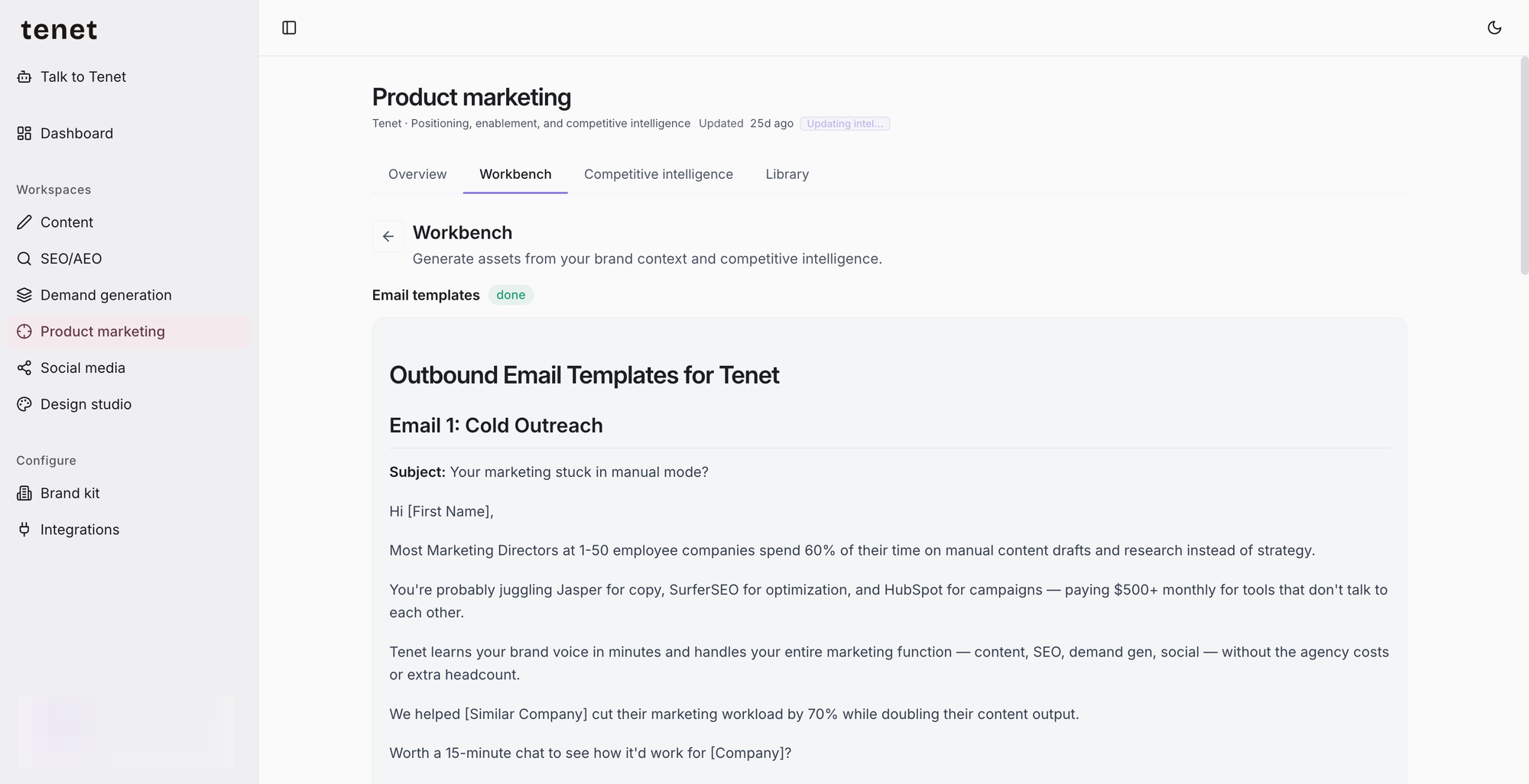
Creating and executing effective outbound marketing campaigns requires coordinating multiple functions: content creation, competitive research, audience segmentation, campaign execution, and performance analysis. Most teams struggle with this coordination, either juggling multiple tools or hiring specialized roles for each function.
Tenet consolidates these outbound marketing functions into a single AI platform that empowers you to execute strategy-to-execution workflows. Instead of managing separate tools for content creation, competitive intelligence, and campaign management, you get integrated outbound marketing capabilities that maintain consistent messaging and brand voice across all touchpoints.
Upload your existing content and Tenet learns your brand tone and competitive positioning in minutes. Then generate personalized outbound content that resonates with specific audience segments. Whether you're developing email sequences, LinkedIn messages, or account-based marketing materials, the platform ensures every piece aligns with your overall strategy while addressing specific prospect challenges.
For marketing teams currently spending 20+ hours per week on outbound campaign creation and management, Tenet automates the time-intensive tasks while maintaining the personalization and quality that drive results. Small teams become operational within minutes rather than weeks, making it possible to test and optimize outbound campaigns rapidly.